When backing a commercial vehicle, which of the following is the most important safety rule?
Because of blind spots, you cannot see everything behind you. Using a helper is the most important safety rule for backing. Always agree on a hand signal for 'stop' before you begin.
Source focus FMCSA CDL Manual Section 2.2 — Basic Control of Your Vehicle
Passenger-side backing is blind-side backing and hides obstacles behind the trailer.
Backing quickly reduces reaction time and prevents you from stopping before striking a hazard.
You must check both mirrors continuously before and throughout the entire backing maneuver.
Study focus Use safe backing, turning, and basic-control habits.
Common trap Backing without a helper or failing to stop when visibility is uncertain.
How far ahead should you be looking while driving a commercial vehicle at highway speeds?
Good drivers look 12 to 15 seconds ahead. At highway speeds, this is about a quarter of a mile. This gives you time to adjust speed or change lanes to avoid hazards.
You are driving a heavily loaded vehicle on a steep downgrade. What is the most important factor in determining your safe speed?
Your safe speed on a downgrade depends primarily on the total weight of the vehicle and cargo, the length and steepness of the grade, road conditions, and weather. Heavier vehicles require more braking power to counteract gravity.
What is the minimum tread depth required for the front steering tires of a commercial vehicle?
Federal regulations require a minimum tread depth of 4/32 inch in every major groove on front (steering) tires. Other tires require at least 2/32 inch.
Use high beams whenever you can to see further ahead, provided it is safe and legal. You must dim them when within 500 feet of an oncoming vehicle or when following another vehicle within 500 feet.
Source focus FMCSA CDL Manual Section 2.11 — Driving at Night
High beams are permitted wherever legal and safe outside 500 feet of traffic, not strictly rural two-lanes.
High beams reflect off fog, rain, and snow, creating glare that worsens driver visibility.
Waiting until 200 feet blinds oncoming drivers; you must dim high beams within 500 feet.
Study focus Apply core CDL safe-driving rules to common road and vehicle situations.
Common trap Memorizing rules without applying them to driving scenarios.
Which of the following statements about drinking alcohol and driving is true?
Alcohol first affects judgment and self-control. Under federal FMCSA regulations (49 CFR § 383.51), operating a CMV with a BAC of 0.04% or higher is illegal—half the 0.08% standard passenger-car limit.
Source focus FMCSA CDL Manual Section 2.22 — Alcohol, Other Drugs, and Driving
Only time allows the liver to burn off alcohol; coffee and cold air merely mask drowsiness briefly.
Food slows absorption slightly, but even small amounts of alcohol impair reaction time and coordination.
Under FMCSA rules, operating a commercial vehicle at 0.04% BAC is an automatic DUI disqualification.
Study focus Respond safely to hazards, emergencies, traction loss, and unsafe conditions.
Common trap Reacting late or using sudden braking/steering when controlled action is safer.
Hydroplaning occurs when water builds up in front of your tires, causing them to lift off the road surface. You lose steering and braking control. To recover, release the accelerator and do not brake hard.
If you experience a tire blowout while driving at highway speeds, what is the FIRST thing you should do?
When a tire blows out, grip the steering wheel firmly and stay off the brakes. Braking hard can cause a skid or loss of control. Let the vehicle slow down naturally before applying brakes gently.
How often should you check your cargo while on the road?
You must inspect the cargo and its securing devices within the first 50 miles after beginning a trip. After that, inspect again after every break, and after you have driven for 3 hours or 150 miles, whichever comes first.
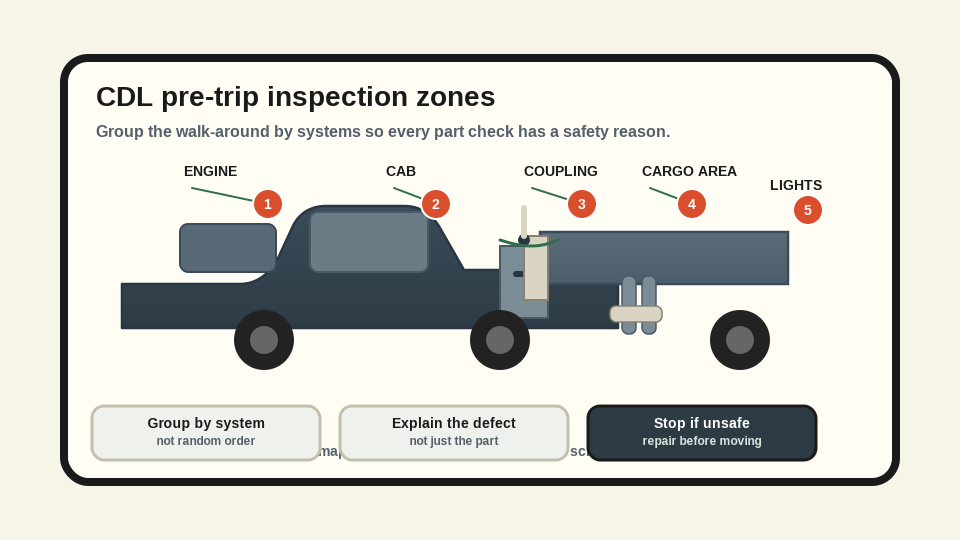
Safety is the most important reason for a pre-trip inspection. Finding and fixing a defect before driving helps prevent breakdowns and crashes on the road.
Which type of fire extinguisher should be used on an electrical fire?
Electrical fires require a B:C or A:B:C rated extinguisher. Using water or water-based foam on an electrical fire can result in a severe electric shock.
Why should you avoid using the engine brake (Jake brake) on wet or icy roads?
Engine retarders (Jake brakes) apply strong braking force to the drive wheels only. On slippery surfaces, this sudden braking force can cause the drive wheels to lose traction, leading to a dangerous skid.
What is the recommended following distance for a heavy vehicle traveling at 55 mph in ideal conditions?
The rule of thumb is 1 second of following distance for every 10 feet of vehicle length at speeds under 40 mph. For speeds over 40 mph, add 1 additional second. A 60-foot truck at 55 mph needs 7 seconds of space.
Source focus FMCSA CDL Manual Section 2.7 — Managing Space
Three seconds is a passenger-car rule that leaves a heavy truck unable to stop in time.
Counting vehicle lengths underestimates stopping distance at 55 mph compared to timed seconds.
Dividing length by 20 cuts your safety cushion in half and leaves inadequate stopping space.
Study focus Choose safe speed, spacing, and visual search habits for commercial vehicles.
Common trap Driving at passenger-car speeds without accounting for weight, space, weather, or grade.
If your vehicle catches fire while driving, what should you do first?
The first step in a vehicle fire is to get the vehicle off the road and stop in an open area, clear of buildings, trees, brush, and other vehicles to prevent the fire from spreading.
Eating, using a phone, or reading while driving are major physical and cognitive distractions that take your eyes, hands, and mind away from the critical task of driving.
If you are being tailgated, increase the space in front of your vehicle. This allows you to brake more smoothly and gradually, reducing the chance that the tailgater will crash into your rear.
Source focus FMCSA CDL Manual Section 2.7 — Managing Space
Flashing brake lights can startle a close tailgater into panic-braking or rear-ending your trailer.
Speeding up decreases your stopping margin ahead, and the tailgater will often match your higher speed.
Swerving a heavy vehicle is aggressive, destabilizing, and creates a sideswipe or rollover hazard.
Study focus Choose safe speed, spacing, and visual search habits for commercial vehicles.
Common trap Driving at passenger-car speeds without accounting for weight, space, weather, or grade.
When approaching a curve, what is the best way to handle your speed?
You should brake to a safe speed before entering a curve. Once in the curve, maintain speed or accelerate slightly, as this helps stabilize the vehicle. Never brake hard in a curve.
What is the most common cause of serious vehicle skids?
Most serious skids result from driving too fast for road conditions, over-braking, over-steering, or over-accelerating. Speed is the primary factor in losing traction.
Source focus FMCSA CDL Manual Section 2.19 — Skid Control and Recovery
Minor pressure variance is not the leading cause of skids; excessive speed for conditions is.
Cruising in a slightly lower gear on dry pavement does not break tire traction or cause skids.
Slight steering-hose wear does not cause most serious skids; driving too fast for conditions does.
Study focus Respond safely to hazards, emergencies, traction loss, and unsafe conditions.
Common trap Reacting late or using sudden braking/steering when controlled action is safer.
What must you do when placing warning devices (triangles) on a two-lane road with traffic in both directions?
Two-way undivided road warning placement scenario
On a two-lane road carrying traffic in both directions, place warning devices within 10 feet of the front or rear corners, about 100 feet behind, and about 100 feet ahead of the vehicle.
Use this set after reading the CDL general knowledge outline or when you want a broad check of safe-driving, inspection, cargo, and road-decision topics. Work through all 20 shuffled General Knowledge questions above—targeting an 80% benchmark under FMCSA and state CDL handbook standards—and inspect every wrong-answer rationale before moving to your next set.
Under FMCSA 49 CFR § 383.133 computerized testing standards, state licensing kiosks randomize option letters,
prohibit notes or phones in the booth, and require at least 16 correct out of 20 items
(80%). After finishing this module benchmark, check the automatic diagnostic
readout above—your browser saves missed IDs locally so you can click Retry Missed immediately without losing progress.
01
Read each question as a real commercial driving decision.
02
Watch for weather, visibility, speed, space, inspection, and cargo clues.
03
Use the explanations after review to decide which focused topic to practice next.
Exam pacing & error triage
Clock budget, 80% cutoff math, and distractor elimination.
Hit 16 of 20 correct (80% minimum) to pass under standard state DMV
grading—giving you a margin of 4 misses in roughly 24 minutes (~72 seconds per question). Do not burn three minutes debating one tricky stem.
Scan qualifiers first: Circle words like FIRST, MOST, EXCEPT, or NOT before reading options A through D—most rushed errors come from answering the opposite question.
Eliminate passenger-car instincts: State test writers build plausible wrong choices around
four-wheeler habits (braking hard on a blowout, swerving at highway speed, or coasting in neutral).
Audit numerical pairs: When two choices differ only by a number, match the unit to exact
federal or state manual thresholds before locking your answer.
Use Retry Missed immediately: Re-answer missed items right after grading while the distractor
trap is fresh, then retest the full shuffled set cold.