Before starting a CDL road trip, what should a driver do first? A Drive five highway miles first so wheel bearings warm before checking brakes. B Complete a pre-trip inspection and confirm the vehicle is safe to operate. C Wait for the terminal dispatcher to sign off on exterior tire condition. D Check only fuel gauges and mirrors whenever the route stays under 50 miles.
A pre-trip inspection is the driver responsibility that confirms key systems are safe before operating the vehicle.
Source focus FMCSA CDL Manual Section 2.1 & 49 CFR § 396.13 — Vehicle Inspection
Pulling onto public roads before inspecting brakes risks catastrophic stopping failure.
Federal rules place pre-trip inspection responsibility squarely on the driver, never dispatch.
Short local trips require the exact same full safety walk-around as interstate runs.
Study focus Use pre-trip inspection habits to identify unsafe vehicle-system defects before driving.
Common trap Memorizing a walk-around order without understanding which defects make the vehicle unsafe.
Spot an error?
Report question cdl-core-001-before-starting-a-cdl-road-trip-what-should-a-dr
What is the minimum tread depth required for the front steering tires of a commercial vehicle? A 2/32 inch in every major groove, matching rear drive tires. B 1/16 inch across the center ribs if no cord fabric shows. C 4/32 inch in every major groove on front steering tires. D 6/32 inch in every major groove under federal inspection rules.
Federal regulations require a minimum tread depth of 4/32 inch in every major groove on front (steering) tires. Other tires require at least 2/32 inch.
Source focus FMCSA CDL Manual Section 2.1 — Vehicle Inspection
2/32 inch is the minimum tread depth for non-steering axles, not front steering tires.
1/16 inch equals 2/32 inch, which is half the legal minimum required on steering axles.
Federal regulations set the minimum front steering tread depth at 4/32 inch, not 6/32 inch.
Study focus Use pre-trip inspection habits to identify unsafe vehicle-system defects before driving.
Common trap Memorizing a walk-around order without understanding which defects make the vehicle unsafe.
Spot an error?
Report question cdl-general-knowledge-004-what-is-the-minimum-tread-depth-required-for-the
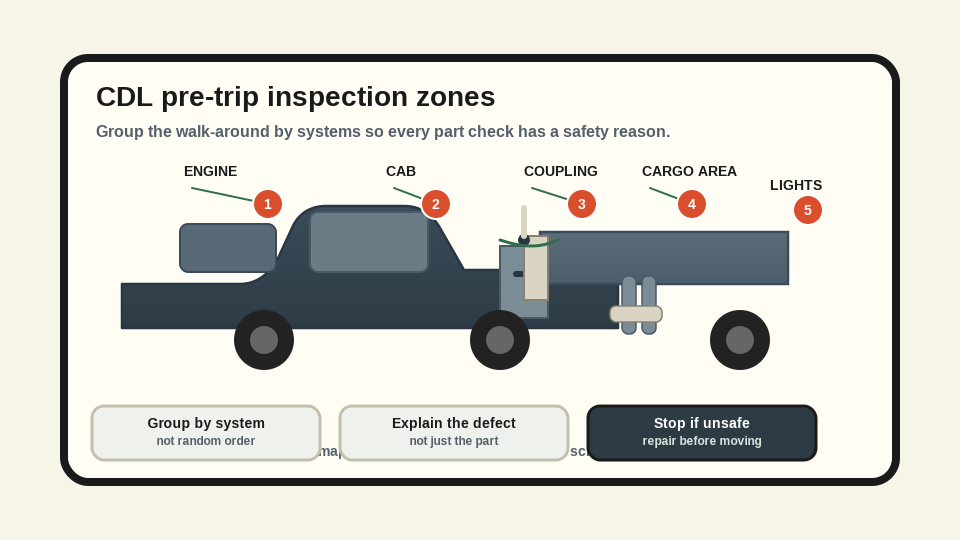
What is the purpose of a pre-trip inspection? Pre-trip inspection zones
Enlarge diagram
A To confirm both saddle tanks hold enough fuel for the entire dispatch route. B To verify your electronic logging device syncs engine hours with dispatch. C To find safety defects that could cause a breakdown or crash before driving. D To complete carrier paperwork so weigh stations waive roadside inspections.
Safety is the most important reason for a pre-trip inspection. Finding and fixing a defect before driving helps prevent breakdowns and crashes on the road.
Source focus FMCSA CDL Manual Section 2.1 — Vehicle Inspection
Checking fuel level is good trip planning, but catching safety defects is the core purpose of pre-trip.
ELD connectivity checks hours-of-service compliance, not mechanical defects that cause crashes.
A pre-trip log never exempts a commercial vehicle from roadside enforcement inspections.
Study focus Use pre-trip inspection habits to identify unsafe vehicle-system defects before driving.
Common trap Memorizing a walk-around order without understanding which defects make the vehicle unsafe.
Spot an error?
Report question cdl-general-knowledge-010-what-is-the-purpose-of-a-pre-trip-inspection
What should you do if your steering feels heavy or the vehicle pulls to one side? A Accelerate 5 to 10 mph, so gyroscopic wheel force straightens the steer axle. B Pull off safely and inspect your front tires for a flat or low pressure. C Counter-steer firmly and continue to the next scheduled truck stop. D Pull the trailer hand valve lightly to help straighten the tractor path.
Heavy steering or pulling to one side is a strong indicator of a front tire blowout or severe under-inflation. You must stop safely and inspect the tires immediately.
Source focus FMCSA CDL Manual Section 2.17 — Driving Emergencies
Speeding up with a failing front tire increases the risk of a catastrophic highway blowout.
Driving on an under-inflated or failing steer tire can cause sudden tread separation and loss of steering.
Using the trailer hand valve while rolling can lock trailer wheels and trigger a jackknife.
Study focus Use pre-trip inspection habits to identify unsafe vehicle-system defects before driving.
Common trap Memorizing a walk-around order without understanding which defects make the vehicle unsafe.
Spot an error?
Report question cdl-general-knowledge-050-what-should-you-do-if-your-steering-feels-heavy-
If you must make an emergency stop, how should you brake? A Lock all wheels immediately and hold the pedal to the floor until stopped. B Brake, so your vehicle stays in a straight line and can still steer if needed. C Pull the trailer hand valve fully down to anchor the trailer behind the cab. D Fan the service pedal rapidly to pulse air pressure like manual ABS valves.
In an emergency, you want to stop as quickly as possible without locking the wheels (controlled braking) or locking and releasing (stab braking) so you maintain steering control.
Source focus FMCSA CDL Manual Section 5.4.3 — Emergency Stops
Locking the wheels eliminates steering control and can cause a skid or tractor-trailer jackknife.
Locking trailer wheels with the hand valve makes the trailer swing out into a dangerous skid.
Rapidly fanning the pedal drains air tank reserve without delivering firm controlled braking.
Study focus Use pre-trip inspection habits to identify unsafe vehicle-system defects before driving.
Common trap Memorizing a walk-around order without understanding which defects make the vehicle unsafe.
Spot an error?
Report question cdl-air-brakes-028-if-you-must-make-an-emergency-stop-how-should-yo
A double-trailer combination begins to sway after a sudden maneuver. What is the safest priority? A Accelerate briskly in a higher gear to pull the converter dolly taut again. B Steer smoothly to regain alignment, ease off speed, and avoid sharp inputs. C Pull the trailer air-supply knob to lock the rear trailer spring brakes first. D Counter-steer sharply in the opposite direction to cancel the first swing.
Abrupt correction can make sway worse. The safer priority is controlled steering and speed reduction while keeping the vehicle stable.
Source focus FMCSA CDL Manual Section 7.1 — Pulling Double/Triple Trailers
Accelerating adds kinetic energy to an unstable combination and increases rear-trailer rollover risk.
Popping the trailer spring brakes locks rear wheels instantly and can trigger a violent jackknife.
Sharp opposite steering doubles rearward amplification and can whip the rear trailer onto its side.
Study focus Use pre-trip inspection habits to identify unsafe vehicle-system defects before driving.
Common trap Memorizing a walk-around order without understanding which defects make the vehicle unsafe.
Spot an error?
Report question cdl-doubles-triples-004-a-double-trailer-combination-begins-to-sway-afte
What is the main purpose of a CDL pre-trip inspection? A To waive en-route cargo checks for the remainder of a driving shift. B To substitute for scheduled shop preventive-maintenance intervals. C To reset electronic hours-of-service clocks before leaving the yard. D To catch safety defects or breakdown risks before hitting the road.
A pre-trip inspection is a safety check. The driver looks for defects before driving, so unsafe conditions can be corrected.
Source focus FMCSA CDL Manual Section 2.1 — Vehicle Inspection
Drivers must still recheck cargo within the first 50 miles and periodically throughout the trip.
Daily driver walk-arounds catch immediate hazards and never replace scheduled shop maintenance.
Pre-trip inspections are logged as on-duty not-driving time and never reset HOS driving limits.
Study focus Understand the safety purpose of a CDL pre-trip inspection.
Common trap Treating the inspection as a memorized routine rather than a safety decision.
Spot an error?
Report question cdl-pre-trip-001-what-is-the-main-purpose-of-a-cdl-pre-trip-inspe
During a pre-trip inspection, you find a steering component that is loose. What should you do? A Proceed cautiously below 35 mph to the nearest truck-stop shop. B Place the vehicle out of service until the part is repaired. C Drive normally if steering wheel lash stays under four inches. D Secure the joint temporarily with heavy wire until post-trip care.
Loose steering parts can cause loss of control. A serious steering defect should be corrected before the vehicle is operated.
Source focus FMCSA CDL Manual Section 11.1 — Internal and External Pre-Trip Inspection
Any loose tie rod, drag link, or pitman arm can separate suddenly even at low city speed.
Loose linkage hardware is unsafe regardless of wheel play, and 20-inch wheel lash tops out near 2 inches.
Improvised wire or straps cannot hold hydraulic steering loads and violate federal safety rules.
Study focus Respond safely to steering defects found before a trip.
Common trap Assuming the vehicle is safe because the steering still moves.
Spot an error?
Report question cdl-pre-trip-002-during-a-pre-trip-inspection-you-find-a-steering
Which tire condition should make a CDL driver stop and address the problem before driving? A A tread or sidewall cut deep enough to expose body plies or cord. B A front steering tire measuring 5/32 inch across every major groove. C A rear drive axle fitted with matching DOT-approved retreaded tires. D Dual rear tires evenly inflated to the sidewall cold-pressure rating.
Exposed fabric or cord indicates dangerous tire damage. The tire should not be treated as safe for operation.
Source focus FMCSA CDL Manual Section 2.1 — Vehicle Inspection
Steer tires require at least 4/32 inch of tread depth, so 5/32 inch passes federal standards.
Retreaded tires are legal on rear drive and trailer axles, being restricted on bus front steer axles.
Matching cold inflation to manufacturer specs is proper tire maintenance rather than a defect.
Study focus Identify dangerous tire defects during inspection.
Common trap Checking tire pressure but missing visible structural damage.
Spot an error?
Report question cdl-pre-trip-003-which-tire-condition-should-make-a-cdl-driver-st
You see fresh fluid dripping under the engine area during inspection. What is the best next step? A Treat clear or colored drips alike as harmless AC condensation. B Top off all engine reservoirs above the full mark and head out. C Trace the fluid source and fix any unsafe leak before departing. D Operate locally until a low-coolant or oil-pressure buzzer sounds.
Fresh fluid can indicate a leak in an important system. The driver should identify the source and correct unsafe conditions before driving.
Source focus FMCSA CDL Manual Section 11.1 — Internal and External Pre-Trip Inspection
Coolant, diesel fuel, brake fluid, and power-steering oil create breakdown or fire hazards if ignored.
Overfilling fluids masks active hose or seal failures that can rupture under road temperature and pressure.
By the time a dash warning buzzer sounds on the highway, severe engine or steering loss may already occur.
Study focus Respond correctly to visible leaks found during inspection.
Common trap Waiting for a dashboard warning instead of investigating visible evidence.
Spot an error?
Report question cdl-pre-trip-004-you-see-fresh-fluid-dripping-under-the-engine-ar
What should you check when inspecting belts and hoses? A More than two inches of center play when pressing each drive belt. B Uniform silicone hose colors matching OEM engine paint codes. C Light oil mist coating serpentine belts to stop pulley squealing. D Snug belt tension plus no cracks, frays, bulges, or hose leaks.
Belts and hoses should be checked for condition and secure attachment because failures can affect safe operation.
Source focus FMCSA CDL Manual Section 11.1 — Internal and External Pre-Trip Inspection
Belt deflection exceeding 1/2 to 3/4 inch indicates unsafe slippage on belt-driven accessories.
Replacement hoses often differ in color; structural integrity and clamp tightness are what matter.
Oil contaminates rubber belts and causes dangerous slipping on alternators, water pumps, or compressors.
Study focus Inspect belts and hoses for visible safety defects.
Common trap Starting the engine without checking visible wear or leaks.
Spot an error?
Report question cdl-pre-trip-005-what-should-you-check-when-inspecting-belts-and-
When inspecting lights and reflectors, what are you trying to confirm? A Clean, working units of legal color with no cracked or missing lenses. B Red clearance lamps on the front cab brow and amber at the rear. C Working low beams alone whenever the entire shift runs in daylight. D Clearance lamps wired to flash continuously with the service brakes.
Lights and reflectors help other road users see the vehicle and understand its movement. They should be working, visible, and correct.
Source focus FMCSA CDL Manual Section 2.1 — Vehicle Inspection
FMCSA lighting rules require amber clearance lamps at the front and sides and red lamps at the rear.
Brake lamps, turn signals, four-way flashers, and reflectors must all work even on daytime runs.
Clearance and marker lights must burn steadily rather than flashing only during brake applications.
Study focus Inspect lighting and reflectors for visibility and safe communication.
Common trap Thinking lights only matter at night.
Spot an error?
Report question cdl-pre-trip-006-when-inspecting-lights-and-reflectors-what-are-y
A brake hose is worn and rubbing against another part. Why is this a serious inspection finding? A Rubbing builds static charge that dims trailer clearance markers. B Chafing can rupture the line and cause air loss or brake failure. C Chafed hoses matter on loaded runs rather than bobtail yard trips. D Outer rubber wear confirms the spring brakes are holding extra tight.
A damaged or rubbing brake hose can fail. Brake defects are serious because they affect stopping ability.
Source focus FMCSA CDL Manual Section 11.1 — Internal and External Pre-Trip Inspection
Hose chafing wears through reinforcing plies and threatens air pressure, not lighting voltage.
A burst service or supply brake line impairs stopping control whether loaded, empty, or bobtailing.
Abraded hose cover signals improper routing or missing clamps, never stronger spring-brake force.
Study focus Recognize brake hose defects that can affect safe operation.
Common trap Not connecting hose wear with braking failure risk.
Spot an error?
Report question cdl-pre-trip-007-a-brake-hose-is-worn-and-rubbing-against-another
Why should wheel fasteners be checked during a pre-trip inspection? A Shiny threads and rust powder streaks confirm recent shop torquing. B One missing lug nut per ten-stud hub is legal on local routes. C Loose, missing, or rust-trailed lug nuts risk wheel separation. D Lug nut checks apply strictly to spoke wheels rather than disc hubs.
Wheel fasteners help secure the wheel. Missing, loose, or damaged fasteners can create a major safety hazard.
Source focus FMCSA CDL Manual Section 2.1 — Vehicle Inspection
Rust trails or shiny bolt threads around lug nuts are classic warning signs of a loose wheel.
All wheel lug nuts and studs must be present, tight, and crack-free before operating a CMV.
Both bud-style/hub-piloted disc wheels and cast-spoke rim clamps require full fastener inspection.
Study focus Understand why wheel fastener condition matters.
Common trap Looking at tire tread while ignoring wheel attachment hardware.
Spot an error?
Report question cdl-pre-trip-008-why-should-wheel-fasteners-be-checked-during-a-p
What should the driver do if an inspection finds a defect that makes the vehicle unsafe? A Stick to two-lane secondary roads at 40 mph to avoid weigh scales. B Note the defect on the post-trip DVIR after completing the delivery. C Have a co-driver countersign the logbook to share legal liability. D Keep the vehicle parked until the unsafe defect is repaired.
An unsafe defect should be corrected before operation. Familiar roads or light traffic do not make an unsafe vehicle safe.
Source focus FMCSA CDL Manual Section 2.1 — Vehicle Inspection
Detouring around scales leaves a dangerous mechanical defect in traffic and violates FMCSA rules.
Safety-critical defects discovered pre-trip must be repaired before departure, not deferred to post-trip.
No signature waives the federal prohibition against operating a commercial vehicle in unsafe condition.
Study focus Choose the correct decision after finding an unsafe vehicle defect.
Common trap Trying to manage an unsafe defect by changing the route instead of fixing the problem.
Spot an error?
Report question cdl-pre-trip-010-what-should-the-driver-do-if-an-inspection-finds
During the walk-around, you find a cracked suspension part. What is the safe interpretation? A Operate carefully if fewer than half the leaves in the pack are split. B Treat it as a severe control hazard that must be fixed pre-trip. C Run light freight loads on smooth interstate pavement until tonight. D Count suspension cracks as out-of-service strictly on passenger buses.
Suspension defects can affect control, stability, and load support. A cracked part should be treated as a serious safety concern.
Source focus FMCSA CDL Manual Section 2.1 — Vehicle Inspection
Having one-fourth or more leaves broken or missing in any spring assembly puts a CMV out of service.
Even light highway bumps can snap a cracked spring hanger or leaf and shift the axle out of alignment.
Broken main leaves, cracked hangers, or 1/4 missing leaf springs ground trucks and buses alike.
Study focus Identify suspension defects that can make a vehicle unsafe.
Common trap Assuming a visible crack is acceptable if the vehicle still sits level.
Spot an error?
Report question cdl-pre-trip-012-during-the-walk-around-you-find-a-cracked-suspen
During a pre-trip inspection, you find a steering component that is loose or cracked. What is the safest decision? A Limp slowly to the first highway fuel plaza and recheck play there. B Proceed if steering wheel play stays under ten degrees in the yard. C Hold the vehicle out of service until the defect is repaired. D Top off the power-steering fluid reservoir to compensate for wear.
Steering defects can cause loss of control. A loose or cracked steering component should be corrected before the vehicle is operated.
Source focus FMCSA CDL Manual Section 11.1 — Internal and External Pre-Trip Inspection
Driving any distance with a cracked or loose steering link risks sudden, total loss of directional control.
Ten degrees of lash is a maximum play check, never an excuse for visibly cracked or loose linkage.
Hydraulic fluid level cannot prevent a cracked pitman arm, tie rod, or drag link from snapping.
Study focus Identify steering defects that make a vehicle unsafe before driving.
Common trap Assuming the vehicle is safe because it still turns in the lot.
Spot an error?
Report question cdl-pre-trip-013-during-a-pre-trip-inspection-you-find-a-steering
What does a deep cut or exposed cord in a tire sidewall usually mean during inspection? A Structural tire damage that must be replaced before driving. B Acceptable outer rubber wear as long as cold air pressure holds. C Underinflation that clears up after adding 15 psi at the air chuck. D Harmless curb scuffing that seals itself once highway heat builds.
A damaged sidewall or exposed cord can lead to tire failure. It is not a cosmetic issue.
Source focus FMCSA CDL Manual Section 2.1 — Vehicle Inspection
Exposed body plies or cords mean the tire carcass is compromised and prone to explosive blowout.
Adding pressure to a sidewall with exposed cord increases blowout risk right at the air hose.
Highway flex and heat accelerate cord separation and trigger catastrophic tread or sidewall failure.
Study focus Recognize unsafe tire damage during pre-trip inspection.
Common trap Checking only air pressure while missing visible tire damage.
Spot an error?
Report question cdl-pre-trip-014-what-does-a-deep-cut-or-exposed-cord-in-a-tire-s
You see fresh fluid under the engine area before a trip. What should you do? A Run a ten-mile warm-up loop to see whether heat swells the seal. B Spread absorbent floor dry over the puddle and depart on schedule. C Treat every under-hood drip as harmless air-conditioner runoff. D Find the leak source and repair any unsafe fault before moving.
Leaks can indicate unsafe engine, fuel, coolant, steering, or brake problems. The driver should identify and address unsafe leaks before moving.
Source focus FMCSA CDL Manual Section 11.1 — Internal and External Pre-Trip Inspection
Heat and pressure usually worsen oil, coolant, or fuel leaks and can ignite fluid on hot exhaust parts.
Cleaning the pavement removes the spill hazard in the yard while leaving the mechanical leak active.
Assuming drips are water overlooks leaking fuel, coolant, or steering oil that can disable the truck.
Study focus Respond safely to visible leaks before driving.
Common trap Treating an unknown leak as harmless without checking it.
Spot an error?
Report question cdl-pre-trip-015-you-see-fresh-fluid-under-the-engine-area-before
A brake hose is rubbing against another part and shows visible wear. Why is this serious? A Hose friction raises air-governor cutout above 150 psi on grades. B Abrasion can burst the hose and cause dangerous brake loss. C Chafing matters only if inner braided cords are already hissing air. D Rubbing hoses cause uneven tread wear without hurting stop distance.
Brake hoses carry pressure or air needed for braking. Wear, rubbing, or damage can lead to brake failure.
Source focus FMCSA CDL Manual Section 11.1 — Internal and External Pre-Trip Inspection
Governor cutout is set by the air compressor valve, whereas a worn hose leaks pressure down.
Visible wear from rubbing against frame or axle parts is a pre-trip defect before it starts leaking.
When a worn service air hose ruptures under heavy braking, stopping distance increases dramatically.
Study focus Recognize brake-line and hose defects during inspection.
Common trap Missing worn hoses because they are not as obvious as a flat tire.
Spot an error?
Report question cdl-pre-trip-016-a-brake-hose-is-rubbing-against-another-part-and