Before starting a CDL road trip, what should a driver do first? A Drive five highway miles first so wheel bearings warm before checking brakes. B Complete a pre-trip inspection and confirm the vehicle is safe to operate. C Wait for the terminal dispatcher to sign off on exterior tire condition. D Check only fuel gauges and mirrors whenever the route stays under 50 miles.
A pre-trip inspection is the driver responsibility that confirms key systems are safe before operating the vehicle.
Source focus FMCSA CDL Manual Section 2.1 & 49 CFR § 396.13 — Vehicle Inspection
Pulling onto public roads before inspecting brakes risks catastrophic stopping failure.
Federal rules place pre-trip inspection responsibility squarely on the driver, never dispatch.
Short local trips require the exact same full safety walk-around as interstate runs.
Study focus Use pre-trip inspection habits to identify unsafe vehicle-system defects before driving.
Common trap Memorizing a walk-around order without understanding which defects make the vehicle unsafe.
Spot an error?
Report question cdl-core-001-before-starting-a-cdl-road-trip-what-should-a-dr
When road conditions become wet, what is the safest driving adjustment? A Maintain dry-pavement highway speed so four-wheelers do not pass on the right. B Apply sharp stab braking right inside every curve to scrub off excess speed. C Reduce road speed by about one-third and double your following distance. D Pull the yellow parking-brake valve halfway out to add rear drag.
Wet roads reduce traction and roughly double stopping distance, so the safer adjustment is slower speed and wider following space.
Source focus FMCSA CDL Manual Section 2.6 & 2.7 — Speed and Space on Wet Roads
Holding dry-weather speed on wet asphalt invites hydroplaning and rear-end crashes.
Braking sharply inside a wet curve locks wheels and triggers skids or jackknifes.
Applying spring parking brakes while moving locks rear axles without ABS modulation.
Study focus Choose safe speed, spacing, and visual search habits for commercial vehicles.
Common trap Driving at passenger-car speeds without accounting for weight, space, weather, or grade.
Spot an error?
Report question cdl-core-002-when-road-conditions-become-wet-what-is-the-safe
What does this orange diamond work-zone sign warn a CDL driver to expect ahead? Work zone flagger warning
Enlarge diagram
A A flagger directing traffic ahead, so slow down early and prepare to stop. B A permanent state weigh station ahead requiring all trucks over 10,000 lbs to enter. C A multi-lane express toll plaza opening ahead along the left median lane. D A designated truck rest area ramp ahead with overnight trailer parking.
Orange diamond signs indicate temporary work zones. When the sign shows a flagger holding a paddle, slow down early, watch for workers and lane shifts, and prepare to stop if directed.
Source focus MUTCD Part 6 & FMCSA CDL Manual Section 2 — Work Zone Flagger Signs
Weigh stations use white regulatory or green guide signs rather than orange construction diamonds.
Toll plazas use regulatory/guide panels, never temporary orange flagger symbols.
Rest areas are marked by blue service signs, not fluorescent orange work-zone diamonds.
Study focus Recognize temporary work-zone flagger warning signs and adjust speed early.
Common trap Treating orange temporary construction warnings with normal highway speed.
Spot an error?
Report question cdl-road-signs-001-which-study-habit-best-connects-the-signs-in-thi
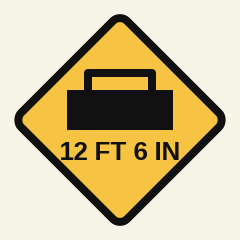
What should a CDL driver do when approaching this low-clearance sign? Low clearance warning
Enlarge diagram
A Accelerate past 55 mph so suspension squat lowers the trailer roof slightly. B Straddle the right paved shoulder so the trailer clears the outer bridge arch. C Verify total rig height and take an alternate legal truck route if clearance is tight. D Continue at normal highway speed whenever hauling an unladen dry-van trailer.
Low-clearance signs require early route and height decisions. Standard 13-foot-6-inch trailers will strike a 12-foot-6-inch bridge, and empty vans actually ride slightly higher than loaded rigs.
Source focus FMCSA CDL Manual Section 2.7 — Managing Overhead Space & Clearances
Speeding toward a low bridge causes catastrophic roof-shearing impacts.
Bridge shoulders frequently have even lower curb/arch clearance than center travel lanes.
Empty trailers sit higher on uncompressed suspension springs, increasing roof-strike risk.
Study focus Use road signs to make early route, speed, space, and clearance decisions.
Common trap Treating a warning sign as information only instead of changing the driving plan early.
Spot an error?
Report question cdl-road-signs-002-what-should-a-cdl-driver-do-when-approaching-thi
What does this railroad crossing advance warning sign tell a CDL driver to prepare for? Railroad crossing advance warning
Enlarge diagram
A A commercial truck detour ahead closing the road to combination vehicles. B Shift manual transmissions into neutral while coasting across steel rails. C Ignore the crossing warning unless hauling passengers or placarded freight. D Highway-rail tracks ahead: slow early, look and listen, and stop if required.
Circular yellow RXR advance signs warn that highway-rail tracks are ahead so drivers can slow down, check mirrors for trailing traffic, listen for trains, and stop 15–50 feet back when required.
Source focus FMCSA CDL Manual Section 2.15 & 49 CFR § 392.10 — Railroad Crossings
Circular yellow RXR signs warn of active rail crossings, not commercial truck bans.
Coasting or shifting gears on railroad tracks risks stalling directly in a train path.
Every CMV must slow down and verify clear tracks even when a full stop is not mandatory.
Study focus Use road signs to make early route, speed, space, and clearance decisions.
Common trap Waiting until the vehicle is already at the tracks before making the crossing decision.
Spot an error?
Report question cdl-road-signs-003-what-does-this-railroad-crossing-advance-warning
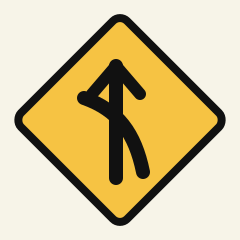
What is the safest CDL response to this merge warning sign? Merge warning
Enlarge diagram
A Hold exact speed and right-lane position without checking fender mirrors. B Check mirrors early, adjust speed or lane space, and watch entering traffic. C Whip abruptly into the left passing lane without signaling first. D Apply full emergency braking right alongside the yellow warning post.
Merge signs tell a CDL driver to update the traffic picture early. Mirror checks, smooth speed adjustments, or an early signaled lane change prevent last-second squeeze conflicts.
Source focus FMCSA CDL Manual Section 2.4 & 2.7 — Visual Search and Space Cushion
Ignoring entering ramp traffic traps cars inside your right-side blind spot.
Unsignaled sudden lane swerves risk sideswiping overtaking left-lane vehicles.
Panic braking on a high-speed freeway main line causes severe rear-end collisions.
Study focus Use road signs to make early route, speed, space, and clearance decisions.
Common trap Reacting late to merging traffic instead of building space before the conflict point.
Spot an error?
Report question cdl-road-signs-004-what-is-the-safest-cdl-response-to-this-merge-wa
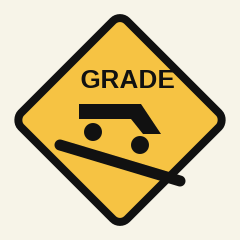
What should a CDL driver do before entering the steep grade shown by this sign? Steep grade warning
Enlarge diagram
A Wait until road speed climbs 10 mph over the limit before touching the pedal. B Shift into neutral at the hillcrest so engine RPM stays cool on the descent. C Slow down and downshift into your controlled descent gear BEFORE the grade starts. D Hold steady light foot-valve pressure continuously from summit to valley.
Heavy vehicles must slow down and select the proper low gear before starting down a steep grade. Downshifting mid-hill or dragging light continuous brake pressure causes severe drum fade.
Source focus FMCSA CDL Manual Section 2.9 — Mountain Driving and Snub Braking
Letting 80,000 lbs build excess momentum downhill can overwhelm foundation brakes.
Coasting downhill in neutral is illegal and strips away engine braking control.
Continuous light pedal dragging overheats brake drums and causes dangerous brake fade.
Study focus Use road signs to make early route, speed, space, and clearance decisions.
Common trap Waiting until speed builds on the downgrade before choosing a control strategy.
Spot an error?
Report question cdl-road-signs-005-what-should-a-cdl-driver-do-before-entering-the-
When backing a commercial vehicle, which of the following is the most important safety rule? A Always back toward the passenger side for a wider convex mirror angle. B Use a helper whenever possible and agree on a clear 'stop' hand signal. C Accelerate briskly in reverse so you spend less time blocking traffic. D Check your side mirrors only while turning the steering wheel sharply.
Because of blind spots, you cannot see everything behind you. Using a helper is the most important safety rule for backing. Always agree on a hand signal for 'stop' before you begin.
Source focus FMCSA CDL Manual Section 2.2 — Basic Control of Your Vehicle
Passenger-side backing is blind-side backing and hides obstacles behind the trailer.
Backing quickly reduces reaction time and prevents you from stopping before striking a hazard.
You must check both mirrors continuously before and throughout the entire backing maneuver.
Study focus Use safe backing, turning, and basic-control habits.
Common trap Backing without a helper or failing to stop when visibility is uncertain.
Spot an error?
Report question cdl-general-knowledge-001-when-backing-a-commercial-vehicle-which-of-the-f
How far ahead should you be looking while driving a commercial vehicle at highway speeds? A 1 to 2 seconds ahead, focusing closely on the bumper in front of you. B 4 to 6 seconds ahead, or roughly one city block on open highways. C 25 to 30 seconds ahead, keeping your eyes fixed on the far horizon. D 12 to 15 seconds ahead, or about a quarter-mile at highway speeds.
Good drivers look 12 to 15 seconds ahead. At highway speeds, this is about a quarter of a mile. This gives you time to adjust speed or change lanes to avoid hazards.
Source focus FMCSA CDL Manual Section 2.4 — Seeing
Looking only 1 to 2 seconds ahead leaves no time for a heavy truck to slow or change lanes.
Four to six seconds falls far short of the stopping and maneuvering distance needed at highway speed.
Fixating on the distant horizon causes you to miss brake lights and merging traffic a quarter-mile ahead.
Study focus Choose safe speed, spacing, and visual search habits for commercial vehicles.
Common trap Driving at passenger-car speeds without accounting for weight, space, weather, or grade.
Spot an error?
Report question cdl-general-knowledge-002-how-far-ahead-should-you-be-looking-while-drivin
You are driving a heavily loaded vehicle on a steep downgrade. What is the most important factor in determining your safe speed? A The total weight of the vehicle and cargo on that downgrade. B Whether your axles use air disc brakes or S-cam drum brakes. C The posted maximum highway speed limit for passenger cars. D The peak horsepower rating of your engine brake or retarder.
Your safe speed on a downgrade depends primarily on the total weight of the vehicle and cargo, the length and steepness of the grade, road conditions, and weather. Heavier vehicles require more braking power to counteract gravity.
Source focus FMCSA CDL Manual Section 2.16 — Mountain Driving
Any service brake type can overheat and fade if you descend too fast for your gross weight.
Posted car speed limits are often dangerously fast for a heavily loaded truck descending a steep grade.
An engine retarder is an aid, not a substitute for matching speed to load weight and grade steepness.
Study focus Understand cargo weight, securement, and load safety responsibilities.
Common trap Assuming cargo safety is only the shipper or dispatcher responsibility.
Spot an error?
Report question cdl-general-knowledge-003-you-are-driving-a-heavily-loaded-vehicle-on-a-st
What is the minimum tread depth required for the front steering tires of a commercial vehicle? A 2/32 inch in every major groove, matching rear drive tires. B 1/16 inch across the center ribs if no cord fabric shows. C 4/32 inch in every major groove on front steering tires. D 6/32 inch in every major groove under federal inspection rules.
Federal regulations require a minimum tread depth of 4/32 inch in every major groove on front (steering) tires. Other tires require at least 2/32 inch.
Source focus FMCSA CDL Manual Section 2.1 — Vehicle Inspection
2/32 inch is the minimum tread depth for non-steering axles, not front steering tires.
1/16 inch equals 2/32 inch, which is half the legal minimum required on steering axles.
Federal regulations set the minimum front steering tread depth at 4/32 inch, not 6/32 inch.
Study focus Use pre-trip inspection habits to identify unsafe vehicle-system defects before driving.
Common trap Memorizing a walk-around order without understanding which defects make the vehicle unsafe.
Spot an error?
Report question cdl-general-knowledge-004-what-is-the-minimum-tread-depth-required-for-the
When is it appropriate to use your high beams? A Only on rural two-lane highways outside city limits with no streetlamps. B During dense fog, heavy rain, or falling snow to improve road visibility. C Whenever traveling above 55 mph, dimming within 200 feet of oncoming cars. D When safe and legal on dark roads, dimming within 500 feet of traffic.
Use high beams whenever you can to see further ahead, provided it is safe and legal. You must dim them when within 500 feet of an oncoming vehicle or when following another vehicle within 500 feet.
Source focus FMCSA CDL Manual Section 2.11 — Driving at Night
High beams are permitted wherever legal and safe outside 500 feet of traffic, not strictly rural two-lanes.
High beams reflect off fog, rain, and snow, creating glare that worsens driver visibility.
Waiting until 200 feet blinds oncoming drivers; you must dim high beams within 500 feet.
Study focus Apply core CDL safe-driving rules to common road and vehicle situations.
Common trap Memorizing rules without applying them to driving scenarios.
Spot an error?
Report question cdl-general-knowledge-005-when-is-it-appropriate-to-use-your-high-beams
Which of the following statements about drinking alcohol and driving is true? A Strong coffee and cold cab air speed up how fast you sober up. B Alcohol impairs judgment and self-control needed for safe driving. C Two beers will not slow reaction time if consumed with a full meal. D Commercial drivers may operate legally with a BAC up to 0.08 percent.
Alcohol first affects judgment and self-control. Under federal FMCSA regulations (49 CFR § 383.51), operating a CMV with a BAC of 0.04% or higher is illegal—half the 0.08% standard passenger-car limit.
Source focus FMCSA CDL Manual Section 2.22 — Alcohol, Other Drugs, and Driving
Only time allows the liver to burn off alcohol; coffee and cold air merely mask drowsiness briefly.
Food slows absorption slightly, but even small amounts of alcohol impair reaction time and coordination.
Under FMCSA rules, operating a commercial vehicle at 0.04% BAC is an automatic DUI disqualification.
Study focus Respond safely to hazards, emergencies, traction loss, and unsafe conditions.
Common trap Reacting late or using sudden braking/steering when controlled action is safer.
Spot an error?
Report question cdl-general-knowledge-006-which-of-the-following-statements-about-drinking
What is 'hydroplaning'? A A trailer drifting sideways across lane lines in gusty crosswinds. B Coasting downhill in neutral gear to save diesel on long grades. C Tires losing road contact and riding on a thin film of water. D Water vapor condensing inside air brake tanks and freezing valves.
Hydroplaning occurs when water builds up in front of your tires, causing them to lift off the road surface. You lose steering and braking control. To recover, release the accelerator and do not brake hard.
Source focus FMCSA CDL Manual Section 2.6 — Controlling Speed
Sideways lane drift from wind gusts is wind buffeting, not tire hydroplaning on water.
Coasting in neutral is an illegal, unsafe downgrade mistake unrelated to wet-pavement traction loss.
Moisture in air tanks is an air-brake contamination hazard, not tire hydroplaning on wet pavement.
Study focus Respond safely to hazards, emergencies, traction loss, and unsafe conditions.
Common trap Reacting late or using sudden braking/steering when controlled action is safer.
Spot an error?
Report question cdl-general-knowledge-007-what-is-hydroplaning
If you experience a tire blowout while driving at highway speeds, what is the FIRST thing you should do? A Grip the steering wheel firmly and stay off the brakes until slowed. B Apply firm service brake pressure immediately to shorten your stop. C Steer sharply onto the right shoulder before the tire shreds further. D Downshift two gears at once and engage full maximum engine retarder.
When a tire blows out, grip the steering wheel firmly and stay off the brakes. Braking hard can cause a skid or loss of control. Let the vehicle slow down naturally before applying brakes gently.
Source focus FMCSA CDL Manual Section 2.17 — Driving Emergencies
Braking during a tire blowout can lock wheels and throw a heavy vehicle into a deadly skid.
Abrupt steering with a blown tire can cause an immediate rollover or loss of directional control.
Sudden severe engine braking on a blown tire can destabilize the axle and trigger a spinout.
Study focus Respond safely to hazards, emergencies, traction loss, and unsafe conditions.
Common trap Reacting late or using sudden braking/steering when controlled action is safer.
Spot an error?
Report question cdl-general-knowledge-008-if-you-experience-a-tire-blowout-while-driving-a
How often should you check your cargo while on the road? A Within the first 100 miles, then once every 5 hours or 300 miles of driving. B Within the first 50 miles, then after breaks and every 3 hours or 150 miles. C Only during your pre-trip walk-around and your mandatory 30-minute rest stop. D Every time you purchase diesel fuel or cross an open highway weigh station.
You must inspect the cargo and its securing devices within the first 50 miles after beginning a trip. After that, inspect again after every break, and after you have driven for 3 hours or 150 miles, whichever comes first.
Source focus FMCSA CDL Manual Section 3.1 — Inspecting Cargo
Waiting 100 miles or 5 hours violates federal cargo rules, allowing loose tie-downs to shift dangerously.
Securement hardware settles on the road and demands repeated en-route checks beyond pre-trip.
Fuel stops and open scales can be hundreds of miles apart and do not satisfy the 3-hour/150-mile rule.
Study focus Understand cargo weight, securement, and load safety responsibilities.
Common trap Assuming cargo safety is only the shipper or dispatcher responsibility.
Spot an error?
Report question cdl-general-knowledge-009-how-often-should-you-check-your-cargo-while-on-t
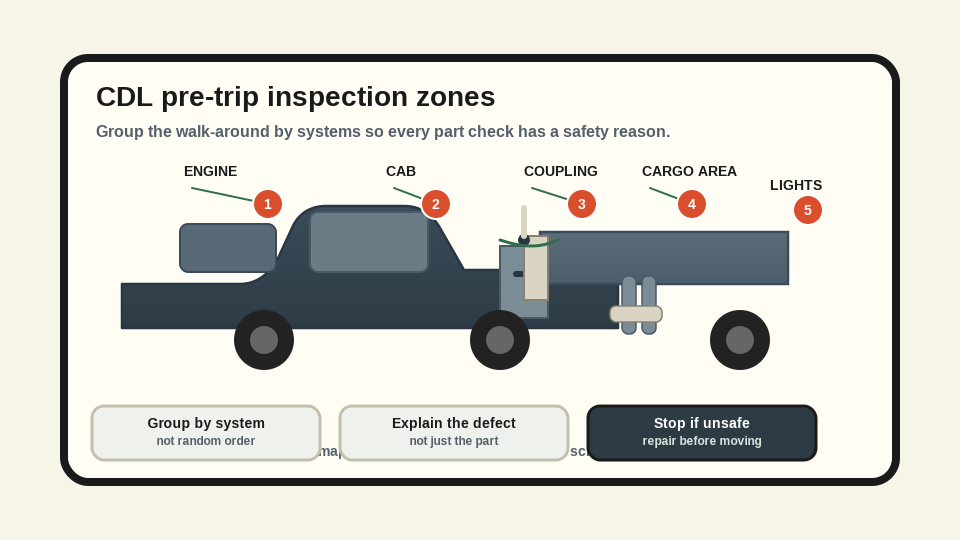
What is the purpose of a pre-trip inspection? Pre-trip inspection zones
Enlarge diagram
A To confirm both saddle tanks hold enough fuel for the entire dispatch route. B To verify your electronic logging device syncs engine hours with dispatch. C To find safety defects that could cause a breakdown or crash before driving. D To complete carrier paperwork so weigh stations waive roadside inspections.
Safety is the most important reason for a pre-trip inspection. Finding and fixing a defect before driving helps prevent breakdowns and crashes on the road.
Source focus FMCSA CDL Manual Section 2.1 — Vehicle Inspection
Checking fuel level is good trip planning, but catching safety defects is the core purpose of pre-trip.
ELD connectivity checks hours-of-service compliance, not mechanical defects that cause crashes.
A pre-trip log never exempts a commercial vehicle from roadside enforcement inspections.
Study focus Use pre-trip inspection habits to identify unsafe vehicle-system defects before driving.
Common trap Memorizing a walk-around order without understanding which defects make the vehicle unsafe.
Spot an error?
Report question cdl-general-knowledge-010-what-is-the-purpose-of-a-pre-trip-inspection
Which type of fire extinguisher should be used on an electrical fire? A Pressurized water or a Class A extinguisher built for paper and wood. B Water-based firefighting foam sprayed directly across the wiring loom. C Any liquid cooling spray carried in the cab, aimed at the battery box. D A B:C or A:B:C rated dry-chemical fire extinguisher.
Electrical fires require a B:C or A:B:C rated extinguisher. Using water or water-based foam on an electrical fire can result in a severe electric shock.
Source focus FMCSA CDL Manual Section 2.21 — Fires
Water conducts electricity and creates a severe electrocution hazard on live electrical fires.
Water-based foam conducts electrical current and is unsafe on energized vehicle wiring.
Unrated liquid sprays can conduct current or spread flames instead of smothering electrical fires.
Study focus Respond safely to hazards, emergencies, traction loss, and unsafe conditions.
Common trap Reacting late or using sudden braking/steering when controlled action is safer.
Spot an error?
Report question cdl-general-knowledge-011-which-type-of-fire-extinguisher-should-be-used-o
Why should you avoid using the engine brake (Jake brake) on wet or icy roads? A It can lock the drive wheels on slick pavement and trigger a skid. B It overcools engine cylinders and stops the cab heater from defrosting. C It consumes extra diesel fuel whenever wheel sensors detect low traction. D It shuts off anti-lock braking sensors on both tractor and trailer axles.
Engine retarders (Jake brakes) apply strong braking force to the drive wheels only. On slippery surfaces, this sudden braking force can cause the drive wheels to lose traction, leading to a dangerous skid.
Source focus FMCSA CDL Manual Section 2.13 — Driving in Winter
Engine retarders do not disable cab defrosting; the real danger is drive-axle traction loss.
Engine brakes cut fuel injection rather than burning fuel, and the risk is skidding, not economy.
Retarders do not turn off ABS sensors, though strong retarder drag can still break drive-tire grip.
Study focus Respond safely to hazards, emergencies, traction loss, and unsafe conditions.
Common trap Reacting late or using sudden braking/steering when controlled action is safer.
Spot an error?
Report question cdl-general-knowledge-012-why-should-you-avoid-using-the-engine-brake-jake
What is the recommended following distance for a heavy vehicle traveling at 55 mph in ideal conditions? A Three seconds behind the vehicle ahead, regardless of trailer length. B One truck length for every 10 mph of speed on dry, level pavement. C One second per 10 feet of vehicle length, plus one second over 40 mph. D One second per 20 feet of vehicle length, plus one second over 60 mph.
The rule of thumb is 1 second of following distance for every 10 feet of vehicle length at speeds under 40 mph. For speeds over 40 mph, add 1 additional second. A 60-foot truck at 55 mph needs 7 seconds of space.
Source focus FMCSA CDL Manual Section 2.7 — Managing Space
Three seconds is a passenger-car rule that leaves a heavy truck unable to stop in time.
Counting vehicle lengths underestimates stopping distance at 55 mph compared to timed seconds.
Dividing length by 20 cuts your safety cushion in half and leaves inadequate stopping space.
Study focus Choose safe speed, spacing, and visual search habits for commercial vehicles.
Common trap Driving at passenger-car speeds without accounting for weight, space, weather, or grade.
Spot an error?
Report question cdl-general-knowledge-013-what-is-the-recommended-following-distance-for-a
What does a broken exhaust system pose the greatest risk of? A Poisonous, odorless carbon monoxide fumes leaking into the cab. B Reduced exhaust backpressure cutting highway fuel mileage in half. C Roadside noise citations when using engine brakes near city limits. D Rapid engine coolant overheating while climbing long highway grades.
A broken exhaust system can allow deadly, odorless carbon monoxide gas to enter the cab, which can cause drowsiness, illness, or death to the driver.
Source focus FMCSA CDL Manual Section 2.1 — Vehicle Inspection
Fuel efficiency loss is minor compared to lethal carbon monoxide poisoning inside the cab.
Noise violations are secondary; toxic exhaust fumes entering the sleeper or cab can be fatal.
A leaking exhaust pipe releases deadly gas under the cab rather than boiling engine coolant.
Study focus Use inspection habits to catch unsafe defects before driving.
Common trap Checking only obvious items and missing brake, tire, coupling, or defect-report steps.
Spot an error?
Report question cdl-general-knowledge-014-what-does-a-broken-exhaust-system-pose-the-great
If your vehicle catches fire while driving, what should you do first? A Increase highway speed to try to blow the flames out with airflow. B Pull beside a fuel-island pump, so station staff can call firefighters. C Stop immediately in your travel lane and open the hood to check wiring. D Pull off the road into an open area away from buildings and trees.
The first step in a vehicle fire is to get the vehicle off the road and stop in an open area, clear of buildings, trees, brush, and other vehicles to prevent the fire from spreading.
Source focus FMCSA CDL Manual Section 2.21 — Fires
Driving faster feeds extra oxygen to the flames and spreads the fire rapidly.
Parking a burning truck near fuel pumps risks a catastrophic explosion.
Stopping in an active lane risks a crash, and opening the hood feeds oxygen to an engine fire.
Study focus Respond safely to hazards, emergencies, traction loss, and unsafe conditions.
Common trap Reacting late or using sudden braking/steering when controlled action is safer.
Spot an error?
Report question cdl-general-knowledge-015-if-your-vehicle-catches-fire-while-driving-what-
Which of these is a sign of distracted driving? A Checking both side mirrors every 5 to 8 seconds for lane changes. B Eating a full meal while steering through heavy highway traffic. C Looking 12 to 15 seconds ahead to identify slowing vehicles early. D Briefly glancing at air-pressure gauges during your normal scan.
Eating, using a phone, or reading while driving are major physical and cognitive distractions that take your eyes, hands, and mind away from the critical task of driving.
Source focus FMCSA CDL Manual Section 2.9 — Distracted Driving
Scanning mirrors every 5 to 8 seconds is an essential defensive-driving habit, not a distraction.
Maintaining a 12-to-15-second visual lead is required safe scanning, not distracted driving.
Quick instrument checks keep you informed of brake air safety without pulling focus off the road.
Study focus Respond safely to hazards, emergencies, traction loss, and unsafe conditions.
Common trap Reacting late or using sudden braking/steering when controlled action is safer.
Spot an error?
Report question cdl-general-knowledge-016-which-of-these-is-a-sign-of-distracted-driving
What should you do if you are being tailgated? A Increase your following distance ahead so you can avoid sudden stops. B Tap your brake pedal lightly to flash brake lights at the tailgater. C Speed up above traffic flow to widen the gap behind your rear bumper. D Weave slightly inside your lane so the following driver drops back.
If you are being tailgated, increase the space in front of your vehicle. This allows you to brake more smoothly and gradually, reducing the chance that the tailgater will crash into your rear.
Source focus FMCSA CDL Manual Section 2.7 — Managing Space
Flashing brake lights can startle a close tailgater into panic-braking or rear-ending your trailer.
Speeding up decreases your stopping margin ahead, and the tailgater will often match your higher speed.
Swerving a heavy vehicle is aggressive, destabilizing, and creates a sideswipe or rollover hazard.
Study focus Choose safe speed, spacing, and visual search habits for commercial vehicles.
Common trap Driving at passenger-car speeds without accounting for weight, space, weather, or grade.
Spot an error?
Report question cdl-general-knowledge-017-what-should-you-do-if-you-are-being-tailgated
When approaching a curve, what is the best way to handle your speed? A Hold cruising speed to the turn-in point, then brake firmly in the curve. B Downshift just past the curve entry while riding the service brake pedal. C Slow to a safe speed before the curve, then accelerate slightly through it. D Shift into neutral before the curve and coast smoothly to the exit lane.
You should brake to a safe speed before entering a curve. Once in the curve, maintain speed or accelerate slightly, as this helps stabilize the vehicle. Never brake hard in a curve.
Source focus FMCSA CDL Manual Section 2.6 — Controlling Speed
Braking hard inside a curve shifts weight outward and can lock wheels or roll a heavy truck.
Shifting and braking mid-curve upsets chassis balance when lateral tire demand is highest.
Coasting in neutral removes engine control and drivetrain stability through the turn.
Study focus Choose safe speed, spacing, and visual search habits for commercial vehicles.
Common trap Driving at passenger-car speeds without accounting for weight, space, weather, or grade.
Spot an error?
Report question cdl-general-knowledge-018-when-approaching-a-curve-what-is-the-best-way-to
What is the most common cause of serious vehicle skids? A Running radial tires 5 psi above cold sidewall inflation specs. B Driving too fast for prevailing road and weather conditions. C Cruising one gear below top gear on dry, level interstate pavement. D Minor wear in power-steering hoses during straight highway travel.
Most serious skids result from driving too fast for road conditions, over-braking, over-steering, or over-accelerating. Speed is the primary factor in losing traction.
Source focus FMCSA CDL Manual Section 2.19 — Skid Control and Recovery
Minor pressure variance is not the leading cause of skids; excessive speed for conditions is.
Cruising in a slightly lower gear on dry pavement does not break tire traction or cause skids.
Slight steering-hose wear does not cause most serious skids; driving too fast for conditions does.
Study focus Respond safely to hazards, emergencies, traction loss, and unsafe conditions.
Common trap Reacting late or using sudden braking/steering when controlled action is safer.
Spot an error?
Report question cdl-general-knowledge-019-what-is-the-most-common-cause-of-serious-vehicle
What must you do when placing warning devices (triangles) on a two-lane road with traffic in both directions? Two-way undivided road warning placement scenario
Enlarge diagram
A Place one at 10 feet, one at 100 feet, and one at 200 feet behind you. B Place one 10 feet ahead, one 10 feet behind, and one 100 feet behind. C Place one 50 feet ahead, one 50 feet behind, and one 150 feet behind. D Place one 100 feet ahead, one 10 feet behind, and one 100 feet behind.
On a two-lane road carrying traffic in both directions, place warning devices within 10 feet of the front or rear corners, about 100 feet behind, and about 100 feet ahead of the vehicle.
Source focus FMCSA CDL Manual Section 2.5 — Communicating
The 10-100-200-foot rear placement applies to divided highways or one-way roads, not two-way roads.
Two-way traffic requires a triangle 100 feet ahead to give oncoming drivers adequate warning.
Federal rules specify 100 feet ahead, 10 feet at the corner, and 100 feet behind on two-lane roads.
Study focus Respond safely to hazards, emergencies, traction loss, and unsafe conditions.
Common trap Reacting late or using sudden braking/steering when controlled action is safer.
Spot an error?
Report question cdl-general-knowledge-020-what-must-you-do-when-placing-warning-devices-tr
When driving a commercial vehicle, how should you adjust your speed for driving at night? A Increase cruising speed slightly, so highway engagement keeps you alert. B Maintain daytime highway speed whenever your high beams are switched on. C Drive slow enough to stop within the distance lit by your headlights. D Drive exactly 10 mph below the posted limit regardless of road conditions.
At night, your visibility is limited to the reach of your headlights. You must adjust your speed so you can safely stop within that visible distance.
Source focus FMCSA CDL Manual Section 2.11 — Driving at Night
Driving faster at night outruns your headlight beam and makes stopping in time impossible.
Even high beams illuminate only around 350 to 500 feet, which may be shorter than daytime stopping sight.
A fixed 10-mph reduction may still overdrive your headlights on dark, wet, or curving roads.
Study focus Choose safe speed, spacing, and visual search habits for commercial vehicles.
Common trap Driving at passenger-car speeds without accounting for weight, space, weather, or grade.
Spot an error?
Report question cdl-general-knowledge-021-when-driving-a-commercial-vehicle-how-should-you
What is the most important reason for inspecting your vehicle? A Safety for yourself and for every other user sharing the road. B Avoiding out-of-service fines and CSA points at state weigh stations. C Ensuring freight reaches the consignee within the delivery window. D Keeping fleet appearance standards high for shipper dock audits.
While avoiding fines is good, safety is the primary reason for inspections. A defect found during an inspection can prevent a breakdown or fatal crash.
Source focus FMCSA CDL Manual Section 2.1 — Vehicle Inspection
Preventing citations matters, but protecting lives on the highway is the primary reason to inspect.
On-time delivery is an operational goal, whereas vehicle inspections exist first to prevent crashes.
Cosmetic cleanliness does not prevent fatal brake, tire, or steering failures on the road.
Study focus Use inspection habits to catch unsafe defects before driving.
Common trap Checking only obvious items and missing brake, tire, coupling, or defect-report steps.
Spot an error?
Report question cdl-general-knowledge-022-what-is-the-most-important-reason-for-inspecting
If you must pull over to the shoulder on a highway, how quickly must you place your warning devices? A Before stepping out of the cab, by tossing flares from the window. B Within 30 minutes, after calling dispatch to report the breakdown. C Only if the roadside stop is expected to last longer than one hour. D Within 10 minutes of stopping on the highway shoulder.
Federal regulations require that emergency warning devices (like reflective triangles) be placed within 10 minutes of stopping on the shoulder or traveled portion of the road.
Source focus FMCSA CDL Manual Section 2.5 — Communicating
Throwing flames from the cab is unsafe and cannot place devices at the required 10- and 100-foot marks.
Waiting 30 minutes leaves approaching traffic unwarned and violates the 10-minute federal rule.
Warning triangles are required within 10 minutes unless you pull away sooner, regardless of repair estimates.
Study focus Respond safely to hazards, emergencies, traction loss, and unsafe conditions.
Common trap Reacting late or using sudden braking/steering when controlled action is safer.
Spot an error?
Report question cdl-general-knowledge-023-if-you-must-pull-over-to-the-shoulder-on-a-highw
What should you do if your vehicle begins to hydroplane? A Apply firm service brake pressure to slow the vehicle before skidding. B Release the accelerator and push in the clutch so wheels regain grip. C Press the accelerator slightly to cut the tires down through standing water. D Steer briskly toward the right shoulder where rainwater drains faster.
To recover from hydroplaning, release the accelerator and push in the clutch. Do not use the brakes, as this can cause the wheels to lock and result in a skid.
Source focus FMCSA CDL Manual Section 2.6 — Controlling Speed
Braking while tires ride on water locks the wheels and triggers a severe skid when tires touch pavement.
Accelerating spins the drive wheels faster on the water layer and worsens hydroplaning.
Sharp steering during hydroplaning leaves front tires turned sideways when grip suddenly returns.
Study focus Respond safely to hazards, emergencies, traction loss, and unsafe conditions.
Common trap Reacting late or using sudden braking/steering when controlled action is safer.
Spot an error?
Report question cdl-general-knowledge-024-what-should-you-do-if-your-vehicle-begins-to-hyd
Which of these statements about managing space is true? A Many heavy-truck crashes result from drivers following too closely. B Staying in the far-left lane continuously is safest near highway ramps. C Following closely is acceptable when a slower car blocks the right lane. D Commercial drivers only need to manage space ahead of the front bumper.
Following too closely (tailgating) severely reduces your reaction time and stopping distance, making it a leading cause of crashes.
Source focus FMCSA CDL Manual Section 2.7 — Managing Space
Camping in the left lane blocks faster traffic and violates lane-use laws in most jurisdictions.
Tailgating never makes a slow driver safer and eliminates the stopping distance a heavy truck needs.
Safe space management requires cushions ahead, behind, to each side, overhead, and underneath.
Study focus Choose safe speed, spacing, and visual search habits for commercial vehicles.
Common trap Driving at passenger-car speeds without accounting for weight, space, weather, or grade.
Spot an error?
Report question cdl-general-knowledge-025-which-of-these-statements-about-managing-space-i
What is black ice? A Compacted snow stained dark gray by diesel soot and leaking crank oil. B Frost glaze that forms exclusively between midnight and sunrise hours. C A thin, clear layer of ice that makes dark pavement look merely wet. D Thick, jagged ice ridges refrozen along unplowed highway shoulders.
Black ice is a thin layer of clear ice. Because it is clear, you can see the dark asphalt underneath, making the road appear wet rather than icy.
Source focus FMCSA CDL Manual Section 2.13 — Driving in Winter
Black ice is transparent glaze over dark asphalt, not snow discolored by soot or oil.
Black ice can form anytime road surfaces sit near freezing, including shaded daytime bridges.
Thick shoulder ice is easy to spot, whereas black ice is dangerous precisely because it looks like water.
Study focus Respond safely to hazards, emergencies, traction loss, and unsafe conditions.
Common trap Reacting late or using sudden braking/steering when controlled action is safer.
Spot an error?
Report question cdl-general-knowledge-026-what-is-black-ice
When should you check your mirrors while driving? A Only immediately before signaling a lane change or highway merge. B Regularly every 5 to 8 seconds as part of your normal scan routine. C Primarily when backing into docks or maneuvering in tight freight yards. D Every 30 to 45 seconds, so your eyes stay fixed on traffic ahead.
You should check your mirrors regularly (about every 5 to 8 seconds) to be aware of traffic around you and to monitor your vehicle and trailer.
Source focus FMCSA CDL Manual Section 2.4 — Seeing
Waiting until a lane change to check mirrors leaves you blind to overtaking cars and tire fires.
Mirrors are vital at highway speeds too for tracking blind-spot traffic, trailer tracking, and tires.
Going 30 to 45 seconds without mirror checks allows fast-moving vehicles to enter blind spots unseen.
Study focus Choose safe speed, spacing, and visual search habits for commercial vehicles.
Common trap Driving at passenger-car speeds without accounting for weight, space, weather, or grade.
Spot an error?
Report question cdl-general-knowledge-027-when-should-you-check-your-mirrors-while-driving
What is the primary cause of fatal crashes involving commercial vehicles? A Sudden mechanical failure of air-brake chambers or steering linkages. B Unexpected severe storms striking corridors without warning signs. C Worn highway lane markings and uneven asphalt pavement joints. D Driving too fast for road, traffic, or weather conditions.
Speeding or driving too fast for conditions is the leading cause of fatal crashes involving large trucks.
Source focus FMCSA CDL Manual Section 2.6 — Controlling Speed
Equipment failure contributes to crashes, but excessive speed for conditions is the number-one fatal factor.
Bad weather requires drivers to slow down; failing to adjust speed is what causes most fatal crashes.
Road surface wear rarely causes fatal truck crashes compared to driving too fast for conditions.
Study focus Choose safe speed, spacing, and visual search habits for commercial vehicles.
Common trap Driving at passenger-car speeds without accounting for weight, space, weather, or grade.
Spot an error?
Report question cdl-general-knowledge-028-what-is-the-primary-cause-of-fatal-crashes-invol
If you are driving a 60-foot truck at 50 mph, what is the minimum following distance you should maintain? A 6 seconds (1 second for every 10 feet of length at any road speed). B 5 seconds (1 second for every 10 mph of highway cruising speed). C 7 seconds (6 seconds for 60 feet plus 1 extra second above 40 mph). D 4 seconds (double the standard 2-second passenger-car rule).
The rule is 1 second per 10 feet of length, plus 1 second if going over 40 mph. For a 60-foot truck, that is 6 seconds + 1 second = 7 seconds.
Source focus FMCSA CDL Manual Section 2.7 — Managing Space
A 6-second gap omits the mandatory extra second required whenever traveling faster than 40 mph.
Five seconds uses speed instead of vehicle length and leaves a 60-foot rig two seconds short.
Four seconds is dangerously short for a 60-foot commercial vehicle traveling at 50 mph.
Study focus Choose safe speed, spacing, and visual search habits for commercial vehicles.
Common trap Driving at passenger-car speeds without accounting for weight, space, weather, or grade.
Spot an error?
Report question cdl-general-knowledge-029-if-you-are-driving-a-60-foot-truck-at-50-mph-wha
What should you do if an aggressive driver is harassing you? A Tap your brakes firmly to warn them not to crowd your commercial rig. B Hold your lane speed steadily so they cannot bully a heavy truck aside. C Sound your air horn and gesture clearly to point out their unsafe move. D Make every safe attempt to get out of their way and avoid eye contact.
To deal with an aggressive driver, do not engage. Get out of their way, avoid eye contact, ignore gestures, and report them if they are a severe danger.
Source focus FMCSA CDL Manual Section 2.10 — Aggressive Drivers/Road Rage
Brake-checking an aggressive motorist escalates road rage and can trigger an immediate collision.
Blocking or competing with an aggressive driver keeps a dangerous conflict right beside your rig.
Gestures and angry horn blasts provoke road-rage drivers instead of defusing the hazard.
Study focus Choose safe speed, spacing, and visual search habits for commercial vehicles.
Common trap Driving at passenger-car speeds without accounting for weight, space, weather, or grade.
Spot an error?
Report question cdl-general-knowledge-030-what-should-you-do-if-an-aggressive-driver-is-ha
Which of these fires can you safely use water to extinguish? A Overheated tire fires, where water cools the burning rubber. B Alternator or cab-wiring electrical fires under the dashboard. C Spilled gasoline or diesel fuel fires pooling beneath the tanks. D Fifth-wheel grease or leaking engine-oil fires on hot manifolds.
Water can be used to cool down a tire fire. Using water on electrical, gasoline, or grease fires can spread the fire or cause electrocution.
Source focus FMCSA CDL Manual Section 2.21 — Fires
Pouring water onto live electrical wiring risks a severe shock and short-circuits further circuits.
Water floats burning fuel outward, spreading gasoline or diesel flames across a wider area.
Water splatters burning oil and grease violently instead of smothering the fuel source.
Study focus Respond safely to hazards, emergencies, traction loss, and unsafe conditions.
Common trap Reacting late or using sudden braking/steering when controlled action is safer.
Spot an error?
Report question cdl-general-knowledge-031-which-of-these-fires-can-you-safely-use-water-to
What happens if the drive wheels lose traction and spin? A The spinning drive tires bite deeper and shorten stopping distance. B You can lose directional control and the rig could spin or jackknife. C The diesel governor immediately stalls the engine to protect the axle. D Front steering tires automatically add grip to keep the trailer straight.
If the drive wheels lose traction due to over-acceleration or slippery roads, the tractor can spin out, potentially causing a jackknife.
Source focus FMCSA CDL Manual Section 2.19 — Skid Control and Recovery
Spinning tires have far less grip than rolling tires and cannot slow or stabilize the truck.
Wheel spin raises RPMs rather than stalling the engine, allowing the rear of the tractor to swing out.
Front tires cannot stop spinning drive axles from pivoting a tractor into a trailer jackknife.
Study focus Control off-tracking, rollover, rearward amplification, and trailer movement risks.
Common trap Turning or steering too sharply without accounting for trailer movement.
Spot an error?
Report question cdl-general-knowledge-032-what-happens-if-the-drive-wheels-lose-traction-a
How does cargo weight affect the height of your vehicle's center of gravity? A Heavy freight stacked near the roof lowers the center of gravity. B Cargo height has no effect as long as gross axle weights are legal. C Vertical weight placement only affects unbaffled liquid tank loads. D Heavy cargo loaded high raises the center of gravity and rollover risk.
Loading heavy cargo high in the trailer raises the center of gravity, making the vehicle top-heavy and much more likely to roll over in a curve or evasive maneuver.
Source focus FMCSA CDL Manual Section 3.2 — Cargo Weight and Balance
Top-heavy loading raises—never lowers—the center of gravity and makes curves hazardous.
A legally weighed truck with top-heavy freight can still roll over on ramps below posted speeds.
High palletized dry freight raises center of gravity and causes rollovers in dry vans and flatbeds too.
Study focus Understand cargo weight, securement, and load safety responsibilities.
Common trap Assuming cargo safety is only the shipper or dispatcher responsibility.
Spot an error?
Report question cdl-general-knowledge-033-how-does-cargo-weight-affect-the-height-of-your-
What is the best way to use the brake pedal on a steep downgrade? A Hold light, continuous foot pressure on the pedal down the whole hill. B Brake firmly to 5 mph below safe speed, then release and repeat. C Fan or pump the air-brake pedal rapidly every few hundred feet. D Stay completely off the service brakes even if speed creeps above safe.
The 'snubbing' technique involves braking firmly to 5 mph below your safe speed, then releasing them to allow cooling, repeating as necessary while the engine brake does most of the work.
Source focus FMCSA CDL Manual Section 2.16 — Mountain Driving
Riding the service brakes continuously prevents drum cooling and causes dangerous brake fade.
Pumping air brakes depletes reservoir air pressure without letting brake linings cool properly.
If low gear and engine braking cannot hold safe speed, you must snub-brake before speed runs away.
Study focus Choose safe speed, spacing, and visual search habits for commercial vehicles.
Common trap Driving at passenger-car speeds without accounting for weight, space, weather, or grade.
Spot an error?
Report question cdl-general-knowledge-034-what-is-the-best-way-to-use-the-brake-pedal-on-a
Why do empty trucks have longer stopping distances than loaded trucks? A Empty trucks carry less momentum to push brake shoes against the drums. B Unloaded governors allow empty tractors to exceed rated brake speeds. C Less weight reduces tire traction, so stiff brakes lock wheels easily. D Air-brake tanks build excessive psi when trailer springs are unloaded.
Empty trucks lack the weight to press the tires firmly against the road. When heavy-duty brakes are applied, the tires easily lock up, reducing traction and increasing stopping distance.
Source focus FMCSA CDL Manual Section 2.6 — Controlling Speed
Lower momentum actually aids stopping; empty trucks take longer because stiff suspensions bounce and lock.
At the exact same road speed, an empty truck still needs more stopping distance than a loaded one.
Air compressor governor cut-out pressure stays the same regardless of cargo weight.
Study focus Understand cargo weight, securement, and load safety responsibilities.
Common trap Assuming cargo safety is only the shipper or dispatcher responsibility.
Spot an error?
Report question cdl-general-knowledge-035-why-do-empty-trucks-have-longer-stopping-distanc
When backing, why should you back toward the driver's side whenever possible? A You can see the rear path of your vehicle far better on the sight side. B Sight-side steering angles put less load on the power-steering pump. C Backing toward the left prevents trailer tandem axles from off-tracking. D Federal rules require larger mirror glass on the left door than the right.
Backing toward the driver's side (sight-side backing) allows you to see the path of the trailer directly out your window, rather than relying solely on mirrors for the blind side.
Source focus FMCSA CDL Manual Section 2.2 — Basic Control of Your Vehicle
Power-steering effort is identical left or right; visibility is the reason to back driver-side.
Trailers off-track in either direction; driver-side backing simply lets you watch that path clearly.
Both doors carry West Coast and convex mirrors; the left side is clearer because you sit on that side.
Study focus Use safe backing, turning, and basic-control habits.
Common trap Backing without a helper or failing to stop when visibility is uncertain.
Spot an error?
Report question cdl-general-knowledge-036-when-backing-why-should-you-back-toward-the-driv
What does it mean if a vehicle has a 'slow-moving vehicle' symbol? A The vehicle is hauling placardable Class 1 or Class 3 hazmat. B The vehicle is built to travel at speeds of 25 mph or less. C The operator holds a commercial learner's permit under supervision. D The vehicle is disabled on the shoulder awaiting heavy-duty towing.
A red triangle with an orange center on the rear of a vehicle indicates it is a slow-moving vehicle, such as a tractor or construction equipment, moving at 25 mph or less.
Source focus FMCSA CDL Manual Section 2.8 — Seeing Hazards
Hazmat placards are diamond-shaped, whereas a red-bordered orange triangle marks slow-moving vehicles.
A slow-moving emblem warns of farm or construction machinery at 25 mph or less, not student drivers.
Stopped trucks use three reflective triangles on the road, not a rear-mounted slow-moving vehicle sign.
Study focus Choose safe speed, spacing, and visual search habits for commercial vehicles.
Common trap Driving at passenger-car speeds without accounting for weight, space, weather, or grade.
Spot an error?
Report question cdl-general-knowledge-037-what-does-it-mean-if-a-vehicle-has-a-slow-moving
What should you do before driving in the mountains? A Verify brake condition and learn escape ramp locations on your route. B Bleed 15 psi from every tire so softer sidewalls grip steep grades. C Close the trailer air-supply valve, so tractor brakes handle descents. D Adjust slack adjusters tight until brake shoes lightly drag the drums.
Mountain driving puts extreme stress on brakes. You must ensure your brakes are in perfect condition and know the route, including the location of runaway truck ramps.
Source focus FMCSA CDL Manual Section 2.16 — Mountain Driving
Under-inflating heavy-truck tires builds destructive heat and risks a blowout on mountain grades.
Cutting off trailer service brakes overloads tractor brakes and triggers brake fade or jackknifing.
Dragging brake linings pre-heats the drums before the grade even starts, causing rapid brake fade.
Study focus Choose safe speed, spacing, and visual search habits for commercial vehicles.
Common trap Driving at passenger-car speeds without accounting for weight, space, weather, or grade.
Spot an error?
Report question cdl-general-knowledge-038-what-should-you-do-before-driving-in-the-mountai
Which of these is NOT a good rule to follow when caring for an injured person at a crash scene? A Keep the injured person covered and warm to help prevent shock. B Control heavy bleeding by applying firm direct pressure to the wound. C Leave injured people in place unless fire or traffic threatens them. D Move a severely injured person off the road immediately for comfort.
You should NEVER move a severely injured person unless they are in immediate danger (like a burning vehicle). Moving them can worsen spinal or internal injuries.
Source focus FMCSA CDL Manual Section 2.20 — Accident Procedures
Keeping crash victims warm is a recommended first-aid step, so this IS a good rule to follow.
Applying direct pressure to stop severe bleeding saves lives and IS a proper crash-scene rule.
Avoiding unnecessary movement protects spinal injuries, making this a proper rule to follow.
Study focus Respond safely to hazards, emergencies, traction loss, and unsafe conditions.
Common trap Reacting late or using sudden braking/steering when controlled action is safer.
Spot an error?
Report question cdl-general-knowledge-039-which-of-these-is-not-a-good-rule-to-follow-when
How can you tell if the road is becoming slippery due to dropping temperatures? A Diesel exhaust plumes turn bright white in your West Coast mirrors. B Radial tire tread hum grows noticeably louder on freezing asphalt. C Ice begins forming on outside mirrors, brackets, or antennas first. D The steering wheel vibrates rhythmically at highway cruising speeds.
Mirrors and antennas are exposed to the cold air and will freeze before the road surface. If ice forms on them, be prepared for black ice on the road.
Source focus FMCSA CDL Manual Section 2.13 — Driving in Winter
White exhaust vapor appears in cold air well before or without road pavement freezing over.
Glaze ice actually quiets tire road spray and noise rather than making tread hum louder.
Steering vibration points to wheel imbalance or tire damage; black ice makes steering feel unusually light.
Study focus Choose safe speed, spacing, and visual search habits for commercial vehicles.
Common trap Driving at passenger-car speeds without accounting for weight, space, weather, or grade.
Spot an error?
Report question cdl-general-knowledge-040-how-can-you-tell-if-the-road-is-becoming-slipper
Why is it important to shift gears correctly? A To maintain firm control of vehicle speed, power, and engine braking. B To keep exhaust decibel levels smooth when passing roadside scales. C To prevent alternator voltage spikes from disrupting cab electronics. D To equalize tread wear between front steering and rear drive axles.
Correct shifting ensures you have engine braking when needed and prevents stalling or getting stuck in neutral, which compromises your control of the vehicle.
Source focus FMCSA CDL Manual Section 2.3 — Shifting Gears
Gear shifting is about maintaining drivetrain control on hills and curves, not exhaust sound.
Missed shifts leave the truck coasting out of gear without control, rather than harming cab radios.
Proper shifting preserves continuous vehicle control; tire rotation and alignment govern tread wear.
Study focus Choose safe speed, spacing, and visual search habits for commercial vehicles.
Common trap Driving at passenger-car speeds without accounting for weight, space, weather, or grade.
Spot an error?
Report question cdl-general-knowledge-041-why-is-it-important-to-shift-gears-correctly
What should you do if your headlights fail while driving at night? A Continue slowly to the next exit using amber roof clearance lamps. B Tuck closely behind a vehicle ahead and follow its headlight beam. C Brake hard in your travel lane and hold a flashlight out the window. D Turn on hazard flashers, slow under control, and pull safely off the road.
If headlights fail, immediately turn on hazard lights or turn signals to make yourself visible, slow down, and steer to a safe stop off the roadway.
Source focus FMCSA CDL Manual Section 2.11 — Driving at Night
Clearance lamps do not illuminate the roadway ahead and cannot safely guide night driving.
Tailgating another vehicle in the dark guarantees a rear-end collision if that driver brakes.
Panic-braking in a dark travel lane invites a high-speed rear-end crash from following traffic.
Study focus Respond safely to hazards, emergencies, traction loss, and unsafe conditions.
Common trap Reacting late or using sudden braking/steering when controlled action is safer.
Spot an error?
Report question cdl-general-knowledge-042-what-should-you-do-if-your-headlights-fail-while
When exiting a highway, when should you start slowing down? A A quarter-mile before the exit gore while still in the right travel lane. B After you have moved completely into the highway deceleration lane. C Once your tractor enters the curved section of the off-ramp. D Only after your speedometer drops below 35 mph by coasting in neutral.
You should maintain highway speed until you are in the deceleration lane, then brake to slow down to the posted ramp speed before entering the curve.
Source focus FMCSA CDL Manual Section 2.7 — Managing Space
Slowing early in an active highway lane creates a rear-end collision hazard unless traffic forces it.
Waiting until the ramp curve to brake is too late and risks rolling a heavy commercial vehicle.
Coasting in neutral is unsafe and fails to match ramp speed properly inside the deceleration lane.
Study focus Choose safe speed, spacing, and visual search habits for commercial vehicles.
Common trap Driving at passenger-car speeds without accounting for weight, space, weather, or grade.
Spot an error?
Report question cdl-general-knowledge-043-when-exiting-a-highway-when-should-you-start-slo
What is the primary danger of driving through deep puddles of water? A Road splash washes fifth-wheel grease off the trailer kingpin plate. B Cold puddle water makes hot radial tire air expand to blowout pressure. C Water soaking the brakes can make them weak, uneven, or prone to grabbing. D Standing water instantly rusts steel air-brake supply lines shut.
Driving through deep water can soak the brake linings. Wet brakes can be weak, apply unevenly, or grab, leading to a lack of braking power or a skid.
Source focus FMCSA CDL Manual Section 2.17 — Driving Emergencies
Puddle spray does not strip fifth-wheel grease fast enough to rival immediate wet-brake loss.
Cooling a tire lowers internal air pressure slightly; soaked brake linings are the real danger.
External rust takes months, whereas wet drums lose stopping friction immediately upon leaving a puddle.
Study focus Respond safely to hazards, emergencies, traction loss, and unsafe conditions.
Common trap Reacting late or using sudden braking/steering when controlled action is safer.
Spot an error?
Report question cdl-general-knowledge-044-what-is-the-primary-danger-of-driving-through-de
How do you dry wet brakes after driving through deep water? A Accelerate to 60 mph for 10 minutes so wind airflow dries the drums. B Park on the shoulder with spring brakes set for two hours to air-dry. C Pump the foot brake hard five times at highway speed to sling water out. D Use a low gear, drive slowly, and lightly apply brakes until heat dries them.
To dry wet brakes, slow down, put the truck in a low gear, and lightly apply the brakes for a short distance. The friction generates heat which dries the linings.
Source focus FMCSA CDL Manual Section 2.17 — Driving Emergencies
Driving at highway speed with wet, uneven brakes leaves you unable to stop for emergencies.
Setting parking brakes on wet drums can trap moisture or freeze linings in cold weather.
Hard braking with wet drums can pull the truck sharply sideways into an adjacent traffic lane.
Study focus Apply core CDL safe-driving rules to common road and vehicle situations.
Common trap Memorizing rules without applying them to driving scenarios.
Spot an error?
Report question cdl-general-knowledge-045-how-do-you-dry-wet-brakes-after-driving-through-
Which of these is true about proper mirror adjustment? A Fine-tune outside mirror brackets once cruising straight at 55 mph. B Adjust mirrors before driving so part of your vehicle's side shows. C Properly angled convex and flat mirrors eliminate every blind spot. D Aim mirrors wide enough that none of the trailer body appears in glass.
Mirrors should be adjusted prior to starting the trip so you can see a small portion of your vehicle's side as a reference point to judge where other objects are.
Source focus FMCSA CDL Manual Section 2.4 — Seeing
Mirrors must be checked and adjusted while parked with the trailer straight before starting out.
Even perfectly aimed mirrors leave blind zones ahead, directly behind, and beside the cab.
Without a sliver of your own trailer visible, you lose the reference point needed to judge lane distance.
Study focus Choose safe speed, spacing, and visual search habits for commercial vehicles.
Common trap Driving at passenger-car speeds without accounting for weight, space, weather, or grade.
Spot an error?
Report question cdl-general-knowledge-046-which-of-these-is-true-about-proper-mirror-adjus
What is a 'pull-up' when backing a commercial vehicle? A Pulling forward during backing to straighten and realign your path. B Cranking trailer landing gear legs fully up before coupling the fifth wheel. C Pulling the yellow parking-brake knob out once docked against bumpers. D Raising engine idle speed with throttle lock before engaging reverse.
A pull-up is when you pull forward during a backing maneuver to correct your angle or clear an obstacle. You should use as many pull-ups as necessary to back safely.
Source focus FMCSA CDL Manual Section 2.2 — Basic Control of Your Vehicle
Raising landing gear is an uncoupling/coupling step, not a pull-up maneuver while backing.
Setting the parking brake secures a parked rig; a pull-up moves the truck forward to fix alignment.
Backing should always be done at idle or creeping speed, never with raised engine RPMs.
Study focus Use safe backing, turning, and basic-control habits.
Common trap Backing without a helper or failing to stop when visibility is uncertain.
Spot an error?
Report question cdl-general-knowledge-047-what-is-a-pull-up-when-backing-a-commercial-vehi
What is the danger of a loose tie-down on your cargo? A Flapping nylon straps scuff trailer rub rails and reflective DOT tape. B Loose webbing increases aerodynamic drag enough to overheat the engine. C Cargo can shift, upsetting vehicle balance and causing a rollover or crash. D Slack chains trigger automatic ABS fault codes on flatbed trailer axles.
Loose tie-downs allow cargo to shift. A sudden shift in weight can destabilize the vehicle, leading to loss of steering control or a rollover.
Source focus FMCSA CDL Manual Section 3.3 — Securing Cargo
Cosmetic rub-rail wear is trivial compared to shifting tons of freight causing a rollover or spill.
A loose strap does not overheat engines; unrestrained cargo shifting in turns or stops causes crashes.
Tie-downs are not wired to ABS sensors; the danger is cargo breaking loose or tipping the trailer.
Study focus Understand cargo weight, securement, and load safety responsibilities.
Common trap Assuming cargo safety is only the shipper or dispatcher responsibility.
Spot an error?
Report question cdl-general-knowledge-048-what-is-the-danger-of-a-loose-tie-down-on-your-c
How often should you inspect your tires when driving in very hot weather? A Every 2 hours or every 100 miles when driving in very hot weather. B Every 5 hours or 300 miles, matching standard summer fuel intervals. C Once at pre-trip and once at post-trip after tires cool down fully. D Every 3 hours or 150 miles, using the same schedule as cargo checks.
In very hot weather, tires can overheat and catch fire or blow out. You must inspect them every 2 hours or 100 miles to ensure they are not too hot to touch.
Source focus FMCSA CDL Manual Section 2.14 — Driving in Very Hot Weather
Waiting 300 miles in extreme heat allows overheated tires to delaminate or catch fire unnoticed.
Extreme heat builds dangerous pressure and temperature en route, requiring checks every 2 hours or 100 miles.
Hot-weather tire checks are stricter than the 3-hour/150-mile cargo rule: inspect every 2 hours or 100 miles.
Study focus Use inspection habits to catch unsafe defects before driving.
Common trap Checking only obvious items and missing brake, tire, coupling, or defect-report steps.
Spot an error?
Report question cdl-general-knowledge-049-how-often-should-you-inspect-your-tires-during-a
What should you do if your steering feels heavy or the vehicle pulls to one side? A Accelerate 5 to 10 mph, so gyroscopic wheel force straightens the steer axle. B Pull off safely and inspect your front tires for a flat or low pressure. C Counter-steer firmly and continue to the next scheduled truck stop. D Pull the trailer hand valve lightly to help straighten the tractor path.
Heavy steering or pulling to one side is a strong indicator of a front tire blowout or severe under-inflation. You must stop safely and inspect the tires immediately.
Source focus FMCSA CDL Manual Section 2.17 — Driving Emergencies
Speeding up with a failing front tire increases the risk of a catastrophic highway blowout.
Driving on an under-inflated or failing steer tire can cause sudden tread separation and loss of steering.
Using the trailer hand valve while rolling can lock trailer wheels and trigger a jackknife.
Study focus Use pre-trip inspection habits to identify unsafe vehicle-system defects before driving.
Common trap Memorizing a walk-around order without understanding which defects make the vehicle unsafe.
Spot an error?
Report question cdl-general-knowledge-050-what-should-you-do-if-your-steering-feels-heavy-
You are approaching a railroad crossing in a heavy commercial vehicle. What is the safest general habit? A Slow early, check both ways, and confirm room to clear the tracks. B Downshift halfway across the rails to keep engine RPMs in peak torque. C Creep onto the tracks behind slow traffic, so cars cannot cut ahead. D Sound your air horn twice instead of slowing down to check the tracks.
Railroad crossings require early observation and enough space beyond the tracks. A commercial vehicle should not enter unless it can clear the crossing safely.
Source focus FMCSA CDL Manual Section 2.15 — Railroad-Highway Crossings
Shifting on railroad tracks risks missing a gear and stalling directly in the path of a train.
Entering a crossing without full containment space beyond the rails can trap your trailer on the tracks.
Sounding a horn never warns a train engineer or replaces looking both ways and slowing early.
Study focus Apply safe railroad crossing decisions to commercial vehicle movement.
Common trap Entering a crossing before there is room to clear it.
Spot an error?
Report question cdl-general-knowledge-051-you-are-approaching-a-railroad-crossing-in-a-hea
Why should you avoid shifting gears while crossing railroad tracks? A Depressing the clutch on steel rails pops out the yellow brake knob. B Transmission vibration disrupts automated crossing gate sensors. C Missing a shift could stall or strand your vehicle on the tracks. D Shifting interrupts trailer marker-lamp power through the pigtail.
A missed shift can stall the vehicle or interrupt movement at the worst possible place. Choose the gear before crossing.
Source focus FMCSA CDL Manual Section 2.15 — Railroad-Highway Crossings
Clutch movement has no mechanical connection to the spring-brake parking control valve.
Railroad track circuits detect train axles on the rails, not truck transmission shifts.
Gear changes do not cut electrical power to the 7-way trailer lighting connector.
Study focus Understand why gear choice should be settled before a railroad crossing.
Common trap Treating a railroad crossing like an ordinary road segment.
Spot an error?
Report question cdl-general-knowledge-052-why-should-you-avoid-shifting-gears-while-crossi
A long downgrade is ahead. What should you do before starting down the grade? A Start down in top cruising gear and downshift once speed builds up. B Slow to a safe speed and shift into the proper low gear early. C Stay in highway gear and hold steady foot pressure on service brakes. D Partially pull the parking brake valve to create drag down the hill.
Mountain driving requires planning before the descent. Entering too fast can overheat brakes and remove safe control options.
Source focus FMCSA CDL Manual Section 2.16 — Mountain Driving
Once gravity accelerates a heavy rig on a grade, high road speed can lock you out of lower gears.
Riding service brakes down a long grade overheats drums rapidly and causes dangerous brake fade.
Applying spring brakes at speed can overheat drums, melt linings, or lock rear wheels into a skid.
Study focus Choose the safe setup before a downgrade.
Common trap Trying to solve downgrade speed after the vehicle is already too fast.
Spot an error?
Report question cdl-general-knowledge-053-a-long-downgrade-is-ahead-what-should-you-do-bef
What is the safest reason to use an escape ramp? A You passed your consignee turnoff and need space to turn a tractor around. B You need a quiet pull-off spot to complete your 30-minute ELD rest break. C Faster passenger vehicles are lined up closely behind you on the grade. D Normal braking and low gear can no longer hold or stop the vehicle safely.
Escape ramps are emergency features for runaway or uncontrollable vehicles on grades. They are not routine stopping areas.
Source focus FMCSA CDL Manual Section 2.16 — Mountain Driving
Runaway ramps use deep arrestor gravel for brake-failure emergencies, not U-turns or route mistakes.
Parking on an escape ramp blocks a life-saving emergency lane needed by runaway trucks.
Use a designated slow-vehicle turnout—never a gravel runaway ramp—to let faster traffic pass.
Study focus Recognize when an escape ramp is the safe emergency option.
Common trap Treating an escape ramp as a normal parking or convenience area.
Spot an error?
Report question cdl-general-knowledge-054-what-is-the-safest-reason-to-use-an-escape-ramp
You are driving through fog. Which adjustment is safest? A Switch on high-beam headlights so light penetrates farther into the mist. B Follow a lead car's taillights within two seconds to stay centered in lane. C Slow down, use low-beam headlights and fog lamps, and widen space ahead. D Maintain the posted speed limit if the asphalt under the fog feels dry.
Fog reduces visibility and can make distance judgment unreliable. Low beams, slower speed, and more space improve control.
Source focus FMCSA CDL Manual Section 2.12 — Driving in Fog
High beams reflect straight back off water droplets in fog and blind the driver with glare.
Tailgating taillights in fog causes chain-reaction crashes if the lead driver stops or leaves the road.
Fog condenses moisture onto pavement and hides stopped traffic well inside highway stopping distance.
Study focus Apply safe low-visibility driving habits.
Common trap Using high beams or following too closely in fog.
Spot an error?
Report question cdl-general-knowledge-055-you-are-driving-through-fog-which-adjustment-is-
What should you do if you become drowsy while driving? A Exit the highway at a safe, legal parking spot and sleep before continuing. B Turn the cab stereo up loud and sing along until reaching your destination. C Roll down both cab windows for cold air until your next fuel stop. D Increase cruising speed by 5 mph to finish the run before fatigue worsens.
Fatigue reduces alertness and reaction time. The safe response is to stop in a safe place and rest.
Source focus FMCSA CDL Manual Section 2.23 — Staying Alert and Fit to Drive
Loud music provides only momentary distraction and cannot prevent microsleeps behind the wheel.
Cold air makes you shiver without curing brain fatigue, leaving reaction time dangerously impaired.
Speeding while drowsy combines slower reaction time with longer stopping distance—a lethal mix.
Study focus Choose a safe response to driver fatigue.
Common trap Using short-term stimulation instead of stopping to rest.
Spot an error?
Report question cdl-general-knowledge-056-what-should-you-do-if-you-become-drowsy-while-dr
An aggressive driver cuts in front of you and slows down. What is the safest response? A Close the gap behind their bumper so they stop brake-checking your truck. B Hold your high beams and air horn on until they move out of your lane. C Pull into the adjacent lane beside them to motion that trucks stop slowly. D Stay calm, avoid eye contact or gestures, and rebuild safe space ahead.
Do not escalate aggressive-driver situations. A commercial driver should protect space and stay focused on safe control.
Source focus FMCSA CDL Manual Section 2.10 — Aggressive Drivers/Road Rage
Tailgating a brake-checking motorist guarantees a rear-end crash that could prove fatal.
Blinding lights and horn blasts escalate road rage and provoke even riskier retaliation.
Pacing an angry driver blocks lanes and invites dangerous sideswipes or road-rage confrontation.
Study focus Respond safely to aggressive drivers.
Common trap Escalating conflict instead of creating space.
Spot an error?
Report question cdl-general-knowledge-057-an-aggressive-driver-cuts-in-front-of-you-and-sl
Which action is a clear example of distracted driving? A Checking flat and convex mirrors before starting a highway lane change. B Reading a dispatch or text message while the vehicle is in motion. C Scanning 12 to 15 seconds ahead along your travel path on the highway. D Activating your turn signal well before merging into an adjacent lane.
Reading a message takes eyes and attention away from driving. CDL safe driving requires full attention to the road and vehicle.
Source focus FMCSA CDL Manual Section 2.9 — Distracted Driving
Mirror checks before lane changes are required defensive observation, not a distraction.
Scanning 12 to 15 seconds ahead is the core CDL visual-lead habit for spotting hazards early.
Early turn-signal communication keeps surrounding traffic predictable and safe.
Study focus Identify unsafe distracted driving behavior.
Common trap Thinking a short distraction is harmless in a large vehicle.
Spot an error?
Report question cdl-general-knowledge-058-which-action-is-a-clear-example-of-distracted-dr
Why is proper mirror adjustment part of a safe pre-trip check? A Properly aimed mirrors eliminate the need to signal before lane changes. B Outside mirrors are required only when traveling on narrow two-lane roads. C Wide convex mirrors make working rear brake lamps optional in daylight. D Mirrors let you monitor traffic, blind spots, lane tracking, and turns.
Mirrors are a key visibility tool for a commercial driver. They support lane changes, turns, backing, and awareness around the vehicle.
Source focus FMCSA CDL Manual Section 2.4 — Seeing
Seeing clear space in your mirrors never replaces signaling your intent to other drivers.
Multi-lane interstates, ramps, turns, and docks demand constant mirror scanning on every road.
Mirrors show what is behind you; functioning brake lights are legally required to warn others.
Study focus Connect mirror condition and adjustment to safe driving.
Common trap Treating mirrors as comfort equipment instead of safety equipment.
Spot an error?
Report question cdl-general-knowledge-059-why-is-proper-mirror-adjustment-part-of-a-safe-p
When should you signal before changing lanes? A Once your front steer tires cross the broken line into the next lane. B Well before moving, after verifying in mirrors that the lane is clear. C Only when an overtaking vehicle flashes headlights or sounds a horn. D Only at night, because daytime motorists easily notice a moving trailer.
Signaling communicates your plan, but it does not make the move safe by itself. Check mirrors and space before moving.
Source focus FMCSA CDL Manual Section 2.5 — Communicating
Signaling after starting the move gives adjacent drivers zero advance warning to react.
You must signal every lane change proactively, even when traffic around you seems light.
Vehicle size does not tell nearby drivers you plan to move sideways without a turn signal.
Study focus Use traffic checks and signaling correctly before a lane change.
Common trap Using a signal as a substitute for checking traffic.
Spot an error?
Report question cdl-general-knowledge-060-when-should-you-signal-before-changing-lanes
What is the safest reason to tap your brake pedal lightly before slowing on a highway? A To circulate cool air across the brake drums prior to a full stop. B To check whether the yellow spring-brake parking valve holds pressure. C To flash brake lights and warn drivers behind before slowing. D To prime the turbocharger, so the truck accelerates smoothly afterward.
Brake lights communicate slowing. Light brake taps can warn following drivers before a more significant speed reduction when conditions call for it.
Source focus FMCSA CDL Manual Section 2.5 — Communicating
Light brake taps generate friction rather than cooling drums; their purpose is visual warning.
Tapping the service pedal actuates service air chambers, not the spring parking brake check.
Service brake light taps have nothing to do with turbocharger boost or engine acceleration.
Study focus Use communication habits to support safe slowing.
Common trap Slowing suddenly without warning traffic behind.
Spot an error?
Report question cdl-general-knowledge-061-what-is-the-safest-reason-to-tap-your-brake-peda
You need to back into a tight area and cannot see the rear of the vehicle clearly. What should you do? A Use a helper with agreed signals and stop if you lose sight. B Increase reverse speed slightly so you clear the blind spot faster. C Continue backing steadily as long as the audible backup alarm beeps. D Watch only the driver-side flat mirror and avoid pausing mid-maneuver.
Backing is dangerous because of blind areas. Use a helper when available, agree on stop signals, and stop if the helper disappears from view.
Source focus FMCSA CDL Manual Section 2.2 — Basic Control of Your Vehicle
Backing faster through a blind zone magnifies stopping distance and impact risk.
Pedestrians, fixed poles, or noisy docks may not respond to a backup alarm; never back blind.
Ignoring passenger-side clearance and refusing to stop invites costly blind-side strikes.
Study focus Apply safe backing habits when visibility is limited.
Common trap Continuing to back after losing clear visibility.
Spot an error?
Report question cdl-general-knowledge-062-you-need-to-back-into-a-tight-area-and-cannot-se
Why should you avoid backing whenever possible? A Reverse gearing consumes three times more diesel than forward pull-throughs. B Large rear blind spots make backing a frequent cause of preventable crashes. C Federal FMCSA rules prohibit backing commercial vehicles outside freight yards. D Moving backward bleeds air pressure rapidly from trailer supply reservoirs.
Backing is risky because drivers cannot see all areas behind the vehicle. Planning to avoid unnecessary backing reduces crash risk.
Source focus FMCSA CDL Manual Section 2.2 — Basic Control of Your Vehicle
Fuel use during brief backing is negligible; severe rear blind-spot crash risk is why you avoid it.
Backing is legal when done safely, though pull-through parking is strongly preferred to avoid blind spots.
Reverse gear does not drain air tanks; limited rear visibility is what makes backing hazardous.
Study focus Understand why backing should be minimized.
Common trap Treating backing as routine instead of high-risk.
Spot an error?
Report question cdl-general-knowledge-063-why-should-you-avoid-backing-whenever-possible
Your vehicle drifts toward the shoulder on a narrow road. What is the safest immediate priority? A Snap the steering wheel sharply left before the right tires leave asphalt. B Slam the service brakes while cranking the wheel back toward the center. C Press the accelerator hard so drive-axle thrust pulls the cab back inline. D Hold firm control, avoid jerky steering, and ease back once slowed safely.
Sudden steering can cause loss of control, especially in a large vehicle. Smooth correction is safer.
Source focus FMCSA CDL Manual Section 2.17 — Driving Emergencies
Wrenching the wheel back onto pavement edge drops can flip a truck or fling it into oncoming traffic.
Hard braking combined with sharp steering on a soft shoulder causes immediate skids or rollovers.
Accelerating on gravel or uneven shoulder edges spins drive tires and worsens loss of control.
Study focus Choose a controlled response to lane-position hazards.
Common trap Overcorrecting with sudden steering.
Spot an error?
Report question cdl-general-knowledge-064-your-vehicle-drifts-toward-the-shoulder-on-a-nar
What should you do if your brakes fail on a downgrade and an escape ramp is available? A Steer straight onto the runaway truck escape ramp immediately. B Bypass the ramp and ride out the hill hoping the grade flattens soon. C Shift the transmission into neutral so engine RPMs do not overspeed. D Switch the ignition key off to lock the drivetrain and slow the wheels.
If normal braking control is lost on a downgrade, the escape ramp is designed to stop the vehicle safely.
Source focus FMCSA CDL Manual Section 2.16 — Mountain Driving
Skipping an escape ramp with failed brakes lets speed multiply beyond survivable curve limits.
Shifting to neutral removes all remaining engine braking and makes the runaway truck accelerate faster.
Turning off the ignition kills power steering and can lock the steering column on a runaway truck.
Study focus Choose the safe emergency response when brakes fail on a grade.
Common trap Delaying use of an escape ramp until options are gone.
Spot an error?
Report question cdl-general-knowledge-065-what-should-you-do-if-your-brakes-fail-on-a-down
Why is it dangerous to swing wide to the left before making a right turn? A Turning left first cancels your right-turn signal switch automatically. B Swinging left shifts cargo forward and shortens your stopping distance. C Drivers behind may pass on your right and get crushed in the turn. D Moving left prevents trailer tandem wheels from off-tracking properly.
Swinging wide before a right turn can invite traffic into a dangerous space. Set up the turn carefully and watch mirrors and the right side.
Source focus FMCSA CDL Manual Section 2.7 — Managing Space
Even if the signal stays on, swinging left tricks motorists into thinking you are turning left.
Swinging wide left creates a lethal right-side squeeze trap rather than improving braking.
Rather than helping safely, swinging left before turning invites cars into your right-side off-track path.
Study focus Choose safe right-turn setup for a large vehicle.
Common trap Creating space for another road user to enter the turn path.
Spot an error?
Report question cdl-general-knowledge-066-why-is-it-dangerous-to-swing-wide-to-the-left-be
When should you use your horn? A Only when needed to warn others of danger and prevent a crash. B Every time a faster motorist overtakes your trailer on a two-lane road. C In place of turn signals when changing lanes in heavy urban traffic. D To vent frustration whenever another driver cuts across your nose.
The horn is a warning device. It should be used to prevent danger, not to express frustration or replace other communication.
Source focus FMCSA CDL Manual Section 2.5 — Communicating
Routine horn blasts on every pass startle nearby drivers instead of reserving the horn for real hazards.
A horn blast does not indicate direction and never replaces mandatory turn signals.
Using an air horn in anger can startle drivers into swerving or trigger dangerous road rage.
Study focus Use the horn as a safety communication tool.
Common trap Using the horn as anger or convenience rather than a warning.
Spot an error?
Report question cdl-general-knowledge-067-when-should-you-use-your-horn
What is the safest way to handle a curve in a heavy vehicle? A Enter at highway speed and apply firm brake pressure at the curve apex. B Accelerate briskly into the curve entry to pin the suspension flat. C Downshift two gears while steering through the sharpest part of the bend. D Reduce speed to a safe level before entering the curve, never mid-turn.
A heavy vehicle should be slowed before the curve. Braking or steering abruptly inside the curve can increase rollover or skid risk.
Source focus FMCSA CDL Manual Section 2.6 — Controlling Speed
Braking hard mid-curve overloads outer tires and can lock wheels or roll the trailer.
Entering a curve too fast increases centrifugal force and is a leading cause of truck rollovers.
Releasing the clutch to shift mid-curve disrupts drivetrain balance when lateral grip is critical.
Study focus Choose safe curve-entry speed for a commercial vehicle.
Common trap Waiting until the vehicle is already in the curve to slow down.
Spot an error?
Report question cdl-general-knowledge-068-what-is-the-safest-way-to-handle-a-curve-in-a-he
Why does a commercial vehicle need more following distance than a passenger car? A Heavy air brakes stop trucks shorter than passenger cars on dry roads. B Greater length, weight, and brake lag demand more stopping space. C High cab seating lets other motorists see around your trailer easily. D Federal right-of-way rules excuse heavy trucks from sudden traffic stops.
Commercial vehicles take more time and space to stop and move. Extra following distance gives the driver time to react safely.
Source focus FMCSA CDL Manual Section 2.7 — Managing Space
Loaded trucks take significantly longer—not shorter—to stop than passenger cars at highway speed.
Tall trailers actually block sightlines for following cars; trucks need space ahead to stop safely.
Commercial drivers have no exemption from stopping safely when traffic ahead slows or halts.
Study focus Explain why commercial vehicles need increased following distance.
Common trap Using passenger-car spacing habits in a commercial vehicle.
Spot an error?
Report question cdl-general-knowledge-069-why-does-a-commercial-vehicle-need-more-followin
What should you do if you are forced to stop on the shoulder because of a breakdown? A Leave your left trailer wheels in the right lane, so traffic slows down. B Switch off four-way flashers and marker lights to conserve battery charge. C Pull fully off the road if safe, turn on flashers, and set triangles. D Stand 50 feet behind the trailer in the lane waving traffic to merge left.
A roadside stop must protect the driver, vehicle, and traffic. Flashers and warning devices help alert approaching drivers.
Source focus FMCSA CDL Manual Section 2.5 — Communicating
Blocking part of a live travel lane invites devastating high-speed underride collisions.
Turning off hazard flashers makes a stopped rig nearly invisible, especially at dusk or night.
Standing in or near live highway lanes exposes the driver to being struck by distracted motorists.
Study focus Choose safe roadside breakdown procedures.
Common trap Stopping or standing where traffic cannot react safely.
Spot an error?
Report question cdl-general-knowledge-070-what-should-you-do-if-you-are-forced-to-stop-on-
What is the main purpose of reflective warning triangles after a roadside stop? A To hold an open truck-stop pull-through space while going inside. B To signal DOT officers that your 50-mile cargo inspection is underway. C To substitute for broken four-way hazard flashers while still driving. D To warn approaching traffic early that a truck is stopped ahead.
Warning triangles make a stopped vehicle visible to approaching traffic and give drivers more time to react.
Source focus FMCSA CDL Manual Section 2.5 — Communicating
Reflective triangles are federal emergency roadside warning devices, not parking-space markers.
Inspectors do not use triangles as cargo-check badges; triangles warn traffic of roadside hazards.
Stationary triangles are placed on the roadway after stopping and cannot replace moving lights.
Study focus Understand why warning devices are used after a roadside stop.
Common trap Treating warning devices as paperwork instead of traffic protection.
Spot an error?
Report question cdl-general-knowledge-071-what-is-the-main-purpose-of-reflective-warning-t
A load seems to have shifted after a hard stop. What should you do before continuing? A Pull over at a safe spot and inspect cargo balance and tie-downs first. B Keep driving steadily since hard braking packs freight tightly forward. C Accelerate briskly so forward inertia slides the cargo back into place. D Continue to the consignee unless fluid is leaking beneath the trailer.
A shifted load can affect handling, braking, or rollover risk. Stop safely and inspect before continuing.
Source focus FMCSA CDL Manual Section 3.1 — Inspecting Cargo
Hard braking can snap straps, crush blocking, or pitch heavy pallets off-center toward rollover.
Trying to slide loose tons of freight by accelerating is reckless and can dump cargo through rear doors.
Dry freight shifts cause rollovers without leaking a drop of fluid; inspect immediately.
Study focus Choose a safe response to suspected cargo shift.
Common trap Continuing after a cargo clue without checking securement.
Spot an error?
Report question cdl-general-knowledge-072-a-load-seems-to-have-shifted-after-a-hard-stop-w
Why should cargo weight be balanced? A Balanced axle loading eliminates the legal need for synthetic tie-downs. B Even weight distribution lets commercial trucks bypass open weigh scales. C Poor weight balance hurts steering or braking and risks rollover. D Off-center freight causes engine coolant pumps to cavitate on flat roads.
Unbalanced cargo can change vehicle handling and stability. Safe loading helps preserve control.
Source focus FMCSA CDL Manual Section 3.2 — Cargo Weight and Balance
Even perfectly balanced cargo will slide in stops or turns unless properly blocked and tied down.
All required commercial vehicles must enter open weigh stations regardless of how well cargo is balanced.
Cargo balance affects axle traction, steering, braking, and stability—not coolant pump operation.
Study focus Understand why cargo balance matters to vehicle control.
Common trap Thinking cargo balance is only a loading-dock concern.
Spot an error?
Report question cdl-general-knowledge-073-why-should-cargo-weight-be-balanced
What does it usually mean if steering feels loose during a pre-trip check? A Power-steering fluid has warmed up properly for effortless highway travel. B Steering linkage may be worn and must be repaired before driving. C The trailer front nose is lightly loaded and needs higher road speed. D Both West Coast mirrors should be angled inward to narrow cab wind drag.
Loose steering can point to a safety defect. Steering problems should be addressed before the vehicle is operated.
Source focus FMCSA CDL Manual Section 2.1 — Vehicle Inspection
Excessive steering play signals dangerous linkage wear—over 10 degrees of lash is an out-of-service defect.
Steering wheel free play during a stationary pre-trip check indicates mechanical wear, not light cargo.
Mirror brackets have nothing to do with loose steering linkage or excessive steering column play.
Study focus Identify steering concerns as pre-trip safety defects.
Common trap Treating steering defects as minor comfort issues.
Spot an error?
Report question cdl-general-knowledge-074-what-does-it-usually-mean-if-steering-feels-loos
Why should loose or missing lug nuts be treated seriously? A Rust trails around lug holes merely stain aluminum wheel polish. B Missing lug nuts cause electronic speedometers to read 5 mph too high. C They warn that a wheel could shear its studs and come off. D Leaving one lug nut off vents trapped brake-drum heat on summer grades.
Lug nuts secure the wheel. Loose or missing lug nuts can lead to wheel failure or separation.
Source focus FMCSA CDL Manual Section 2.1 — Vehicle Inspection
Rust trails or shiny threads around lug nuts are urgent signs of loose fasteners, not just stains.
Wheel lug nuts secure the rim to the hub and have no effect on transmission speedometer sensors.
Every lug nut is required to clamp the wheel safely; missing nuts overload remaining studs.
Study focus Recognize wheel fastener defects during inspection.
Common trap Checking tire tread but ignoring wheel attachment.
Spot an error?
Report question cdl-general-knowledge-075-why-should-loose-or-missing-lug-nuts-be-treated-
What should you do if a low bridge clearance is posted ahead, and you are not sure your vehicle can clear it? A Increase speed slightly, so air suspension squats lower under the beams. B Stop before the bridge, verify clearance, or take a legal detour. C Straddle the center yellow line assuming arched bridges are taller mid-road. D Bleed half the air from all tires on the shoulder to drop trailer height.
Clearance problems must be resolved before entering the hazard area. Do not guess with a commercial vehicle.
Source focus FMCSA CDL Manual Section 2.7 — Managing Space
Speeding into an uncertain low clearance causes catastrophic roof strikes and bridge damage.
Crossing into oncoming lanes or guessing arch height is illegal and still risks wedging the trailer.
Driving on deflated heavy-truck tires ruins casings and causes blowouts or rim fires once moving.
Study focus Choose safe action when clearance is uncertain.
Common trap Continuing toward a clearance hazard without verification.
Spot an error?
Report question cdl-general-knowledge-076-what-should-you-do-if-a-low-bridge-clearance-is-
What should you do before driving under an overpass with snow or ice on the road? A Accelerate briefly so drive-tire torque cuts through any frost patch. B Pull the trailer hand valve slightly to test whether black ice is present. C Move closer to the vehicle ahead to stay inside its warm tire tracks. D Slow smoothly beforehand because bridges and shade freeze first.
Bridges and shaded areas can be slick even when other pavement looks safer. Slower speed and more space reduce risk.
Source focus FMCSA CDL Manual Section 2.13 — Driving in Winter
Applying extra power over shaded ice spins the drive wheels and can trigger an instant jackknife.
Testing traction with trailer brakes on ice locks trailer tandems and swings the trailer sideways.
Tailgating on icy pavement removes any chance of stopping if the lead car spins out.
Study focus Apply safe traction decisions around bridges and shaded road areas.
Common trap Assuming traction is the same on every part of the road.
Spot an error?
Report question cdl-general-knowledge-077-what-should-you-do-before-driving-under-an-overp
What is the safest way to recover from hydroplaning? A Ease off the accelerator, stay off the brakes, and hold straight steering. B Press the service brake pedal firmly to scrub speed off right away. C Turn the steering wheel briskly toward the drier crown of the road. D Apply gentle throttle so spinning tread grooves pump standing water out.
Hydroplaning means tires have lost contact with the road. Smooth control and avoiding hard braking help the tires regain traction.
Source focus FMCSA CDL Manual Section 2.6 — Controlling Speed
Braking on hydroplaning tires locks the wheels and causes a violent skid when pavement contact returns.
Turning front wheels while hydroplaning yanks the truck sideways the instant tires regain grip.
Adding throttle keeps tires planing on top of the water film instead of letting them sink back to asphalt.
Study focus Choose a controlled response to hydroplaning.
Common trap Using sudden braking or steering during traction loss.
Spot an error?
Report question cdl-general-knowledge-078-what-is-the-safest-way-to-recover-from-hydroplan
Which answer best describes safe communication with other road users? A Count on the sheer size of your tractor-trailer to make cars yield space. B Use turn signals, brake light taps, horn when needed, and clear lane position. C Use short air-horn blasts for turns and merges instead of turn signals. D Wait to signal or blink headlamps until another driver encroaches on your lane.
Commercial drivers communicate through predictable movement and safety signals. The goal is to help others know what the vehicle will do.
Source focus FMCSA CDL Manual Section 2.5 — Communicating
Assuming small cars will yield without clear signals leads to blind-spot and turn collisions.
Horns warn of danger but never indicate which way you intend to turn or change lanes.
Safe communication happens early and proactively before conflicts develop, not after.
Study focus Recognize the full set of CDL communication habits.
Common trap Thinking communication means only turn signals.
Spot an error?
Report question cdl-general-knowledge-079-which-answer-best-describes-safe-communication-w
What should you do if a vehicle is tailgating your commercial vehicle? A Tap your service brakes sharply to force the tailgater to drop back. B Accelerate 10 mph over your cruising speed to pull away from them. C Widen your following distance ahead and make all speed changes gradually. D Switch on rear work lights or high beams to signal them back.
If someone tailgates, create more room ahead so you can brake more gradually and reduce the chance of being hit from behind.
Source focus FMCSA CDL Manual Section 2.7 — Managing Space
Brake-checking or flashing brake lights at a close tailgater can cause an immediate rear-end crash.
Speeding up shrinks your stopping cushion ahead and often results in being tailgated at higher speed.
Shining bright rear lights blinds following drivers and violates highway lighting rules.
Study focus Manage space safely when being tailgated.
Common trap Reacting aggressively to a tailgater.
Spot an error?
Report question cdl-general-knowledge-080-what-should-you-do-if-a-vehicle-is-tailgating-yo
Which pre-trip defect should stop you from driving until it is corrected? A Cracked brake drums, leaking air lines, or out-of-adjustment slack adjusters. B Scuffed paint on the rear trailer bumper with intact DOT reflective tape. C Slight surface dust on cab floor mats with pedals completely unobstructed. D A fully charged B:C fire extinguisher pinned securely inside the cab.
Brake defects can make the vehicle unsafe to operate. Safety-related defects should be corrected before driving.
Source focus FMCSA CDL Manual Section 2.1 — Vehicle Inspection
Minor paint scuffs do not affect mechanical safety when lighting and reflective tape remain intact.
Light cab dust is harmless as long as nothing rolls under the brake, clutch, or throttle pedals.
A secured, charged B:C extinguisher is required safety equipment in proper condition, not a defect.
Study focus Identify stop-and-correct pre-trip defects.
Common trap Treating safety defects as items to fix after the trip.
Spot an error?
Report question cdl-general-knowledge-081-which-pre-trip-defect-should-stop-you-from-drivi
Why should you keep both hands on the steering wheel during a tire blowout? A Gripping the wheel activates automatic central tire inflation compressors. B Two-hand pressure triggers four-way emergency flashers through the column. C Holding the rim tightly eliminates air-brake mechanical lag time. D A blowout can yank steering hard, requiring both hands for control.
A blowout can pull the vehicle sharply. Firm steering and avoiding panic braking help maintain control until you can slow safely.
Source focus FMCSA CDL Manual Section 2.17 — Driving Emergencies
Steering-wheel grip has no connection to tire inflation hardware; its purpose is physical control.
Hazard flashers require pressing a dash or column switch manually, not gripping the wheel.
Air-brake lag is fixed by air flow through valves and lines, regardless of how you hold the wheel.
Study focus Choose safe first actions during a tire blowout.
Common trap Braking hard before controlling the vehicle.
Spot an error?
Report question cdl-general-knowledge-082-why-should-you-keep-both-hands-on-the-steering-w
You are entering a work zone with narrow lanes in a large commercial vehicle. What is the safest adjustment? A Hold full interstate cruising speed, so traffic behind does not bunch up. B Slow down, widen space, check mirrors, and stay centered in lane. C Ride half on the paved shoulder to give adjacent cars extra passing width. D Close the gap to the truck ahead so passenger cars cannot merge between.
Work zones reduce room for error. A CDL driver should slow down, leave extra space, and monitor lane position and mirrors carefully.
Source focus FMCSA CDL Manual Section 2.8 — Seeing Hazards
Maintaining high speed through narrow barriers leaves zero margin for workers or lane shifts.
Work-zone shoulders often hold workers, equipment, or drop-offs and must never be used as travel lanes.
Tailgating inside a construction zone guarantees a rear-end pileup if flaggers stop traffic.
Study focus Adjust speed and spacing in work zones.
Common trap Treating a work zone like an ordinary highway lane.
Spot an error?
Report question cdl-general-knowledge-083-you-are-entering-a-work-zone-with-narrow-lanes-i
What should you do before making a lane change in a commercial vehicle? A Ease your steer tire onto the lane line first, so cars yield space. B Check only the driver window beside the cab since trailers follow inline. C Signal briefly and move over immediately, trusting cars to brake for you. D Signal early, check flat and convex mirrors, and verify a full safe gap.
Commercial vehicles have large blind areas and need more room. Lane changes require early communication, mirror checks, and space judgment.
Source focus FMCSA CDL Manual Section 2.5 — Communicating
Drifting across lane lines before signaling or checking mirrors causes sideswipe collisions.
Looking only beside the cab misses vehicles hidden alongside your 53-foot trailer.
Turn signals request or announce intent—they never grant right-of-way into an occupied lane.
Study focus Use safe lane-change communication and observation.
Common trap Checking only one mirror and missing blind-area traffic.
Spot an error?
Report question cdl-general-knowledge-084-what-should-you-do-before-making-a-lane-change-i
Why should you look far enough ahead while driving a heavy vehicle? A Early hazard sightlines give time to adjust speed or lane position smoothly. B Scanning far ahead eliminates the need for 5-to-8-second mirror checks. C Looking a quarter-mile ahead physically shortens air-brake stopping distance. D Long forward vision makes turn signals optional during gentle lane merges.
Looking well ahead helps a driver spot hazards early and avoid sudden braking or steering.
Source focus FMCSA CDL Manual Section 2.4 — Seeing
Drivers must combine a 12-to-15-second forward lead with regular mirror scans.
Mechanical stopping distance stays the same; looking ahead simply lets you begin slowing earlier.
No matter how far ahead you look, nearby drivers still need turn signals to anticipate your move.
Study focus Connect visual search distance to safe vehicle control.
Common trap Watching only the vehicle directly ahead.
Spot an error?
Report question cdl-general-knowledge-085-why-should-you-look-far-enough-ahead-while-drivi
You are turning right in a long vehicle. What is the safest way to manage the turn? A Swing completely into the left lane before starting your right-hand turn. B Accelerate briskly around the corner, so trailer tandems track wider. C Turn slowly, keep the rear right, and watch right-side mirrors. D Focus solely forward once the tractor front bumper clears the crosswalk.
Long vehicles can off-track during turns. Slow speed and mirror checks help monitor rear wheel path and nearby road users.
Source focus FMCSA CDL Manual Section 2.7 — Managing Space
Swinging wide left invites cars to pass on your right directly into your trailer's squeeze path.
Fast turns multiply centrifugal force and can roll a commercial vehicle or strike pedestrians.
Rear trailer wheels off-track tighter than the cab and can jump curbs if you stop checking mirrors.
Study focus Control off-tracking risk during right turns.
Common trap Watching only the front of the vehicle during a long turn.
Spot an error?
Report question cdl-general-knowledge-086-you-are-turning-right-in-a-long-vehicle-what-is-
What is the safest approach when traffic ahead suddenly slows? A Whip into the adjacent lane first, then check mirrors for overtaking cars. B Pull out the yellow parking-brake knob to add spring-brake stopping force. C Delay braking until the last hundred feet so traffic behind stays brisk. D Brake smoothly and early while keeping the vehicle straight.
Early, smooth braking reduces skid and rear-end risk. Abrupt steering or delayed braking can make a heavy vehicle harder to control.
Source focus FMCSA CDL Manual Section 2.6 — Controlling Speed
Blind emergency swerves cause severe sideswipe crashes or roll a high-center-of-gravity truck.
Popping spring brakes at speed locks rear axles without ABS modulation and causes skids.
Late panic braking exceeds heavy-truck stopping limits and risks jackknifing or rear-ending cars.
Study focus Respond safely to sudden traffic slowdowns.
Common trap Waiting too long and then making abrupt controls.
Spot an error?
Report question cdl-general-knowledge-087-what-is-the-safest-approach-when-traffic-ahead-s
Why should a CDL driver avoid driving beside another vehicle for a long time? A Driving side-by-side keeps your trailer inside the other driver's mirror view. B Pacing beside traffic blocks your side escape route if a road hazard appears. C Shared aerodynamic draft beside another truck shortens your brake lag. D Federal lane rules treat two side-by-side vehicles as an oversize load.
Keeping space around the vehicle gives more options. Riding beside another vehicle can reduce escape routes.
Source focus FMCSA CDL Manual Section 2.7 — Managing Space
Riding alongside another vehicle actually traps them in your blind spots and blocks escape paths.
Side-by-side drafting creates turbulent cross-push and has zero benefit to air-brake response.
While not an oversize-load rule, pacing beside vehicles removes life-saving lateral escape space.
Study focus Maintain side space and escape options.
Common trap Thinking only front following distance matters.
Spot an error?
Report question cdl-general-knowledge-088-why-should-a-cdl-driver-avoid-driving-beside-ano
What should you do if another driver is in your blind spot? A Inch slowly toward the lane line to nudge the car out of your blind spot. B Blast your air horn once and merge over before another car fills the gap. C Hold your lane and wait to move until you confirm the blind zone is clear. D Count three flashes of your turn signal and assume the car has dropped back.
A signal does not make a blind spot clear. The CDL driver must know the space is open before moving.
Source focus FMCSA CDL Manual Section 2.4 — Seeing
Crowding an adjacent lane risks clipping a vehicle whose driver may have nowhere to move.
A horn blast does not clear an occupied lane and can startle the hidden motorist into swerving.
Never assume a blind-spot driver saw your signal or yielded; verify open space first.
Study focus Avoid lane changes into blind spots.
Common trap Using a signal as a substitute for space verification.
Spot an error?
Report question cdl-general-knowledge-089-what-should-you-do-if-another-driver-is-in-your-
A vehicle ahead splashes water across your windshield. What is the safest response? A Hold lane control, use wipers, avoid jerky moves, and slow down. B Slam the service brakes hard before your rig travels blind any farther. C Pull sharply onto the right shoulder before the windshield wipers clear. D Accelerate past the splashing vehicle so clean air clears your glass.
Sudden loss of visibility requires calm control. The driver should maintain lane control and reduce speed if needed.
Source focus FMCSA CDL Manual Section 2.13 — Driving in Winter
Panic-braking on wet pavement while blinded risks hydroplaning, skidding, and getting rear-ended.
Steering onto an unseen shoulder while blinded can strike parked vehicles, guardrails, or ditches.
Speeding up with zero forward visibility is reckless and worsens spray and hydroplaning risk.
Study focus Maintain control during sudden visibility loss.
Common trap Reacting with abrupt steering or braking.
Spot an error?
Report question cdl-general-knowledge-090-a-vehicle-ahead-splashes-water-across-your-winds
Why should you slow before entering a curve instead of braking hard inside it? A Slowing inside a curve stretches the turn radius beyond legal lane width. B Applying service brakes in a bend folds power-adjusted side mirrors inward. C Braking hard mid-curve steals tire grip and risks skids or rollovers. D Braking while turning shifts gross vehicle weight above statutory limits.
Heavy vehicles need speed controlled before a curve. Braking or steering abruptly inside the curve can cause loss of control.
Source focus FMCSA CDL Manual Section 2.6 — Controlling Speed
Road geometry stays fixed; the real hazard of mid-curve braking is wheel lockup and rollover.
Brake pressure has no connection to mirror mounts; mid-curve braking upsets tire traction and balance.
Dynamic weight transfer overloads outer tires toward rollover, though total scale weight never changes.
Study focus Choose safe speed management for curves.
Common trap Entering a curve too fast and trying to correct mid-curve.
Spot an error?
Report question cdl-general-knowledge-091-why-should-you-slow-before-entering-a-curve-inst
What should you do if your vehicle begins to skid? A Release brakes, steer your intended path, and counter-steer smoothly. B Set the spring parking brake immediately to anchor the rear trailer axles. C Press the accelerator briskly to pull the front steering axle straight. D Hold the brake pedal to the floor and lock your arms straight ahead.
Skid recovery requires regaining traction and steering control. Overbraking and oversteering can make the skid worse.
Source focus FMCSA CDL Manual Section 2.19 — Skid Control and Recovery
Locking rear wheels with the parking brake guarantees a severe spinout or trailer jackknife.
Adding drive-wheel power on slick pavement worsens wheel spin and deepens the skid.
Keeping wheels locked prevents rolling tire traction, leaving you unable to steer out of the skid.
Study focus Apply basic skid recovery principles.
Common trap Continuing to brake hard during a skid.
Spot an error?
Report question cdl-general-knowledge-092-what-should-you-do-if-your-vehicle-begins-to-ski
Why should cargo be secured even on a short trip? A FMCSA cargo securement rules apply only when crossing interstate lines. B Local city speeds under 35 mph prevent heavy pallets from sliding forward. C Tie-downs are required only after your mandatory 50-mile en-route check. D One hard stop or turn on a short run can shift or spill unsecured freight.
Cargo can shift during any movement, stop, or turn. Trip length does not remove the driver's securement responsibility.
Source focus FMCSA CDL Manual Section 3.3 — Securing Cargo
Safe cargo securement is mandatory on every public road regardless of trip length or state borders.
A sudden 25-mph city stop still produces enough forward force to slam unrestrained cargo into the cab.
All cargo must be fully blocked, braced, and tied down before the vehicle ever moves.
Study focus Apply cargo securement responsibility to all trips.
Common trap Skipping securement checks because the route is short.
Spot an error?
Report question cdl-general-knowledge-093-why-should-cargo-be-secured-even-on-a-short-trip
What can happen if cargo weight is too far to one side? A Air brakes automatically shut off on the lighter side of the trailer. B Uneven side loading degrades handling and raises rollover risk on turns. C Off-center loading exempts single-wheel axle weights at state scales. D Uneven trailer weight locks the fifth-wheel kingpin against turning.
Uneven weight can affect balance, steering, braking, and rollover risk. Proper distribution is part of safe loading.
Source focus FMCSA CDL Manual Section 3.2 — Cargo Weight and Balance
Air pressure still reaches both sides, causing lighter wheels to lock easily while heavy wheels lean.
Side-heavy loading can overload single tire ratings and increase rollover danger without any exemption.
The kingpin still pivots, but side-heavy freight leans dangerously and can tip the trailer over.
Study focus Understand side-to-side cargo weight balance.
Common trap Thinking securement matters but weight placement does not.
Spot an error?
Report question cdl-general-knowledge-094-what-can-happen-if-cargo-weight-is-too-far-to-on
Which action is safest if you are unsure whether your cargo is still secure after a rough road segment? A Pull over at the first safe location and inspect the load and tie-downs. B Continue driving if the rear swing doors still look latched in your mirrors. C Speed up slightly to reach the delivery dock before straps loosen more. D Defer checking until your next 3-hour or 150-mile scheduled stop.
Rough roads can loosen or shift cargo. If securement is uncertain, the safe response is to stop where safe and inspect.
Source focus FMCSA CDL Manual Section 3.1 — Inspecting Cargo
Closed trailer doors hide shifted freight that could spill out when opened or roll the rig in a curve.
Higher speed amplifies curve and braking forces on an already loosened load.
Routine intervals are minimums—any suspected load shift after rough pavement requires an immediate safe check.
Study focus Inspect cargo after conditions that may shift a load.
Common trap Using a closed trailer door as proof that cargo is secure.
Spot an error?
Report question cdl-general-knowledge-095-which-action-is-safest-if-you-are-unsure-whether
Why should you avoid overloading a vehicle? A Overloading presses tires harder and shortens highway stopping distance. B Extra cargo weight always lowers center of gravity and prevents rollovers. C Overloading strains brakes, tires, and steering past safe limits. D Heavy gross weight pins freight down so fewer tie-downs are required.
Too much weight can damage vehicle systems and make the vehicle harder to control. Legal and safety limits both matter.
Source focus FMCSA CDL Manual Section 3.2 — Cargo Weight and Balance
Excessive mass overwhelms brake heat capacity and lengthens stopping distances dramatically.
Heavy freight stacked high raises the center of gravity and makes rollovers far more likely.
Heavier cargo requires higher aggregate working load limits—more tie-down strength, never less.
Study focus Recognize safety risks from overloaded vehicles.
Common trap Treating overload as only a paperwork or scale issue.
Spot an error?
Report question cdl-general-knowledge-096-why-should-you-avoid-overloading-a-vehicle
A tire fails while you are driving. What should you avoid? A Gripping the steering wheel firmly with both hands to fight sudden pull. B Slamming on the service brakes immediately after the tire blows. C Keeping the vehicle straight in your lane while speed bleeds off safely. D Braking gently only after the vehicle has slowed down under full control.
Hard braking during a tire failure can worsen loss of control. First hold steering control, then slow safely.
Source focus FMCSA CDL Manual Section 2.17 — Driving Emergencies
Firm two-hand steering is essential during a blowout, so you MUST do this rather than avoid it.
Maintaining straight lane control until slowed is the proper response, not an action to avoid.
Gentle braking once slowed and stabilized is the exact safe procedure recommended by the CDL manual.
Study focus Avoid unsafe braking during tire failure.
Common trap Braking hard before stabilizing the vehicle.
Spot an error?
Report question cdl-general-knowledge-097-a-tire-fails-while-you-are-driving-what-should-y
What should you do if an oncoming vehicle drifts into your lane? A Steer left into the opposing lane assuming the drifting car stays in yours. B Hold center lane position and flash headlights without slowing down. C Switch off all exterior lights, so glare does not confuse the other driver. D Slow down, ease right if safe, and avoid swerving into oncoming lanes.
The safest response is to reduce impact risk while preserving control and escape space. Abrupt steering can create another crash.
Source focus FMCSA CDL Manual Section 2.17 — Driving Emergencies
If the oncoming driver wakes up and swerves back right, steering left causes a head-on collision.
Refusing to slow or yield right maximizes impact energy if the impaired or drowsy driver keeps coming.
Turning off lights hides your truck's position instead of warning the drifting driver with horn and lamps.
Study focus Respond safely to an oncoming vehicle hazard.
Common trap Making a panic steering move without checking escape space.
Spot an error?
Report question cdl-general-knowledge-098-what-should-you-do-if-an-oncoming-vehicle-drifts
Why should you keep extra space above your vehicle in mind? A Extra overhead clearance reduces aerodynamic roof drag at 65 mph. B Low bridges, wires, tree limbs, and canopies can strike tall trailers. C High-cube trailers off-track less sharply around tight city corners. D Overhead clearance only needs checking when backing under dock awnings.
Commercial vehicles may be taller than drivers expect. Overhead clearance should be checked before passing under obstacles.
Source focus FMCSA CDL Manual Section 2.7 — Managing Space
Open sky does not alter trailer drag; knowing exact vehicle height prevents bridge and wire strikes.
Trailer height affects vertical clearance and rollover stability, whereas wheelbase governs off-tracking.
Arched bridges, repaved roads, snowpack, and sagging wires create overhead hazards at road speed too.
Study focus Manage overhead clearance risk.
Common trap Thinking only width and length matter for space management.
Spot an error?
Report question cdl-general-knowledge-099-why-should-you-keep-extra-space-above-your-vehic
What is the safest response if your route includes a low-clearance bridge you did not expect? A Stop safely before the structure and take a verified legal truck route. B Creep under at 3 mph with windows down to listen for roof scraping. C Proceed if a delivery step-van ahead passes underneath without touching. D Drive along the unpaved shoulder ditch to gain six inches of headroom.
If clearance is uncertain, do not guess. A bridge strike can cause serious damage and danger.
Source focus FMCSA CDL Manual Section 2.7 — Managing Space
Once a trailer wedges or peels open under a bridge girder, even slow contact causes severe damage.
Step-vans are typically feet shorter than a 13-foot-6-inch commercial semitrailer.
Soft shoulders can collapse under heavy axle weight and tip the top of the trailer into the bridge.
Study focus Choose safe action when overhead clearance is uncertain.
Common trap Guessing clearance instead of stopping before the hazard.
Spot an error?
Report question cdl-general-knowledge-100-what-is-the-safest-response-if-your-route-includ
Why does wet pavement require more following distance? A Rainwater lubricates S-cam rollers, so air brakes engage instantaneously. B Water droplets make convex side mirrors magnify distances inaccurately. C Posted interstate truck speed limits legally rise when traffic thins out. D Wet pavement cuts tire grip roughly a third and lengthens stops.
Reduced traction means the vehicle needs more time and distance to stop safely. Extra space also reduces sudden braking.
Source focus FMCSA CDL Manual Section 2.6 — Controlling Speed
Wet roads reduce tire grip and can soak brake linings, making stopping weaker and longer.
Rain spray hampers sightlines, but reduced tire-to-road friction is why stopping requires extra space.
Posted limits represent ideal dry maximums; wet roads require slower speed and greater following gaps.
Study focus Adjust following distance for wet roads.
Common trap Keeping dry-road spacing in wet conditions.
Spot an error?
Report question cdl-general-knowledge-101-why-does-wet-pavement-require-more-following-dis
You are driving at night and cannot see far enough ahead to stop safely. What should you do? A Speed up slightly to exit the unlit highway stretch as soon as possible. B Follow two seconds behind a faster truck and rely on its headlights. C Slow down until your stopping distance fits inside headlight reach. D Dim headlights to parking lamps so reflective highway signs stand out.
At night, speed must match visibility. A driver should be able to stop within the distance they can see ahead.
Source focus FMCSA CDL Manual Section 2.11 — Driving at Night
Outrunning your headlights means any stalled vehicle or debris ahead cannot be avoided in time.
If the lead driver swerves around an obstacle, a two-second gap leaves you zero room to stop.
Driving with headlights off at night is illegal, blinds you to dark hazards, and hides you from others.
Study focus Match night speed to visibility and stopping distance.
Common trap Driving faster than the visible stopping distance allows.
Spot an error?
Report question cdl-general-knowledge-102-you-are-driving-at-night-and-cannot-see-far-enou
Why should you avoid using cruise control on slippery roads? A Cruise control can keep applying power on ice or water and worsen a skid. B Cruise engagement shifts extra weight onto the front steering axle. C Using cruise control in rain switches off heated side-mirror elements. D Automated speed control inflates drive tires above wet-traction limits.
Slippery roads require active speed control. Cruise control can maintain power when the driver should be adjusting to traction.
Source focus FMCSA CDL Manual Section 2.13 — Driving in Winter
Electronic throttle control cannot move physical axle weight; the danger is unintended wheel spin.
Mirror heaters run independently; cruise control is unsafe on slick roads because it delays throttle cut.
Cruise control governs engine fueling, which can spin drive tires instantly when pavement turns icy.
Study focus Avoid cruise control when traction is poor.
Common trap Using convenience controls when conditions require active control.
Spot an error?
Report question cdl-general-knowledge-103-why-should-you-avoid-using-cruise-control-on-sli
What should you do if you see a hazard in the road ahead? A Hold steady speed until 50 feet out before deciding whether to brake. B Yank the wheel into the next lane immediately without mirror checks. C Accelerate briskly to clear the conflict zone before other cars react. D Signal or flash brake lights early, slow smoothly, and plan a safe path.
Early hazard recognition gives time to signal, slow, and steer smoothly. Last-second action is riskier in a commercial vehicle.
Source focus FMCSA CDL Manual Section 2.8 — Seeing Hazards
Delaying action in a heavy truck eliminates smooth braking options and forces dangerous panic moves.
Sudden unchecked lane swerves cause rollovers or sideswipes worse than controlled early slowing.
Accelerating toward an active road hazard multiplies crash force and shrinks reaction time.
Study focus Use early hazard response instead of sudden corrections.
Common trap Reacting late instead of planning around the hazard.
Spot an error?
Report question cdl-general-knowledge-104-what-should-you-do-if-you-see-a-hazard-in-the-ro
Which driver condition should stop you from beginning a trip? A Having 10 consecutive off-duty hours logged cleanly in your ELD. B Finishing a defect-free pre-trip walk-around before sunrise hours. C Being too fatigued, ill, medicated, or impaired to operate safely. D Reviewing alternate truck detour routes before leaving the terminal.
Driver condition is part of safety. Fatigue, illness, or impairment can make the driver unsafe even when the vehicle is ready.
Source focus FMCSA CDL Manual Section 2.23 — Staying Alert and Fit to Drive
Completing full legal rest supports safe alertness rather than disqualifying you from driving.
A thorough, defect-free pre-trip check prepares you safely to depart regardless of time of day.
Advance route planning prevents low-bridge and restriction surprises; impairment is what stops a trip.
Study focus Recognize unsafe driver condition before a trip.
Common trap Checking only the vehicle and ignoring driver readiness.
Spot an error?
Report question cdl-general-knowledge-105-which-driver-condition-should-stop-you-from-begi
What should you do after passing a vehicle before returning to the right lane? A Merge right as soon as your tractor cab clears the car's front bumper. B Wait until the passed vehicle's front shows in your mirror safely. C Ease back into the right lane silently without flashing a turn signal. D Pull in tightly ahead and apply brakes to reset your following gap.
Commercial vehicles are long and need more space to complete a pass. Mirror checks help avoid cutting off another road user.
Source focus FMCSA CDL Manual Section 2.7 — Managing Space
Moving over once the cab clears swings 53 feet of trailer directly into the passed vehicle.
Every lane return requires a turn signal so the passed driver and following traffic anticipate your move.
Cutting off a passed vehicle and braking invites a dangerous underride rear-end crash.
Study focus Return safely after passing.
Common trap Forgetting vehicle length after the cab has passed.
Spot an error?
Report question cdl-general-knowledge-106-what-should-you-do-after-passing-a-vehicle-befor
Why should you be cautious when driving empty or lightly loaded? A Unloaded semitrailers stop in half the distance of fully loaded rigs. B Empty drive and trailer axles cannot hydroplane or skid on wet asphalt. C Gross cargo weight changes fuel burn only and never alters braking feel. D Light axle weight cuts grip so stiff springs bounce or lock.
Vehicle handling can change with load. Empty or lightly loaded vehicles may not behave the way a driver expects.
Source focus FMCSA CDL Manual Section 2.6 — Controlling Speed
Empty trucks actually require longer stopping distances because stiff springs bounce and lock tires.
Lightly loaded tires hydroplane and lock up at even lower speeds than heavily loaded tires.
Load weight dramatically changes tire traction, suspension bounce, wind sensitivity, and braking.
Study focus Adjust driving expectations for load condition.
Common trap Assuming an empty truck is always easier to stop and control.
Spot an error?
Report question cdl-general-knowledge-107-why-should-you-be-cautious-when-driving-empty-or
What should you do if you are unsure whether a road is icy? A Jab the service brake pedal sharply to feel when ABS begins pulsing. B Press the throttle briefly to check whether the drive wheels break loose. C Ease off speed smoothly and treat the pavement as icy until proven safe. D Saw the steering wheel left and right to gauge front-axle road grip.
Uncertain traction should be handled conservatively. Hard braking or sharp steering can trigger a skid.
Source focus FMCSA CDL Manual Section 2.13 — Driving in Winter
Hard brake jabs on hidden black ice can break traction and start a jackknife before you recover.
Spinning drive wheels intentionally on possible ice can kick the tractor sideways out of alignment.
Abrupt steering inputs on slick pavement easily trigger a front-wheel skid.
Study focus Respond cautiously to possible ice.
Common trap Testing traction with abrupt controls.
Spot an error?
Report question cdl-general-knowledge-108-what-should-you-do-if-you-are-unsure-whether-a-r
What is the safest reason to check mirrors after completing a turn? A To verify your trailer cleared curbs and traffic and straightened in lane. B To skip signaling your next lane change if no cars trailed through. C To read bill-of-lading seal numbers reflected on the nose of the van. D To check whether engine coolant temperature stayed steady in the turn.
A turn is not complete just because the cab clears the corner. The driver should confirm the rear path and traffic around the vehicle.
Source focus FMCSA CDL Manual Section 2.4 — Seeing
Past mirror checks never excuse skipping turn signals on upcoming lane changes.
Cargo seals cannot be verified accurately in side mirrors while driving; mirrors track clearance and traffic.
Coolant temperature shows on dash gauges, whereas post-turn mirror checks confirm rear trailer tracking.
Study focus Use mirrors to confirm vehicle path after turns.
Common trap Stopping mirror checks once the front of the vehicle clears.
Spot an error?
Report question cdl-general-knowledge-109-what-is-the-safest-reason-to-check-mirrors-after
Why should a driver know the vehicle's length before entering traffic or crossing intersections? A Vehicles over 50 feet legally hold right-of-way after yellow lights turn red. B Long commercial vehicles need larger traffic gaps and space beyond crossings. C Added trailer length shrinks rear and side blind spots in urban lanes. D Overall rig length matters only when backing into narrow truck stops.
Long commercial vehicles may take more time to clear intersections, tracks, and traffic gaps. The driver must judge space before entering.
Source focus FMCSA CDL Manual Section 2.7 — Managing Space
Long vehicles have no signal exemption and must judge space before entering an intersection.
Longer trailers expand blind spots and off-tracking rather than shrinking them.
Total length governs highway following distance, passing clearance, railroad crossings, and turns.
Study focus Use vehicle length when judging gaps and crossings.
Common trap Using passenger-car gap judgment in a long commercial vehicle.
Spot an error?
Report question cdl-general-knowledge-110-why-should-a-driver-know-the-vehicle-s-length-be
Why can cargo loaded too high increase rollover risk? A High freight shifts axle weight forward onto the front steering tires. B Top-heavy cargo raises the center of gravity during curves and swerves. C Tall pallets reduce aggregate tiedown working load limits below 50 percent. D Stacking freight near the roof increases air-brake lag on highway ramps.
Cargo loaded high can raise the center of gravity, making the vehicle more likely to roll over during curves or sudden maneuvers.
Source focus FMCSA CDL Manual Section 3.2 — High Center of Gravity
Loading cargo vertically raises center-of-gravity height rather than shifting weight to steer tires.
Working load limits depend on strap and anchor ratings relative to weight, not stack height alone.
Brake lag comes from compressed air travel time in lines, whereas high cargo causes rollover tip risk.
Study focus Connect cargo placement with rollover risk.
Common trap Thinking cargo weight matters but cargo height does not.
Spot an error?
Report question cdl-general-knowledge-111-why-can-cargo-loaded-too-high-increase-rollover-
A driver notices a tiedown is loose during a trip. What is the safest response? A Wait until the next 150-mile or 3-hour cargo check to re-tension the strap. B Maintain steady highway speed, so wind pressure holds the freight in place. C Pull off safely right away and re-tension or replace the loose tiedown. D Leave it alone if the remaining straps still equal 25 percent of load weight.
Loose securement can allow cargo to shift, fall, or affect vehicle handling. The driver should correct the problem before continuing.
Source focus FMCSA CDL Manual Section 3.1 & 3.3 — Inspecting and Securing Cargo
Scheduled 150-mile checks are maximum intervals; a known loose tiedown must be corrected immediately.
Highway wind and road bounce worsen cargo movement rather than pinning unsecured freight safely.
Aggregate tiedown working load limit must be at least 50 percent of cargo weight, and all straps tight.
Study focus Choose a safe response to loose cargo securement.
Common trap Waiting until delivery instead of treating securement as an active safety issue.
Spot an error?
Report question cdl-general-knowledge-112-a-driver-notices-a-tiedown-is-loose-during-a-tri
What is one danger of cargo that shifts suddenly during a turn? A Shifting freight adds front-axle downforce that sharpens steering grip. B Moving pallets transfer momentum into the drums to shorten stopping distance. C Sideways load movement automatically centers the trailer in curves. D Sudden weight transfer can destabilize the rig and cause a rollover.
A sudden shift can change balance and handling, especially in curves or evasive maneuvers.
Source focus FMCSA CDL Manual Section 3.2 & 3.3 — Weight, Balance, and Cargo Movement
Shifting cargo upsets lateral and axle balance unpredictably rather than improving steering grip.
A shifting load surges forward or sideways and destabilizes braking rather than shortening stops.
Lateral cargo shift pushes outward with centrifugal force in a turn, tipping the trailer toward rollover.
Study focus Recognize how shifting cargo affects control.
Common trap Treating shifting cargo as only a freight-damage problem.
Spot an error?
Report question cdl-general-knowledge-113-what-is-one-danger-of-cargo-that-shifts-suddenly
Which cargo issue should be corrected before driving? A Freight that can slide, shift, spill, blow off, or block emergency equipment. B Pallets positioned low over the trailer floor to keep center of gravity down. C Tiedowns whose aggregate working load limit exceeds 50 percent of load weight. D Header boards and blocking braced tightly against the front of flatbed cargo.
Cargo that can move, spill, leak, or fall creates a safety hazard and should be secured before the trip.
Source focus FMCSA CDL Manual Section 3.1 & 49 CFR § 393.100 — Cargo Securement
Keeping heavy cargo low on the deck lowers the center of gravity and reduces rollover danger.
Meeting or exceeding the 50 percent aggregate working load limit is required safe securement.
Intact front-end header boards and tight blocking protect the cab from forward-sliding cargo.
Study focus Identify unsafe cargo conditions before driving.
Common trap Focusing on paperwork neatness while missing physical load safety.
Spot an error?
Report question cdl-general-knowledge-114-which-cargo-issue-should-be-corrected-before-dri
Why should weight distribution matter to a CDL driver? A As long as gross weight is legal, individual axle weights cannot be cited. B Uneven axle loading harms steering, traction, braking, and legal axle limits. C Loading maximum weight behind the rear tandem improves icy steering control. D Shippers alone face enforcement penalties if a sealed load overloads an axle.
Weight distribution changes how the vehicle handles and whether axle or gross weight limits may be exceeded.
Source focus FMCSA CDL Manual Section 3.2 — Cargo Weight and Balance
A truck under gross weight can still violate individual steer, drive, or tandem axle weight limits.
Tail-heavy loading lifts weight off the front axle, making steering too light for safe control.
The commercial driver is legally responsible for operating within gross, axle, and bridge limits.
Study focus Understand why weight distribution is part of cargo safety.
Common trap Assuming cargo weight is not the driver's concern once the trailer is sealed.
Spot an error?
Report question cdl-general-knowledge-115-why-should-weight-distribution-matter-to-a-cdl-d
A sealed trailer feels unstable after loading. What should a driver avoid doing? A Pulling into a safe area promptly to report the unstable trailer handling. B Checking axle scale weights to verify the sealed load is balanced legally. C Continuing down the highway while ignoring unsafe sway because of the seal. D Slowing down immediately and contacting dispatch before risking a rollover.
A seal does not make an unstable load safe. If handling suggests a load problem, the driver should not ignore it.
Source focus FMCSA CDL Manual Section 3.1 — Inspecting Cargo and Sealed Loads
Stopping safely to report unstable handling is the responsible action, not something to avoid.
Scaling axle weights on a sealed load is a smart, legal check that drivers should perform, not avoid.
Reducing speed and contacting dispatch or the shipper to fix an unstable load is proper practice.
Study focus Respond safely when cargo may be affecting vehicle handling.
Common trap Using the sealed-trailer status as a reason to ignore unsafe handling.
Spot an error?
Report question cdl-general-knowledge-116-a-sealed-trailer-feels-unstable-after-loading-wh
When should cargo securement be checked? A Before starting and then once every 500 miles or at final freight delivery. B Within the first 150 miles only, with no pre-trip or follow-up inspections. C Only when roadside enforcement stops the truck or a strap visibly snaps. D Before driving, within 50 miles, and every 3 hours or 150 miles thereafter.
Cargo checks are part of keeping the load safe during transportation, not just a delivery task.
Source focus FMCSA CDL Manual Section 3.1 & 49 CFR § 392.9 — Cargo Inspection Intervals
Waiting 500 miles violates the CDL rule requiring checks within 50 miles and every 150 miles/3 hours.
Cargo must be inspected before driving, within the first 50 miles, and repeatedly every 150 miles.
Drivers must proactively inspect cargo on fixed mileage and time intervals, not wait for failures.
Study focus Understand when cargo securement checks matter.
Common trap Checking cargo only once and assuming it cannot change during the trip.
Spot an error?
Report question cdl-general-knowledge-117-when-should-cargo-securement-be-checked
Who is legally responsible for making sure cargo is safely secured before transport? A The driver is responsible for inspecting cargo, weight, and securement. B Only the dock loader who placed pallets onto the trailer is responsible. C Only the carrier dispatcher who assigned the bill of lading is liable. D Only the consignee receiving the freight at delivery bears liability.
The driver must not ignore obvious unsafe cargo conditions and should understand the safety responsibility of transporting the load.
Source focus FMCSA CDL Manual Section 3.1 — Driver Responsibility for Cargo
Even when dock staff load the freight, the driver remains responsible for safe cargo securement.
Dispatchers assign freight, but federal rules hold the driver responsible for inspecting the load.
Receivers handle unloading at destination; safe highway securement is the driver's responsibility.
Study focus Recognize driver responsibility for cargo safety.
Common trap Assigning all cargo safety responsibility to someone else.
Spot an error?
Report question cdl-general-knowledge-118-a-cargo-question-asks-who-is-responsible-for-mak
Why can liquid cargo be especially challenging even when the vehicle is not overloaded? A Partially filled liquid tanks lower center of gravity and stop trailer sway. B Liquid surge sloshes forward and sideways during stops, starts, and turns. C Internal tank baffles stop side-to-side surge completely on highway curves. D Liquid freight distributes axle weight automatically without brake push.
Liquid surge can move weight inside a tank or container and affect control, especially during braking and turning.
Source focus FMCSA CDL Manual Section 3.4 & Section 8.2 — Liquid Surge
Partially full tanks actually have room to slosh violently, raising rollover and skidding danger.
Baffles reduce fore-and-aft surge only; side-to-side liquid surge can still roll a tank in curves.
Sloshing liquid can shove a stopped truck into an intersection rather than balancing axle braking.
Study focus Recognize surge and shifting risk in liquid cargo.
Common trap Thinking only solid cargo can shift.
Spot an error?
Report question cdl-general-knowledge-119-why-can-liquid-cargo-be-especially-challenging-e
If cargo falls from a commercial vehicle, what is the main safety concern? A Lost pallets reduce gross weight and violate minimum bridge-formula rules. B Lightened drive axles cause the air compressor governor to cut out early. C Fallen debris creates a sudden roadway hazard that can cause severe crashes. D Freight claims require returning in reverse along the highway shoulder.
Falling cargo creates hazards for surrounding traffic and can cause serious crashes. Securement helps prevent that risk.
Source focus FMCSA CDL Manual Section 3.1 & 3.3 — Preventing Falling Cargo
There is no minimum weight violation; the critical danger is striking or swerving other motorists.
Axle weight loss has no effect on air compressor cut-out; fallen freight endangers nearby traffic.
Never back up along a highway shoulder; the primary concern is preventing fallen-cargo road crashes.
Study focus Understand why falling cargo is a public-road safety hazard.
Common trap Viewing fallen cargo only as damaged freight.
Spot an error?
Report question cdl-general-knowledge-120-if-cargo-falls-from-a-commercial-vehicle-what-is