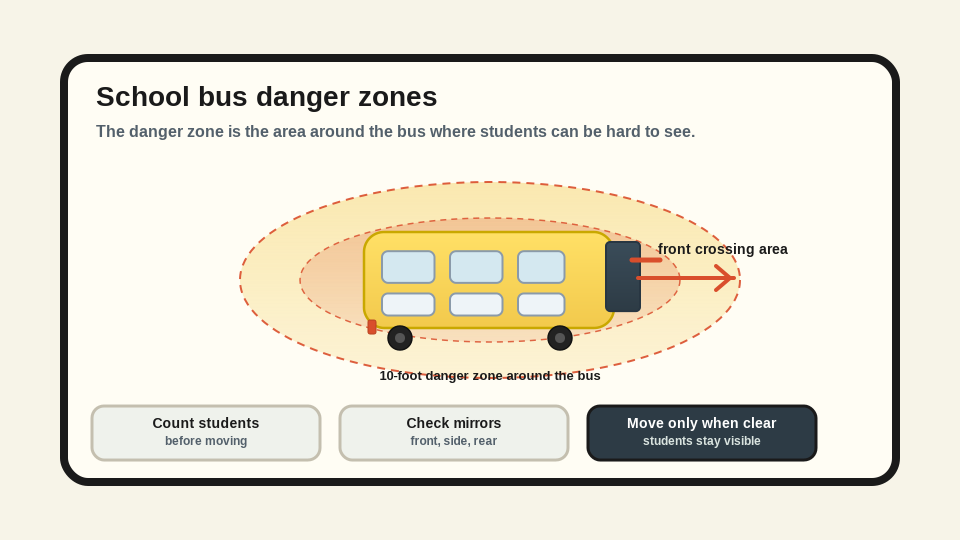
What is the danger zone around a school bus? Danger zones are the areas where students can be hardest to see.
Enlarge diagram
A Only the blind spot directly behind the rear bumper during backing maneuvers. B Any public roadway segment posted with flashing 15-mph school-speed-limit signs. C The front stairwell and center aisle behind the white standee line inside the bus. D The perimeter up to 10 feet out—and further in front—where children can be unseen.
School bus drivers must understand the danger zones around the bus because children can be hidden from view near the front, sides, and rear.
Source focus FMCSA CDL Manual Section 10.1 — Danger Zones and Use of Mirrors
Danger zones surround all four sides—front bumper, both sides, and rear—especially near front and rear tires.
A posted school zone is a roadway speed area, whereas the school bus danger zone moves with the bus itself.
Danger zones are outside perimeter areas around the bus exterior where pedestrians can be struck.
Study focus Protect students during loading, unloading, crossings, inspections, and emergency situations.
Common trap Treating a school bus stop like a normal passenger stop instead of a student-safety event.
Spot an error?
Report question cdl-school-bus-001-what-is-the-danger-zone-around-a-school-bus
Before loading or unloading students, what is the safest priority? A Pull the service door handle at 5 mph so red lights stop traffic before halting. B Secure the bus, activate required warning lights, and track students continuously. C Activate red lights 200 feet early and wave waiting students toward the curb edge. D Keep transmission in drive with foot brake only so the bus can pull out quickly.
Student loading and unloading requires controlled stopping, warning devices when required, and constant attention to student location.
Source focus FMCSA CDL Manual Section 10.2 — Loading and Unloading
Never open the service door while rolling; stop completely, set the brake, and confirm traffic stops first.
Alternating amber lights—not red—warn traffic 200 feet ahead, and students wait until you stop and signal.
Should your foot slip off the brake in drive, the bus could lurch forward into boarding children.
Study focus Protect students during loading, unloading, crossings, inspections, and emergency situations.
Common trap Treating a school bus stop like a normal passenger stop instead of a student-safety event.
Spot an error?
Report question cdl-school-bus-002-before-loading-or-unloading-students-what-is-the
Why must a school bus driver count students during loading and unloading? A To log state mileage reimbursement totals before canceling the red stop lights. B To determine whether crossover mirror scans can be skipped when pulling out. C To verify every student is safely aboard or clear of danger zones before moving. D To decide whether to skip subsequent stops when seats appear half occupied.
Counting and tracking students helps prevent moving the bus while a child is still near the vehicle or crossing the road.
Source focus FMCSA CDL Manual Section 10.2 — Unloading Procedures
Headcounts at stops are a critical life-safety check against hidden children, not a billing task.
Even when every student is counted, you must still scan all flat, convex, and crossover mirrors.
Drivers count unloading and boarding students, so nobody vanishes unseen under the bumper or tires.
Study focus Protect students during loading, unloading, crossings, inspections, and emergency situations.
Common trap Treating a school bus stop like a normal passenger stop instead of a student-safety event.
Spot an error?
Report question cdl-school-bus-003-why-must-a-school-bus-driver-count-students-duri
What should a school bus driver do before crossing railroad tracks when required to stop? A Stop 15 to 50 feet back, quiet the bus, open door and window, look and listen. B Flash alternating red student stop lights while halted ahead of the nearest rail. C Upshift halfway across the rails, so engine speed stays brisk through the crossing. D Leave the service door propped open across the tracks to hear approaching whistles.
School buses have special railroad crossing duties. The driver should stop when required, look and listen carefully, and avoid unsafe actions on the tracks.
Source focus FMCSA CDL Manual Section 10.4 — Railroad-Highway Crossings
Use 4-way hazard lamps—never red student loading lights—at railroad crossings.
Never shift gears on railroad tracks because a missed gear could stall the bus in a train path.
Close the service door before moving onto the tracks after completing your look-and-listen check.
Study focus Protect students during loading, unloading, crossings, inspections, and emergency situations.
Common trap Treating a school bus stop like a normal passenger stop instead of a student-safety event.
Spot an error?
Report question cdl-school-bus-004-what-should-a-school-bus-driver-do-before-crossi
During a school bus evacuation, what is the safest driver priority? A Have students scatter across both roadsides, so everyone exits in half the time. B Move students to a safe spot at least 100 feet away and keep them together. C Evacuate downwind of a smoking engine, so smoke blows past the bus windshield. D Unload backpacks and band instruments first, so aisles clear before students exit.
Evacuation is about protecting students after they leave the bus. The driver should direct them to a safe location and keep them organized.
Source focus FMCSA CDL Manual Section 10.3 — Emergency Exit and Evacuation
Letting students scatter puts children into live traffic and prevents accounting for missing riders.
Always lead students upwind—never downwind—of fire, smoke, or hazardous spills, at least 100 feet away.
Personal belongings must be left behind during an emergency evacuation, so students get out immediately.
Study focus Protect students during loading, unloading, crossings, inspections, and emergency situations.
Common trap Treating a school bus stop like a normal passenger stop instead of a student-safety event.
Spot an error?
Report question cdl-school-bus-005-during-a-school-bus-evacuation-what-is-the-safes
Which item is especially important in a school bus pre-trip inspection? A Overhead luggage racks and underfloor freight bays required on highway coaches. B Disconnecting emergency door buzzers, so bumps on rough routes do not startle kids. C Padlocking emergency roof hatches shut so older students cannot open vents on routes. D Emergency exits, mirrors, eight-way warning lights, stop arm, and safety equipment.
School bus inspection adds student-safety equipment and loading controls to normal vehicle checks. Warning systems, exits, mirrors, and stop arms matter directly to student safety.
Source focus FMCSA CDL Manual Section 10.1 & 10.2 — School Bus Inspection
Standard school buses prioritize stop arms, crossover mirrors, and student exits over coach baggage bays.
Emergency exit warning buzzers must operate properly during pre-trip checks and must never be disabled.
Locking any emergency exit while transporting students is strictly prohibited and blocks evacuation.
Study focus Protect students during loading, unloading, crossings, inspections, and emergency situations.
Common trap Treating a school bus stop like a normal passenger stop instead of a student-safety event.
Spot an error?
Report question cdl-school-bus-006-which-item-is-especially-important-in-a-school-b
A student drops an item near the front of the school bus after unloading. What is the safest driver response? A Keep the student visible, secure the bus, and never move until the zone is clear. B Creep forward five feet, so the child can pick up the object behind the front axle. C Wave from the seat for the student to duck below the bumper and grab it quickly. D Sound two horn blasts, cancel red lights, and pull out, so the child steps back.
Children near the bus are in a high-risk area. The driver should keep them visible and never move until the danger zone is clear.
Source focus FMCSA CDL Manual Section 10.2 — Dropped or Forgotten Objects
Moving the bus an inch with a child near the bumper risks a fatal run-over in the front blind spot.
Ducking below the hood drops the child out of direct sight inside the deadliest front danger zone.
Never cancel warning lights or move when a child is near a dropped item; secure the bus and assist safely.
Study focus Protect students during loading, unloading, crossings, inspections, and emergency situations.
Common trap Treating a school bus stop like a normal passenger stop instead of a student-safety event.
Spot an error?
Report question cdl-school-bus-007-a-student-drops-an-item-near-the-front-of-the-sc
Why is mirror adjustment especially important for a school bus driver? A Crossover mirrors give a clear highway rearview and replace highway lane checks. B Flat west-coast mirrors show directly in front of the front bumper without distortion. C Properly aimed flat, convex, and crossover mirrors reveal children in danger zones. D Adjusted interior mirrors waive mandatory stops at passive rural railroad crossings.
School bus mirrors help the driver see areas near the bus where students may be present, including zones that are difficult to see directly.
Source focus FMCSA CDL Manual Section 10.1 — Danger Zones and Use of Mirrors
Crossover mirrors show the front bumper and tire danger zones while stopped, not distant highway lanes.
Outside flat mirrors have blind spots along the sides and cannot see anywhere near the front bumper.
Mirror setup never excuses a school bus from stopping 15 to 50 feet before railroad crossings.
Study focus Protect students during loading, unloading, crossings, inspections, and emergency situations.
Common trap Treating a school bus stop like a normal passenger stop instead of a student-safety event.
Spot an error?
Report question cdl-school-bus-008-why-is-mirror-adjustment-especially-important-fo
When students must cross the road after leaving a school bus, what should the driver do? A Direct students to walk behind the rear bumper once oncoming cars slow down. B Cancel red lights and pull away first, so students have an unobstructed street view. C Have them walk 10 feet ahead in view, confirm traffic stopped, then signal across. D Sound the horn twice as the standard go-ahead signal to sprint across all lanes.
Student crossing is one of the highest-risk school bus tasks. The driver should control the stop, watch the students, and allow crossing only when the area is safe.
Source focus FMCSA CDL Manual Section 10.2 — Unloading Procedures
Students must never cross behind a school bus where neither the driver nor oncoming cars can see them.
Pulling away removes stop-arm protection and leaves crossing children exposed to moving traffic.
Students should walk—not run—on a prearranged hand signal; horn blasts indicate danger to retreat.
Study focus Apply safe student crossing procedures after unloading.
Common trap Letting students cross before traffic is fully controlled.
Spot an error?
Report question cdl-school-bus-009-when-students-must-cross-the-road-after-leaving-
Why should a school bus driver check the danger zones before moving after a stop? A A child may be hidden from direct line of sight near the bumper, doors, or tires. B Air interlocks keep the transmission locked until every mirror glass is tapped. C The electric stop arm retracts only if crossover mirrors stay clear for five seconds. D State right-of-way rules suspend mirror checks once the service door latches shut.
Students can be hidden around the front, sides, and rear of the bus. The driver should verify the danger zones are clear before moving.
Source focus FMCSA CDL Manual Section 10.1 — Danger Zones
No sensor verifies mirror checks; only the driver visual scan detects hidden children.
Stop arms link to the service door control, not optical sensors; mirror checks protect unseen kids.
Closing the door never guarantees children cleared the sides or front bumper—always scan every mirror.
Study focus Use danger-zone checks before moving a school bus.
Common trap Assuming students are clear because the door has closed.
Spot an error?
Report question cdl-school-bus-010-why-should-a-school-bus-driver-check-the-danger-
A student is late and runs toward the bus from across the street. What is the safest response? A Pull out briskly so the late student stops on the far sidewalk for tomorrow bus. B Wave the running student across immediately before approaching cars reach the bus. C Back the bus toward the student driveway while sounding four-way hazard flashers. D Stay stopped, reactivate warning lights to halt traffic, and keep the child in view.
A running student can enter traffic or a danger zone quickly. The driver should stay stopped and control the situation until it is safe.
Source focus FMCSA CDL Manual Section 10.2 — Loading Procedures
A running child often darts into traffic chasing a departing bus rather than stopping on the curb.
Never wave a student across until warning lights are active, and all traffic has come to a full stop.
Backing at a student stop creates extreme rear blind-spot danger and violates safe loading rules.
Study focus Choose safe actions when a student approaches unexpectedly.
Common trap Prioritizing route timing over controlling student movement.
Spot an error?
Report question cdl-school-bus-011-a-student-is-late-and-runs-toward-the-bus-from-a
What should a school bus driver verify after the last student leaves the bus? A Glance in the overhead interior mirror from the driver seat before shutting off power. B Walk through the bus for sleeping children or left items and clear all danger zones. C Unlatch the rear emergency door slightly so fresh air circulates between bus routes. D Cancel mirror checks at the final stop because all riders have already stepped off.
A post-stop and post-route check helps prevent leaving a child on the bus or moving while a student is near the vehicle.
Source focus FMCSA CDL Manual Section 10.2 — Post-Trip Inspection
An overhead mirror glance misses small sleeping children tucked low behind high-backed bus seats.
Emergency exits are for evacuation or inspection checks, while walking the aisle checks every seat row.
Unloaded students at the final stop are still outside in the danger zones until they walk clear.
Study focus Use post-stop checks to account for students.
Common trap Checking mirrors only once and assuming all students are gone.
Spot an error?
Report question cdl-school-bus-012-what-should-a-school-bus-driver-verify-after-the
At a school bus stop, what is the safest reason to use mirrors continuously? A To track students, traffic, and danger zones before, during, and after the stop. B To watch for illegal passers only while boarding kids find seats without looking out. C To substitute for eight-way flashing lights on quiet neighborhood residential streets. D To check rear tire tread wear reflection against wet pavement while students board.
School bus stops require constant observation. Mirrors help the driver monitor students near the bus and traffic around the stop.
Source focus FMCSA CDL Manual Section 10.1 — Properly Adjusted Mirrors
Mirrors must track both traffic threats and every student near the bus exterior, not cars alone.
Mirrors aid driver vision and never replace mandatory amber and red warning lights at bus stops.
Tire tread is checked by hand during pre-trip inspection; stop-time mirror scans protect children.
Study focus Connect mirror use to student safety at stops.
Common trap Using mirrors only for lane changes instead of student protection.
Spot an error?
Report question cdl-school-bus-013-at-a-school-bus-stop-what-is-the-safest-reason-t
What should a driver do if the stop arm or student warning lights do not work before a school bus route? A Extend your left arm out the driver window to stop oncoming traffic at each pickup. B Operate the route using four-way hazard flashers at stops with right-side exits only. C Do not place the bus into student service until the warning equipment is repaired. D Run the morning pickup on back roads first and report the fault after school drop-off.
Student warning equipment controls traffic during loading and unloading. A defect can expose students to serious risk.
Source focus FMCSA CDL Manual Section 10.2 — School Bus Warning Systems
Driver hand signals cannot legally or safely replace high-visibility alternating red lights and stop arms.
Four-way hazard flashers tell drivers to pass with caution rather than commanding traffic to stop.
Broken student warning lights or stop arms are critical safety defects that ground the bus before pickup.
Study focus Identify student warning equipment defects as serious safety issues.
Common trap Treating warning-light defects as minor electrical problems.
Spot an error?
Report question cdl-school-bus-014-what-should-a-driver-do-if-the-stop-arm-or-stude
Why should students be kept together after an emergency evacuation? A So older students can take turns re-entering the bus to collect dropped phones. B So the group can form a human warning line along the shoulder behind the bus. C So passing motorists see enough riders waiting to stop and offer private rides. D So the driver can account for every rider and shield the group from road hazards.
After evacuation, the driver still has responsibility for student safety. Keeping students together helps account for everyone and keeps them away from danger.
Source focus FMCSA CDL Manual Section 10.3 — Evacuation Procedures
No student should ever re-enter an evacuated bus for belongings while an emergency hazard exists.
Reflective triangles warn approaching traffic—never station children near live highway shoulders.
Students must stay under supervised custody in one safe spot rather than leaving with passing strangers.
Study focus Manage students after a school bus evacuation.
Common trap Thinking the evacuation is complete as soon as students leave the bus.
Spot an error?
Report question cdl-school-bus-015-why-should-students-be-kept-together-after-an-em