Study topic

CDL School Bus Study Guide

Under FMCSA 49 CFR Part 383 testing standards, state CDL written subtests enforce an 80% minimum passing cutoff. Benchmark your readiness on CDL School Bus Study Guide using 6 instant-feedback questions grounded in the FMCSA CDL Manual, eliminate recurring distractor traps, and advance to full 20-question sets.

Last updated:

FMCSA Section 10 danger-zone & 8-light loading rules

FMCSA CDL Manual Section 10 enforces strict perimeter dimensions, mirror calibrations, student crossing hand signals, and silent railroad listening procedures.

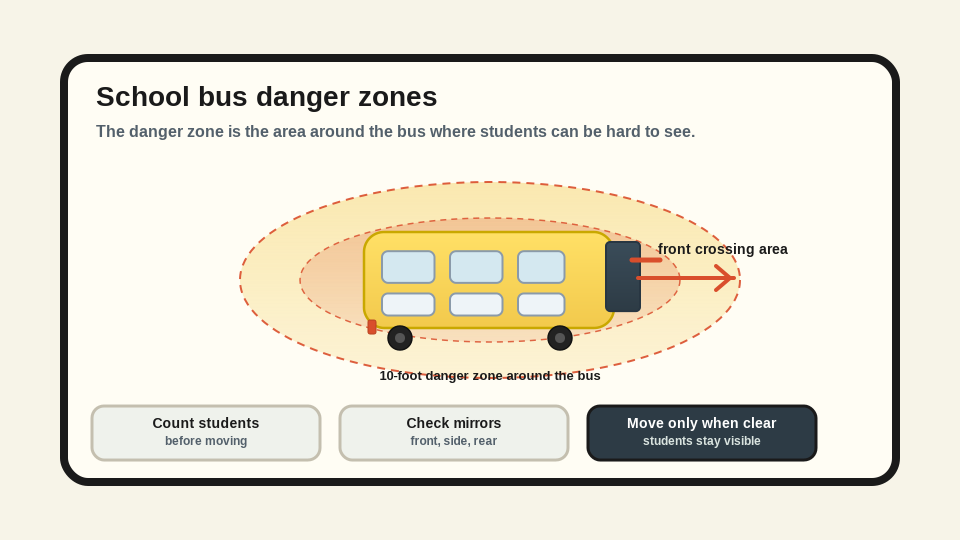
  • 10-Foot Perimeter Danger Zone: Extends 10 feet around all four sides of the bus—and state manuals warn to allow up to 30 feet of extra caution directly in front
  • Highest-Risk Blind Zones: Right in front of the front bumper (crossover mirror zone) and beside the right rear dual tires / service door
  • 7-Mirror Grid Verification: Left/right flat, left/right convex, and left/right front fender crossover mirrors (seeing bumper to 200 ft rear) plus overhead student mirror
  • Overhead 8-Way Warning Sequence: Activate flashing amber lights ~200 feet (or 100–300 ft per state law) before the stop; switch to red lights & stop arm only after halting
  • Railroad Crossing Silence & Window Rule: Stop 15–50 feet back in the rightmost lane, quiet students, silence noisy fans/heaters, and open driver window + service door
How to study this topic

Count students twice—and freeze if one disappears from sight

Count unloading students as they step off the bottom stair, then recount them once they stand at least 10 feet clear of the side of the bus. If you cannot account for a single child outside, secure the bus in neutral with the parking brake set, remove the ignition key, and walk outside to check underneath before moving an inch.

Dropped backpack rule and student crossing signal discipline

Teach students never to dart back under the bumper for a dropped phone or folder—they must stand clear, catch your eye, and let you retrieve or guard the stop. Crossing students walk at least 10 feet ahead of the front bumper, pause at the left edge of the bus, and cross only on your pre-arranged hand signal (blowing the horn means immediate danger: retreat to the curb).

Mandatory school bus evacuation triggers and 100-foot upwind lead

Evacuate immediately for active fire/smoke, stalling on or adjacent to live railroad tracks, shifting hazardous-cargo spills, or rising floodwaters. Lead students at least 100 feet away (upwind of fire or chemical fumes; at a 45-degree angle toward an oncoming train if stalled on tracks).

Diagrams

Visual study aids.

Use these diagrams to understand the space, parts, or scoring terms behind the study topic.

Top-down school bus danger zone diagram showing higher-risk areas around the bus.
School bus danger zone diagram Danger-zone checks, student counts, and mirror use should happen before the bus moves.
Study Mode Sample Questions (6 Questions)

Showing 6 study-mode sample questions here so you can check concepts immediately. Take full 20-question sets on the practice hub or try the 50-question timed simulator next.

Study examples
CDL School Bus Study Guide
Answered 0 / 6
Study Mode · Instant feedback
A–D / 1–4 choose · F flag · N/P jump
Question 1

What is the danger zone around a school bus?

School bus danger zone diagram showing higher-risk areas around the bus.
Danger zones are the areas where students can be hardest to see.
Question 2

Before loading or unloading students, what is the safest priority?

Question 3

Why must a school bus driver count students during loading and unloading?

Question 4

What should a school bus driver do before crossing railroad tracks when required to stop?

Question 5

During a school bus evacuation, what is the safest driver priority?

Question 6

Which item is especially important in a school bus pre-trip inspection?

Submit your exam?

Diagram

Scroll horizontally or pinch to zoom & read labels.