Free CDL test questions with answers, explanations, and links back to the study topics behind each question.
Where this page fits
Core CDL knowledge: CDL Test Questions and Answers
This page is one checkpoint inside the CDL study guide. Use the map to move between the full outline, topic notes, practice questions, and focused weak-area review.
Read the explanation after every answer.
Move from missed mixed questions back to the topic page behind the weakness.
Use original practice instead of copied private test-bank material.
CDL questions are most useful when the answer explains the safety decision. Use this page to practice original CDL questions, review explanations, and move back to the study topic behind any missed answer.
General knowledge questions for inspection, speed, space, and hazard response
Air brake questions about pressure, warnings, leakage, and safe braking
Combination vehicle questions about coupling, trailer control, and spacing
Endorsement-style questions for hazmat, passenger, tank, doubles/triples, and school bus topics
Short explanations that point back to the CDL study path instead of memorized answer dumps
How to study this topic
Study the explanation, not just the letter
A correct answer matters less if you cannot explain why it is safer. Read the explanation after each question and connect it to the topic it came from.
Avoid answer-dump habits
Pages that only list answers can make practice feel faster, but they do not help when the test changes the vehicle, road condition, or wording. Use the reasoning behind the answer.
Move from mixed questions to focused review
If several missed answers share the same topic, stop the mixed set and review that page before answering another batch.
Quick answers
Answers before you practice.
Short answers for the search questions behind this CDL page.
01
Are these official CDL test questions?
No. These are original CDL practice questions written from handbook topics and linked official sources. Use them to study the reasoning behind safe answers; your state agency and official testing provider control the actual exam.
Answer first, read the explanation, then review the study topic behind any miss. If several missed answers share the same skill, stop the mixed set and review that focused page before practicing again.
Start with general knowledge and vehicle inspection. Add air brakes, combination vehicles, endorsements, skills-test topics, and state notes only when they match the vehicle or job path you plan to pursue.
Answers alone are not enough because CDL questions often change the vehicle, road condition, or wording. Use the answer to confirm the safety rule, then practice a new question that tests the same idea in a different scenario.
Practice questions
CDL Test Questions and Answers Quiz
Answered 0 / 24
Question 1
How far ahead should you be looking while driving a commercial vehicle at highway speeds?
Good drivers look 12 to 15 seconds ahead. At highway speeds, this is about a quarter of a mile. This gives you time to adjust speed or change lanes to avoid hazards.
Study focusChoose safe speed, spacing, and visual search habits for commercial vehicles.
Common trapDriving at passenger-car speeds without accounting for weight, space, weather, or grade.
Question 2
What is the minimum tread depth required for the front steering tires of a commercial vehicle?
Federal regulations require a minimum tread depth of 4/32 inch in every major groove on front (steering) tires. Other tires require at least 2/32 inch.
Study focusUse pre-trip inspection habits to identify unsafe vehicle-system defects before driving.
Common trapMemorizing a walk-around order without understanding which defects make the vehicle unsafe.
Question 3
When is it appropriate to use your high beams?
Use high beams whenever you can to see further ahead, provided it is safe and legal. You must dim them when within 500 feet of an oncoming vehicle or when following another vehicle within 500 feet.
Study focusApply core CDL safe-driving rules to common road and vehicle situations.
Common trapMemorizing rules without applying them to driving scenarios.
Question 4
What is 'hydroplaning'?
Hydroplaning occurs when water builds up in front of your tires, causing them to lift off the road surface. You lose steering and braking control. To recover, release the accelerator and do not brake hard.
Study focusUse pre-trip inspection habits to identify unsafe vehicle-system defects before driving.
Common trapMemorizing a walk-around order without understanding which defects make the vehicle unsafe.
Question 5
If you experience a tire blowout while driving at highway speeds, what is the FIRST thing you should do?
When a tire blows out, grip the steering wheel firmly and stay off the brakes. Braking hard can cause a skid or loss of control. Let the vehicle slow down naturally before applying brakes gently.
Study focusUse pre-trip inspection habits to identify unsafe vehicle-system defects before driving.
Common trapMemorizing a walk-around order without understanding which defects make the vehicle unsafe.
Question 6
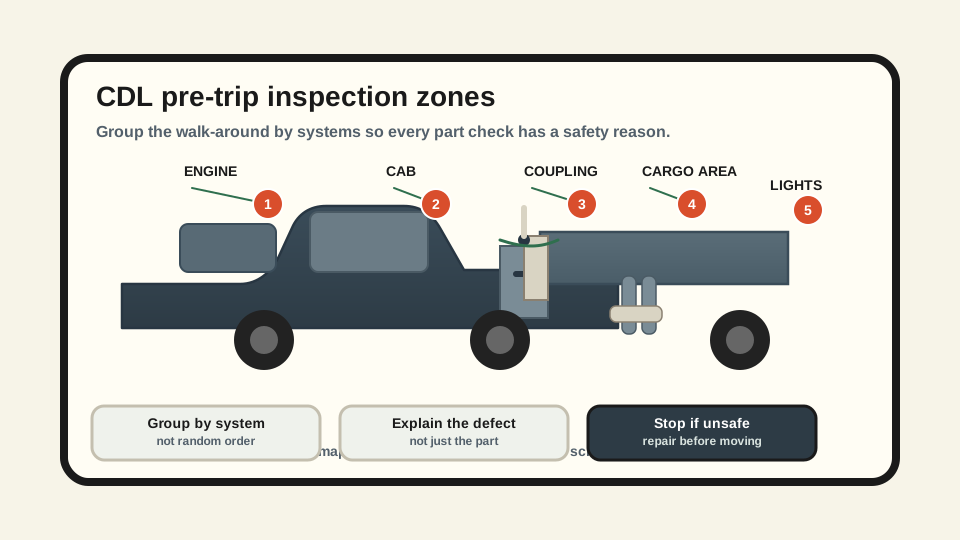
What is the purpose of a pre-trip inspection?
Safety is the most important reason for a pre-trip inspection. Finding and fixing a defect before driving helps prevent breakdowns and crashes on the road.
Study focusUse pre-trip inspection habits to identify unsafe vehicle-system defects before driving.
Common trapMemorizing a walk-around order without understanding which defects make the vehicle unsafe.
Question 7
Which type of fire extinguisher should be used on an electrical fire?
Electrical fires require a B:C or A:B:C rated extinguisher. Using water or water-based foam on an electrical fire can result in a severe electric shock.
Study focusApply safe loading, separation, parking, routing, and emergency-response decisions for hazmat.
Common trapChoosing a convenient action instead of the action that protects people and isolates the hazard.
Question 8
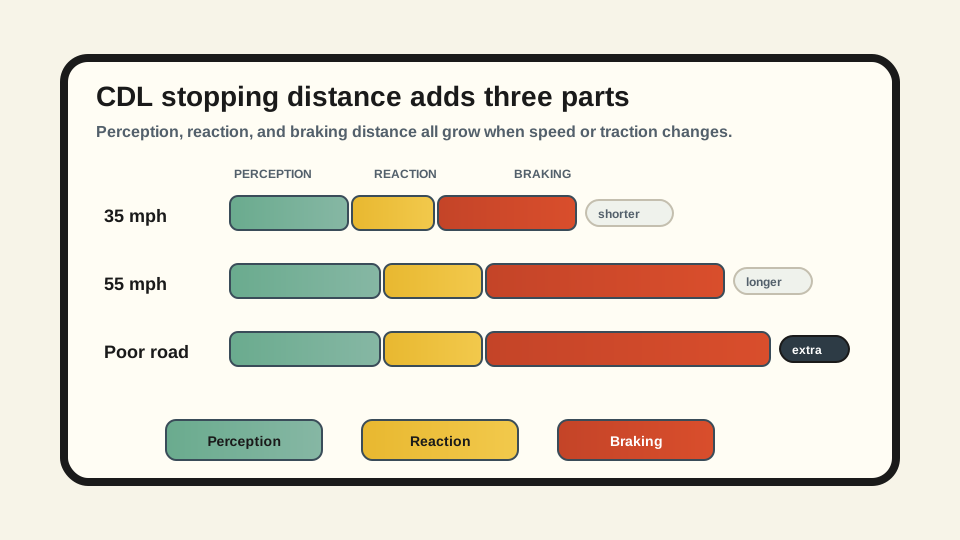
What is the recommended following distance for a heavy vehicle traveling at 55 mph in ideal conditions?
The rule of thumb is 1 second of following distance for every 10 feet of vehicle length at speeds under 40 mph. For speeds over 40 mph, add 1 additional second. A 60-foot truck at 55 mph needs 7 seconds of space.
Study focusChoose safe speed, spacing, and visual search habits for commercial vehicles.
Common trapDriving at passenger-car speeds without accounting for weight, space, weather, or grade.
Question 9
If your vehicle catches fire while driving, what should you do first?
The first step in a vehicle fire is to get the vehicle off the road and stop in an open area, clear of buildings, trees, brush, and other vehicles to prevent the fire from spreading.
Study focusApply safe loading, separation, parking, routing, and emergency-response decisions for hazmat.
Common trapChoosing a convenient action instead of the action that protects people and isolates the hazard.
Question 10
What should you do if you are being tailgated?
If you are being tailgated, increase the space in front of your vehicle. This allows you to brake more smoothly and gradually, reducing the chance that the tailgater will crash into your rear.
Study focusChoose safe speed, spacing, and visual search habits for commercial vehicles.
Common trapDriving at passenger-car speeds without accounting for weight, space, weather, or grade.
Question 11
When approaching a curve, what is the best way to handle your speed?
You should brake to a safe speed before entering a curve. Once in the curve, maintain speed or accelerate slightly, as this helps stabilize the vehicle. Never brake hard in a curve.
Study focusChoose safe speed, spacing, and visual search habits for commercial vehicles.
Common trapDriving at passenger-car speeds without accounting for weight, space, weather, or grade.
Question 12
What is the most common cause of serious vehicle skids?
Most serious skids result from driving too fast for road conditions, over-braking, over-steering, or over-accelerating. Speed is the primary factor in losing traction.
Study focusUse pre-trip inspection habits to identify unsafe vehicle-system defects before driving.
Common trapMemorizing a walk-around order without understanding which defects make the vehicle unsafe.
Question 13
When driving a commercial vehicle, how should you adjust your speed for driving at night?
At night, your visibility is limited to the reach of your headlights. You must adjust your speed so you can safely stop within that visible distance.
Study focusUse inspection habits to catch unsafe defects before driving.
Common trapChecking only obvious items and missing brake, tire, coupling, or defect-report steps.
Question 14
What is the most important reason for inspecting your vehicle?
While avoiding fines is good, safety is the primary reason for inspections. A defect found during an inspection can prevent a breakdown or fatal crash.
Study focusUse inspection habits to catch unsafe defects before driving.
Common trapChecking only obvious items and missing brake, tire, coupling, or defect-report steps.
Question 15
When should you check your mirrors while driving?
You should check your mirrors regularly (about every 5 to 8 seconds) to be aware of traffic around you and to monitor your vehicle and trailer.
Study focusChoose safe speed, spacing, and visual search habits for commercial vehicles.
Common trapDriving at passenger-car speeds without accounting for weight, space, weather, or grade.
Question 16
What is the primary cause of fatal crashes involving commercial vehicles?
Speeding or driving too fast for conditions is the leading cause of fatal crashes involving large trucks.
Study focusChoose safe speed, spacing, and visual search habits for commercial vehicles.
Common trapDriving at passenger-car speeds without accounting for weight, space, weather, or grade.
Question 17
If you are driving a 60-foot truck at 50 mph, what is the minimum following distance you should maintain?
The rule is 1 second per 10 feet of length, plus 1 second if going over 40 mph. For a 60-foot truck, that is 6 seconds + 1 second = 7 seconds.
Study focusChoose safe speed, spacing, and visual search habits for commercial vehicles.
Common trapDriving at passenger-car speeds without accounting for weight, space, weather, or grade.
Question 18
What should you do if an aggressive driver is harassing you?
To deal with an aggressive driver, do not engage. Get out of their way, avoid eye contact, ignore gestures, and report them if they are a severe danger.
Study focusChoose safe speed, spacing, and visual search habits for commercial vehicles.
Common trapDriving at passenger-car speeds without accounting for weight, space, weather, or grade.
Question 19
Which of these fires can you safely use water to extinguish?
Water can be used to cool down a tire fire. Using water on electrical, gasoline, or grease fires can spread the fire or cause electrocution.
Study focusApply safe loading, separation, parking, routing, and emergency-response decisions for hazmat.
Common trapChoosing a convenient action instead of the action that protects people and isolates the hazard.
Question 20
How does cargo weight affect the height of your vehicle's center of gravity?
Loading heavy cargo high in the trailer raises the center of gravity, making the vehicle top-heavy and much more likely to roll over in a curve or evasive maneuver.
Study focusApply safe loading, separation, parking, routing, and emergency-response decisions for hazmat.
Common trapChoosing a convenient action instead of the action that protects people and isolates the hazard.
Question 21
What is the best way to use the brake pedal on a steep downgrade?
The 'snubbing' technique involves braking firmly to 5 mph below your safe speed, then releasing them to allow cooling, repeating as necessary while the engine brake does most of the work.
Study focusChoose safe speed, spacing, and visual search habits for commercial vehicles.
Common trapDriving at passenger-car speeds without accounting for weight, space, weather, or grade.
Question 22
What does it mean if a vehicle has a 'slow-moving vehicle' symbol?
A red triangle with an orange center on the rear of a vehicle indicates it is a slow-moving vehicle, such as a tractor or construction equipment, moving at 25 mph or less.
Study focusApply safe loading, separation, parking, routing, and emergency-response decisions for hazmat.
Common trapChoosing a convenient action instead of the action that protects people and isolates the hazard.
Question 23
What should you do before driving in the mountains?
Mountain driving puts extreme stress on brakes. You must ensure your brakes are in perfect condition and know the route, including the location of runaway truck ramps.
Study focusApply safe loading, separation, parking, routing, and emergency-response decisions for hazmat.
Common trapChoosing a convenient action instead of the action that protects people and isolates the hazard.
Question 24
Which of these is NOT a good rule to follow when caring for an injured person at a crash scene?
You should NEVER move a severely injured person unless they are in immediate danger (like a burning vehicle). Moving them can worsen spinal or internal injuries.
Study focusApply safe loading, separation, parking, routing, and emergency-response decisions for hazmat.
Common trapChoosing a convenient action instead of the action that protects people and isolates the hazard.