Use this set after reading the combination vehicles page or before moving into doubles, triples, and other longer-combination topics.
Last updated:
Study the weak area
What to understand before you answer.
Combination vehicle practice connects mechanical checks with road behavior. Coupling, trailer tracking, braking, rollover risk, and spacing all work together.
01
Confirm coupling and trailer checks before thinking about road movement.
02
Picture the trailer path during turns, curves, lane changes, and backing.
03
Use smoother control and more space than a single vehicle would need.
Before the questions
How to improve this score.
Read the combination vehicles study page.
Answer this practice set.
Review whether misses came from coupling, trailer control, braking, or inspection.
Use a coupling or trailer-control drill before retesting.
Common traps to watch for
Turning or steering too sharply without accounting for trailer movement.
When this pattern appears in a missed answer, review the explanation before trying another set.
Skipping visual checks after coupling or confusing kingpin contact points.
When this pattern appears in a missed answer, review the explanation before trying another set.
Assuming parking brakes work independently of air pressure behavior.
When this pattern appears in a missed answer, review the explanation before trying another set.
Ignoring a low air warning or waiting until spring brakes apply.
When this pattern appears in a missed answer, review the explanation before trying another set.
Assuming cargo safety is only the shipper or dispatcher responsibility.
When this pattern appears in a missed answer, review the explanation before trying another set.
Practice questions
CDL Combination Vehicles Test 1 Quiz
Answered 0 / 20
Question 1
Why is the risk of a rollover higher in a combination vehicle compared to a single vehicle?
Fully loaded rigs have high centers of gravity, making them top-heavy. Also, in a multi-trailer combination, steering movements are amplified at the rear (the crack-the-whip effect), greatly increasing rollover risk.
Study focusControl off-tracking, rollover, rearward amplification, and trailer movement risks.
Common trapTurning or steering too sharply without accounting for trailer movement.
Question 2
What is 'off-tracking' (or 'cheating') in a combination vehicle?
Off-tracking occurs when turning. The rear wheels follow a shorter path than the front wheels. The longer the vehicle, the greater the off-tracking, requiring wider turns.
Study focusControl off-tracking, rollover, rearward amplification, and trailer movement risks.
Common trapTurning or steering too sharply without accounting for trailer movement.
Question 3
Which part of the kingpin should the locking jaws close around?
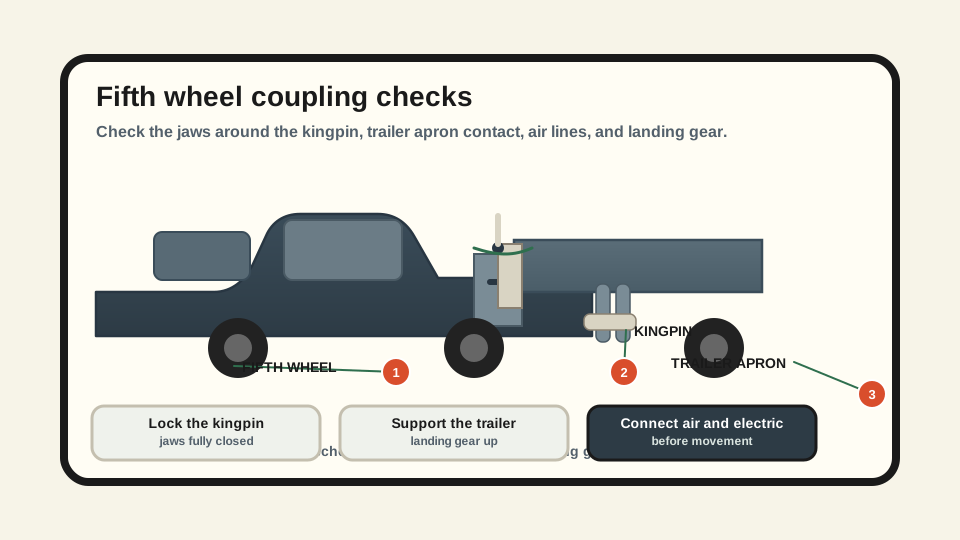
Fifth wheel and kingpin coupling
When properly coupled, the locking jaws of the fifth wheel must close securely around the shank (the narrower middle part) of the kingpin, not the head or the base.
Study focusRecognize safe coupling, uncoupling, fifth wheel, kingpin, and trailer air-line checks.
Common trapSkipping visual checks after coupling or confusing kingpin contact points.
Question 4
What color are the trailer air lines (glad hands) usually painted?
To prevent crossing the lines, glad hands are color-coded: Blue is used for the service (control) line, and Red is used for the emergency (supply) line.
Study focusRecognize safe coupling, uncoupling, fifth wheel, kingpin, and trailer air-line checks.
Common trapSkipping visual checks after coupling or confusing kingpin contact points.
Question 5
If you cross the air lines when hooking up to an older trailer, what will happen?
If lines are crossed, air goes to the service brakes instead of releasing the spring brakes. You won't be able to move (if spring brakes are working) or you won't have service brakes (if spring brakes are broken/missing on older trailers).
Study focusUnderstand how spring brakes and parking brakes behave when air pressure changes.
Common trapAssuming parking brakes work independently of air pressure behavior.
Question 6
What is the purpose of the trailer hand valve (trolley valve or Johnson bar)?
The trailer hand valve allows you to apply only the trailer brakes. It should be used to test trailer brakes but never used for parking or during normal driving because of the risk of causing a jackknife.
Study focusControl off-tracking, rollover, rearward amplification, and trailer movement risks.
Common trapTurning or steering too sharply without accounting for trailer movement.
Question 7
What does the tractor protection valve do?
The tractor protection valve closes automatically if air pressure drops too low. This keeps air in the tractor to ensure the driver still has tractor brakes even if the trailer is lost or severely leaking.
Study focusRecognize low air pressure warnings and choose the safest response.
Common trapIgnoring a low air warning or waiting until spring brakes apply.
Question 8
When coupling a semi-trailer, how should you test that the fifth wheel jaws have locked around the kingpin?
After coupling, always pull gently forward while the trailer brakes are locked. This 'tug test' ensures the locking jaws have securely grabbed the kingpin.
Study focusRecognize safe coupling, uncoupling, fifth wheel, kingpin, and trailer air-line checks.
Common trapSkipping visual checks after coupling or confusing kingpin contact points.
Question 9
Before backing under a trailer, what should you do with the trailer height?
The trailer should be at a height where the front of the trailer is lifted slightly by the tractor's fifth wheel as it backs under. If it's too high, the kingpin could slide over the fifth wheel.
Study focusRecognize safe coupling, uncoupling, fifth wheel, kingpin, and trailer air-line checks.
Common trapSkipping visual checks after coupling or confusing kingpin contact points.
Question 10
What causes a trailer jackknife?
A trailer jackknife occurs when the trailer wheels lock up, lose traction, and the trailer swings outward alongside the tractor. Releasing the brakes to let the trailer wheels roll is the way to recover.
Study focusControl off-tracking, rollover, rearward amplification, and trailer movement risks.
Common trapTurning or steering too sharply without accounting for trailer movement.
Question 11
Where should the tractor be positioned when uncoupling a trailer?
You should always align the tractor straight with the trailer when uncoupling. Pulling out at an angle can damage the landing gear or cause the trailer to fall.
Study focusRecognize safe coupling, uncoupling, fifth wheel, kingpin, and trailer air-line checks.
Common trapSkipping visual checks after coupling or confusing kingpin contact points.
Question 12
After uncoupling a trailer, what is a crucial safety step before driving away?
Always verify that the landing gear is secure, fully lowered, and resting on solid ground (with pads or wood blocks if needed) before pulling the tractor away from the trailer.
Study focusRecognize safe coupling, uncoupling, fifth wheel, kingpin, and trailer air-line checks.
Common trapSkipping visual checks after coupling or confusing kingpin contact points.
Question 13
What should you check regarding the space between the upper and lower fifth wheel after coupling?
There must be absolutely no space between the upper and lower fifth wheel. If there is space, the kingpin may be resting on top of the locking jaws, which is extremely dangerous.
Study focusRecognize safe coupling, uncoupling, fifth wheel, kingpin, and trailer air-line checks.
Common trapSkipping visual checks after coupling or confusing kingpin contact points.
Question 14
When supplying air to a trailer, at what pressure should the trailer emergency brakes release?
The trailer spring brakes (emergency brakes) release when you push in the red trailer air supply valve and air pressure builds up in the trailer's emergency system.
Study focusUnderstand how spring brakes and parking brakes behave when air pressure changes.
Common trapAssuming parking brakes work independently of air pressure behavior.
Question 15
What is the 'crack-the-whip' effect?
When a driver makes a quick lane change or sudden steering movement, the movement is amplified at the rear of the combination. The last trailer swings out violently, which often leads to a rollover.
Study focusControl off-tracking, rollover, rearward amplification, and trailer movement risks.
Common trapTurning or steering too sharply without accounting for trailer movement.
Question 16
How should you drive when pulling an empty trailer?
Empty trailers have less traction and bounce more. Therefore, they actually take longer to stop than loaded trailers (because the tires lock up easily) and are more susceptible to wind and jackknifing.
Study focusUnderstand cargo weight, securement, and load safety responsibilities.
Common trapAssuming cargo safety is only the shipper or dispatcher responsibility.
Question 17
When inspecting the trailer before coupling, you should make sure the trailer wheels are:
Before backing under a trailer, ensure the trailer wheels are chocked (blocked) or the spring brakes are properly applied so the trailer doesn't roll away when you push against it with the fifth wheel.
Study focusUnderstand how spring brakes and parking brakes behave when air pressure changes.
Common trapAssuming parking brakes work independently of air pressure behavior.
Question 18
What is a 'bobtail'?
A bobtail is a tractor operating without a trailer attached. Bobtails can be surprisingly difficult to stop safely due to the lack of weight over the rear drive axles.
Study focusUnderstand cargo weight, securement, and load safety responsibilities.
Common trapAssuming cargo safety is only the shipper or dispatcher responsibility.
Question 19
When uncoupling, why do you apply the parking brakes, lower the landing gear, and disconnect the air lines BEFORE pulling the fifth wheel release handle?
You secure the trailer (brakes and landing gear) and disconnect lines first so that when you finally release the kingpin and pull away, the trailer is fully supported and won't rip the air lines out.
Study focusUnderstand how spring brakes and parking brakes behave when air pressure changes.
Common trapAssuming parking brakes work independently of air pressure behavior.
Question 20
How can you prevent a rollover?
To prevent rollovers, keep the center of gravity low by distributing weight properly, load cargo evenly, and significantly reduce your speed before entering curves and ramps.
Study focusControl off-tracking, rollover, rearward amplification, and trailer movement risks.
Common trapTurning or steering too sharply without accounting for trailer movement.