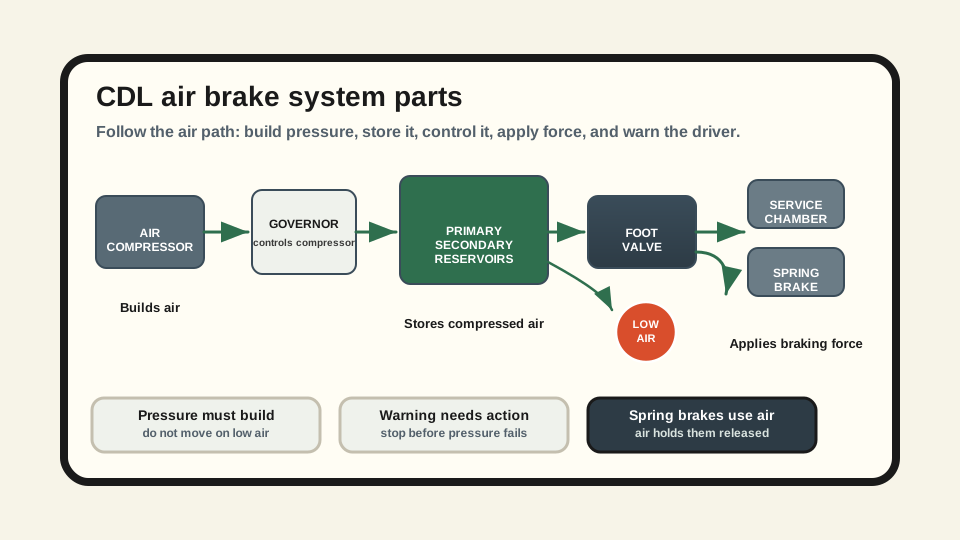
Use this set after reading the air brakes outline or when you need to check warning devices, pressure behavior, leakage tests, and safe braking decisions.
Last updated:
Study the weak area
What to understand before you answer.
Air brakes practice is most useful when you understand the system parts first, then connect them to warning signs and safe driver actions.
01
Know what the compressor, governor, tanks, gauges, and warning devices do.
02
Pay close attention to pressure loss, warning thresholds, and inspection steps.
03
Treat every answer as a safety decision, not just a memorized number.
Before the questions
How to improve this score.
Review the air brakes study page.
Answer the practice set.
Use the score report to choose a focused drill.
Retake the topic after correcting the weakest skill.
Common traps to watch for
Confusing compressor cut-in/cut-out behavior with brake application.
When this pattern appears in a missed answer, review the explanation before trying another set.
Ignoring a low air warning or waiting until spring brakes apply.
When this pattern appears in a missed answer, review the explanation before trying another set.
Assuming parking brakes work independently of air pressure behavior.
When this pattern appears in a missed answer, review the explanation before trying another set.
Mixing up single-vehicle and combination-vehicle leakage limits.
When this pattern appears in a missed answer, review the explanation before trying another set.
Memorizing part names without understanding what each part does.
When this pattern appears in a missed answer, review the explanation before trying another set.
Practice questions
CDL Air Brakes Test 1 Quiz
Answered 0 / 20
Question 1
What is the purpose of the air compressor in an air brake system?
Air brake system parts
The air compressor pumps air into the air storage tanks (reservoirs), providing the compressed air needed to operate the braking system.
Study focusUnderstand compressor, governor, reservoir, and air supply behavior.
Common trapConfusing compressor cut-in/cut-out behavior with brake application.
Question 2
When must the low air pressure warning signal come on during an air brake check?
During the air brake check, the low-air warning device must activate before air pressure drops below 55 psi or the level specified by the manufacturer. Current handbooks also describe normal low-air warning activation in the 55-75 psi range, with large buses sometimes warning at a higher pressure.
Study focusRecognize low air pressure warnings and choose the safest response.
Common trapIgnoring a low air warning or waiting until spring brakes apply.
Question 3
What are spring brakes?
Spring brakes are held back by air pressure. If air pressure is lost, the springs expand and apply the brakes automatically. They serve as both the emergency and parking brakes.
Study focusUnderstand how spring brakes and parking brakes behave when air pressure changes.
Common trapAssuming parking brakes work independently of air pressure behavior.
Question 4
How do you test the static air leakage rate on a combination vehicle with air brakes?
For a static leak test (brakes released, engine off), a combination vehicle should not lose more than 3 psi in one minute. A single vehicle should not lose more than 2 psi in one minute.
Study focusApply the correct static and applied air leakage test limits.
Common trapMixing up single-vehicle and combination-vehicle leakage limits.
Question 5
During an applied air leakage rate test, what is the maximum allowable pressure loss for a combination vehicle?
During an applied leak test (engine off, service brakes fully applied by pressing the brake pedal), a combination vehicle must not lose more than 4 psi in one minute.
Study focusApply the correct static and applied air leakage test limits.
Common trapMixing up single-vehicle and combination-vehicle leakage limits.
Question 6
What does the air compressor governor control?
The governor controls when the air compressor pumps air into the reservoirs (cut-in) and when it stops pumping (cut-out) to maintain proper system pressure.
Study focusUnderstand compressor, governor, reservoir, and air supply behavior.
Common trapConfusing compressor cut-in/cut-out behavior with brake application.
Question 7
At what pressure does the air compressor governor typically 'cut out' (stop pumping air)?
The air compressor governor typically cuts out, meaning it stops pumping air into the tanks, when the system reaches its maximum pressure of about 125-130 psi.
Study focusUnderstand compressor, governor, reservoir, and air supply behavior.
Common trapConfusing compressor cut-in/cut-out behavior with brake application.
Question 8
What is the purpose of alcohol evaporators in some air brake systems?
Alcohol evaporators put alcohol into the air system to help prevent moisture in the system from freezing in cold weather, which could cause brake failure.
Study focusUnderstand compressor, governor, reservoir, and air supply behavior.
Common trapConfusing compressor cut-in/cut-out behavior with brake application.
Question 9
Why is it important to drain air storage tanks daily?
Compressed air usually contains water and compressor oil, which can build up in the tanks. If not drained, this mixture can freeze in cold weather and cause brake failure.
Study focusUnderstand compressor, governor, reservoir, and air supply behavior.
Common trapConfusing compressor cut-in/cut-out behavior with brake application.
Question 10
What is 'brake lag' in an air brake system?
Air brakes are not instantaneous like hydraulic brakes. Brake lag is the time required for the air to flow through the lines to all the brake chambers (typically about one-half second).
Study focusIdentify key air brake parts and explain how the system produces braking force.
Common trapMemorizing part names without understanding what each part does.
Question 11
When testing the low pressure warning signal, how should you reduce the air pressure?
To test the warning signal, turn the engine off, leave the key in the 'on' position, and rapidly step on and off the brake pedal. The warning signal must activate before pressure drops below 55 psi or the manufacturer-specified level.
Study focusRecognize low air pressure warnings and choose the safest response.
Common trapIgnoring a low air warning or waiting until spring brakes apply.
Question 12
If the spring brakes apply while you are driving, what should you do?
If air pressure falls below 20-45 psi, the spring brakes will engage automatically and bring the vehicle to a rapid stop. You must steer safely off the road before you lose complete mobility.
Study focusUnderstand how spring brakes and parking brakes behave when air pressure changes.
Common trapAssuming parking brakes work independently of air pressure behavior.
Question 13
What is the proper way to brake on a long, steep downgrade using air brakes?
Rely primarily on engine braking. When you reach your 'safe speed', apply the brakes firmly until you are 5 mph under that speed, then release them. Repeat this process as needed.
Study focusIdentify key air brake parts and explain how the system produces braking force.
Common trapMemorizing part names without understanding what each part does.
Question 14
What causes brake fade?
Brake fade is the loss of braking power caused by excessive heat, usually from riding the brakes on a downgrade. Heat causes the drums to expand away from the brake shoes.
Study focusIdentify key air brake parts and explain how the system produces braking force.
Common trapMemorizing part names without understanding what each part does.
Question 15
What color is the tractor parking brake control valve in the cab?
The tractor parking brake control is a diamond-shaped, yellow, push-pull control knob.
Study focusUnderstand how spring brakes and parking brakes behave when air pressure changes.
Common trapAssuming parking brakes work independently of air pressure behavior.
Question 16
When should you NOT use the parking brake?
Do not use the parking brake if the brakes are extremely hot (they could warp) or if they are very wet in freezing temperatures (they could freeze locked). Use wheel chocks instead.
Study focusUnderstand how spring brakes and parking brakes behave when air pressure changes.
Common trapAssuming parking brakes work independently of air pressure behavior.
Question 17
What does an Anti-Lock Braking System (ABS) do on an air brake equipped vehicle?
ABS only prevents the wheels from locking up during a hard braking event. This allows you to steer around obstacles while stopping, rather than going into an uncontrollable skid.
Study focusIdentify key air brake parts and explain how the system produces braking force.
Common trapMemorizing part names without understanding what each part does.
Question 18
How can you tell if your vehicle is equipped with ABS?
Vehicles built after 1998 are required to have ABS. You can verify this by looking for the yellow ABS malfunction indicator light on the dashboard when turning the key on.
Study focusUse inspection habits to catch unsafe defects before driving.
Common trapChecking only obvious items and missing brake, tire, coupling, or defect-report steps.
Question 19
What is the function of the slack adjusters in an S-cam brake system?
Slack adjusters are mechanical links between the pushrod and camshaft. They are used to adjust the brakes to ensure the shoes remain close enough to the drums as the friction lining wears away.
Study focusIdentify key air brake parts and explain how the system produces braking force.
Common trapMemorizing part names without understanding what each part does.
Question 20
How do you manually check the slack adjusters on S-cam brakes?
To check slack adjusters, you must release the parking brakes so there is no tension on the system. If a slack adjuster moves more than about one inch when pulled by hand, it probably needs adjustment.
Study focusUnderstand how spring brakes and parking brakes behave when air pressure changes.
Common trapAssuming parking brakes work independently of air pressure behavior.