Topic

CDL Hazmat Endorsement

Under FMCSA 49 CFR Part 383 testing standards, state CDL written subtests enforce an 80% minimum passing cutoff. Benchmark your readiness on CDL Hazmat Endorsement using 6 instant-feedback questions grounded in the FMCSA CDL Manual, eliminate recurring distractor traps, and advance to full 20-question sets.

Last updated:

CDL Section 9 Hazardous Materials exam blueprint (30 questions)

The Hazardous Materials (H) endorsement exam typically presents 30 multiple-choice items (24 correct required for 80%) testing federal 49 CFR Parts 172 and 397 compliance.

  • Nine federal hazard classes: Class 1 Explosives through Class 9 Miscellaneous Dangerous Goods
  • Shipping paper sequence (ISHP: Identification number, Shipping name, Hazard class, Packing group) and cab reach rules
  • Table 1 (any amount) vs. Table 2 (1,001 lbs+ aggregate) four-sided diamond placarding thresholds
  • Loading segregation: never load Poison/Toxic near foodstuffs or Oxidizers with Flammables
  • 49 CFR Part 397 parking rules (5 feet from traveled roadway; 300 feet from bridges/tunnels/crowds for Division 1.1–1.3)
How to study this topic

Table 1 (any quantity) vs. Table 2 (1,001-lb rule) & Dangerous placard

Memorize the Table 1 zero-tolerance list—Explosives 1.1/1.2/1.3, Poison Gas 2.3, Dangerous When Wet 4.3, Organic Peroxide Type B, Poison Inhalation Hazard 6.1, and Radioactive Yellow-III Class 7 require placards in ANY amount. Table 2 classes trigger placards at 1,001 lbs aggregate gross weight, and you may use a DANGEROUS placard for two or more Table 2 classes until a single class reaches 2,205 lbs (1,000 kg) at one loading facility.

Refueling, railroad crossings, and route-plan traps

Shut off the engine completely when fueling a placarded HazMat rig, and ensure someone stays at the nozzle controlling fuel flow. Stop 15 to 50 feet before railroad tracks without shifting gears while crossing, and carry a written route plan whenever transporting Division 1.1, 1.2, or 1.3 explosives.

Emergency containment: wind direction, 10 B:C extinguisher, and ERG

Carry the Emergency Response Guidebook (ERG) alongside shipping papers and a UL-rated 10 B:C (or higher) fire extinguisher. In a toxic or flammable leak, park upwind and uphill, keep bystanders away, never pull apart jammed cargo doors, and warn responders before opening a hot trailer.

Diagrams

Visual study aids.

Use these diagrams to understand the space, parts, or scoring terms behind the study topic.

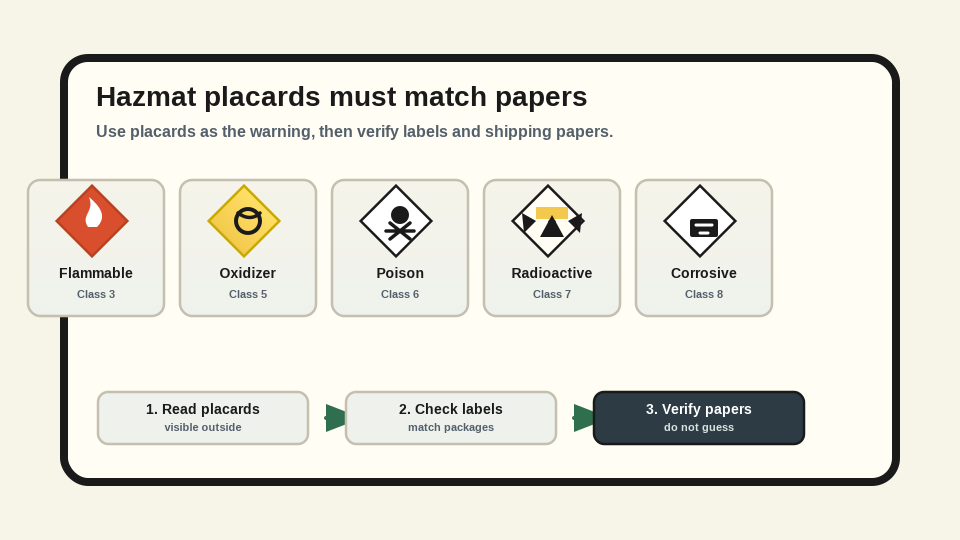
CDL hazmat placards chart with common placard examples and document checks.
CDL hazmat placards chart Use placards as the visible warning, then verify package labels and shipping papers before moving a hazmat load.
Quick answers

Answers before you practice.

Short answers for the common CDL questions on this topic.

01

Where must HazMat shipping papers be kept inside the tractor cab?

When buckled in, keep shipping papers in a pouch on the driver’s door or in clear view within immediate reach; when out of the cab, leave them on the driver’s seat or in the driver’s door pouch.

Study shipping papers & placards
02

What federal checks are required to add an H endorsement?

Applicants must complete Hazardous Materials ELDT theory training and pass a federal Transportation Security Administration (TSA) Security Threat Assessment fingerprint check—and re-verify upon renewal.

Review TSA & ELDT steps
03

Within what distance is smoking banned around Class 1, 2.1, 3, or 4 loads?

Smoking or carrying a lit cigar, cigarette, or pipe is strictly prohibited within 25 feet of any placarded Class 1 (Explosives), Division 2.1 (Flammable Gas), Class 3 (Flammable Liquid), Oxidizer, or Organic Peroxide vehicle or tank.

Take HazMat Test 1
Study Mode Sample Questions (6 Questions)

Showing 6 study-mode sample questions here so you can check concepts immediately. Take full 20-question sets on the practice hub or try the 50-question timed simulator next.

Study examples
CDL Hazmat Endorsement
Answered 0 / 6
Study Mode · Instant feedback
A–D / 1–4 choose · F flag · N/P jump
Question 1

You are carrying a placarded hazardous materials load. Where should the shipping papers be kept while you are driving?

Question 2

A shipping paper lists the proper shipping name, hazard class, and identification number. Why are these details important?

Question 3

You notice that the shipping papers for a hazmat load do not match the labels on several packages. What should you do before moving the load?

Question 4

What is the main purpose of placards on a vehicle carrying hazardous materials?

Question 5

Before leaving with a placarded load, what should the driver check about the placards?

Question 6

A package label says the material is flammable. What should that tell you as a driver?

Submit your exam?

Diagram

Scroll horizontally or pinch to zoom & read labels.