Study CDL skills test cone layout and cone spacing, score sheet language, basic control mistakes, pull-ups, encroachments, and safe correction habits.
Last updated:
Where this page fits
Skills test preparation: CDL Skills Test Cone Layout and Score Sheet
This page is one checkpoint inside the CDL study guide. Use the map to move between the full outline, topic notes, practice questions, and focused weak-area review.
Use cones as clearance and control markers, not random memorization.
Understand score sheet terms such as pull-up, encroachment, stop, and final position.
Verify the exact current layout with your state testing source.
A cone layout or score sheet is useful when it helps you understand what is being measured: slow control, boundary awareness, pull-ups, encroachments, traffic checks, and safe correction before the vehicle leaves the maneuver path.
CDL cone spacing and boundary measurements as clearance markers, not decoration
Basic control maneuvers such as straight-line backing, offset backing, alley dock, or parallel-style control when used by a state
Cone and boundary awareness as a stand-in for real vehicle clearance
Score sheet terms such as pull-up, encroachment, observation, stop, and final position
Why stopping to check is safer than continuing blind
State testing offices control the current layout, scoring details, and appointment process
How to study this topic
CDL cone spacing and boundary measurements
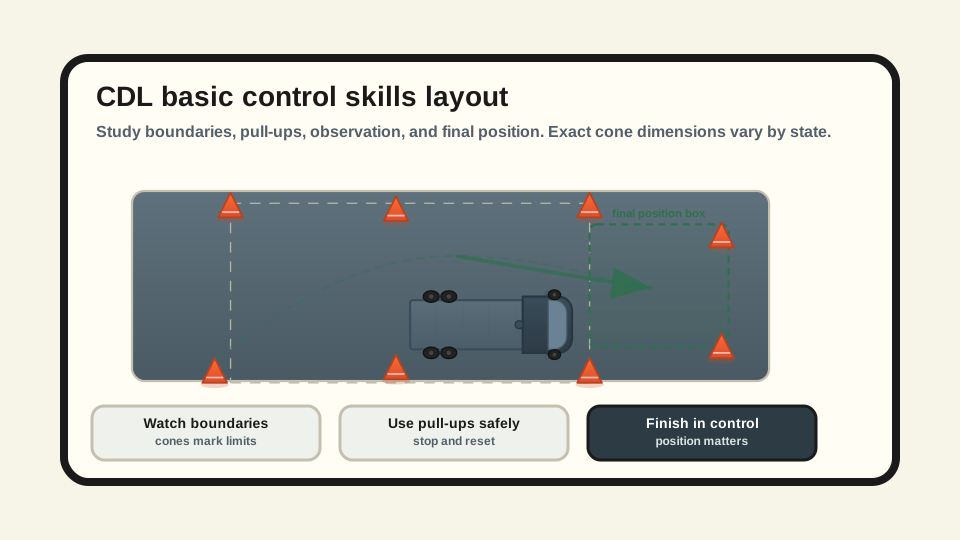
Learners often search for cone spacing before they understand what the cones represent. On a skills test, cones are clearance markers for the tractor, trailer wheels, and final stopping box. Exact spacing varies by state and maneuver, so do not memorize one national diagram. Instead, study how much room you need to correct, where a legal pull-up is allowed, and when an encroachment means you crossed a real boundary. Use the cone layout diagram as a study map, then confirm the current state layout with your testing office.
Do not memorize cones without purpose
A cone is a testing marker for real-world clearance. Study what each boundary represents: trailer path, rear swing, lane position, or final stopping point.
Score sheets reward safe correction
A rushed correction can create a worse position. Skills-test study should make pull-ups, stops, mirror checks, and slow steering feel normal instead of desperate.
Verify the current state layout
Use this page for study concepts, then check the current state handbook, examiner instructions, or testing location details before test day.
Class A learners should picture the trailer path
For Class A skills practice, the important question is where the trailer wheels and rear of the trailer are going, not only where the tractor is pointed.
Diagrams
Visual study aids.
Use these diagrams to understand the space, parts, or scoring terms behind the study topic.
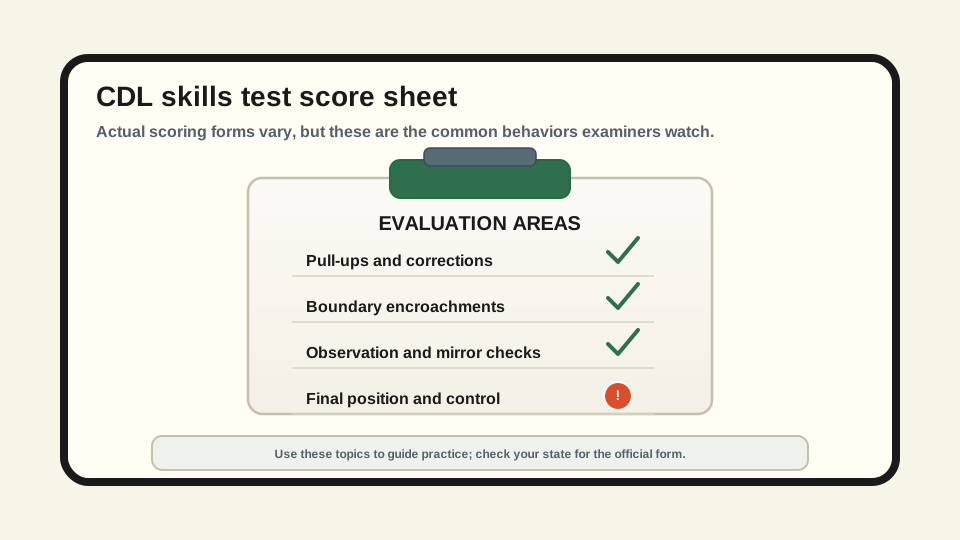
CDL skills test cone layout and spacingUse the layout to study cone spacing, trailer path, boundaries, and why slow correction matters.CDL skills test score sheetUse the score sheet diagram to understand what the examiner is measuring before test day.
Quick answers
Answers before you practice.
Short answers for the common CDL questions on this topic.
01
What is CDL cone spacing?
Cone spacing is the distance between boundary cones on a skills-test layout. Cones mark clearance limits for the tractor, trailer path, and final position. Spacing is state-controlled, but the study goal is the same: stay inside boundaries, stop when the picture is unclear, and use legal pull-ups instead of guessing.
Is the CDL skills test cone layout the same in every state?
No. CDL skills concepts are similar, but the exact layout, scoring details, vehicle setup, and appointment process are controlled by the state testing agency or official examiner process.
A score sheet usually tracks whether you control the vehicle safely, stay inside boundaries, use pull-ups and corrections correctly, observe traffic or surroundings, and finish the maneuver in the required position.
An encroachment is when part of the vehicle crosses or touches a boundary such as a cone, line, or marked limit. Treat it as a clearance and control problem, not just a test penalty.
05
How should I practice a cone layout?
Practice slowly, stop when the picture is unclear, check mirrors and reference points, use legal pull-ups when needed, and review why the vehicle drifted before repeating the maneuver.
06
What is on the CDL basic control skills test?
Basic control usually focuses on controlled backing and maneuvering, boundary awareness, pull-ups, encroachments, mirror use, and safe corrections. States control the exact maneuvers and scoring.
Class A learners often need to think about trailer path, off-tracking, and rear swing, but the exact test layout and scoring are state-controlled. Study the concept first, then verify your state layout.
Common mistakes are rushing, failing to stop and check, late mirror use, oversteering, losing track of the trailer path, and treating a cone boundary as only a penalty instead of a clearance warning.
Study focusApply safe on-road habits for turns, intersections, lane changes, speed, and traffic checks.
Common trapTreating the road test as route memory instead of continuous observation, communication, and control.
Question 6
During an on-road test, why is speed management judged continuously?
Safe commercial driving depends on speed for conditions, not only speed limits. The examiner watches whether the driver adjusts to real road conditions.
Source focusCDL Manual - On-Road Driving Test: speed and traffic
Study focusApply safe on-road habits for turns, intersections, lane changes, speed, and traffic checks.
Common trapTreating the road test as route memory instead of continuous observation, communication, and control.
Question 7
What should a driver do at intersections during the on-road test?
Intersections test scanning, lane control, signs, signals, and safe gap judgment. Commercial vehicles need early observation and controlled movement.
Study focusApply safe on-road habits for turns, intersections, lane changes, speed, and traffic checks.
Common trapTreating the road test as route memory instead of continuous observation, communication, and control.
Question 9
What is a safe study approach for basic control skills?
The skills test checks real vehicle control. Slow practice, mirror use, stopping when uncertain, and boundary awareness build safer habits.
Source focusCDL Manual - Basic Vehicle Control Skills Test
Study focusUse safe backing, turning, and basic-control habits.
Common trapBacking without a helper or failing to stop when visibility is uncertain.
Question 10
What does good road-test communication include?
Communication is more than signals. Lane position, speed changes, brake timing, and mirror use all help other road users understand a large vehicle's movement.
Source focusCDL Manual - On-Road Driving Test: traffic communication
Study focusApply safe on-road habits for turns, intersections, lane changes, speed, and traffic checks.
Common trapTreating the road test as route memory instead of continuous observation, communication, and control.
Question 11
A mirror is loose and will not stay adjusted. Why is this unsafe?
Mirrors are essential for scanning, lane changes, turns, and backing. A loose mirror can leave the driver without reliable visibility.
Source focusFMCSA CDL Manual - Vehicle Inspection: mirrors and visibility
A loose mirror does not usually prevent starting.
Air compressor behavior is unrelated.
Tire pressure is unrelated.
Study focusRecognize mirror defects that affect safe driving.
Common trapTreating mirror movement as a comfort issue instead of a visibility issue.
Question 12
A windshield wiper blade is missing before a trip that may include rain. What is the safest decision?
Wipers support visibility when weather changes. A missing blade can make driving unsafe in rain or spray.
Source focusFMCSA CDL Manual - Vehicle Inspection: windshield and wipers
Study focusIdentify visibility equipment defects before driving.
Common trapJudging visibility only by current weather at the yard.
Question 13
What is the concern with a cracked windshield in the driver's view?
Windshield condition matters because the driver must see clearly. Cracks in the driver's view can become a safety issue.
Study focusInspect cab communication equipment before driving.
Common trapThinking cab checks are less important than exterior checks.
Question 16
When backing a commercial vehicle, which of the following is the most important safety rule?
Because of blind spots, you cannot see everything behind you. Using a helper is the most important safety rule for backing. Always agree on a hand signal for 'stop' before you begin.
Study focusUse safe backing, turning, and basic-control habits.
Common trapBacking without a helper or failing to stop when visibility is uncertain.
Question 17
When driving a commercial vehicle, how should you adjust your speed for driving at night?
At night, your visibility is limited to the reach of your headlights. You must adjust your speed so you can safely stop within that visible distance.
Study focusUse inspection habits to catch unsafe defects before driving.
Common trapChecking only obvious items and missing brake, tire, coupling, or defect-report steps.
Question 18
What is the most important reason for inspecting your vehicle?
While avoiding fines is good, safety is the primary reason for inspections. A defect found during an inspection can prevent a breakdown or fatal crash.
Study focusUse inspection habits to catch unsafe defects before driving.
Common trapChecking only obvious items and missing brake, tire, coupling, or defect-report steps.