Class B

CDL Class B Practice Test

Under FMCSA 49 CFR Part 383 testing standards, state CDL written subtests enforce an 80% minimum passing cutoff. Benchmark your readiness on CDL Class B Practice Test using 6 instant-feedback questions grounded in the FMCSA CDL Manual, eliminate recurring distractor traps, and advance to full 20-question sets.

Last updated:

Federal 49 CFR § 383.91 Class B vehicle definition and subtests

Under FMCSA 49 CFR § 383.91(a)(2), a Class B CDL covers any single vehicle with a GVWR of 26,001 pounds or more—or any such vehicle towing a trailer not exceeding 10,000 pounds GVWR—with each written subtest graded at an 80% minimum cutoff.

  • General Knowledge core written exam (50 questions; minimum 40 correct)
  • Air Brakes written exam (25 questions; 20 correct) unless restricted to hydraulic-brake trucks (L restriction)
  • Passenger (P) and School Bus (S) endorsement exams for transit coaches, charter motor coaches, and yellow school buses
  • Tank (N) and HazMat (H) endorsement modules for fuel-delivery straight trucks, vacuum trucks, and propane bobtails
  • Three-part Class B skills test in a representative straight truck or bus (no fifth-wheel tractor-trailer coupling)
How to study this topic

Rear overhang tail-swing vs. Class A trailer off-tracking

Straight trucks and 40-foot transit buses pivot differently than articulated semis. Long rear overhang behind the drive axle swings outward up to three feet into the adjacent lane during sharp turns; check your off-side flat and convex mirrors before turning, so the tail never clips parked cars or pedestrians.

Air-brake cutoffs and pre-trip automatic fail items

Most Class B dump trucks and buses run full dual air brakes. Know the non-negotiable numbers cold: governor cut-in around 100 psi and cut-out between 120–140 psi, low-air warning before 55–60 psi, spring brakes popping at 20–45 psi, applied single-vehicle leakage capped at 3 psi per minute, and 4/32-inch minimum steer-tire tread.

Liquid surge in bobtail tankers and standee-line bus rules

Smooth-bore or partially full Class B water, milk, and fuel straight trucks slam forward after you stop, shoving the truck into intersections. On passenger and school buses, enforce the 2-inch white standee line behind the driver seat, keep stepwells completely clear, and stop 15–50 feet before railroad crossings.

Quick answers

Answers before you practice.

Short answers for the common CDL questions on this topic.

01

What is the minimum age to hold a Class B CDL?

Federal law sets age 21 for interstate commerce across state lines or hauling placarded materials, while states issue intrastate-only Class B CDLs at age 18 with a K intrastate restriction.

Read the CDL licensing path
02

Can I upgrade from Class B to Class A later without starting over?

You keep your existing core record, complete the FMCSA Class A Upgrade ELDT curriculum, pass the Combination Vehicles written test, and take the skills exam in a tractor-trailer.

Study combination vehicles
03

What triggers an E, L, or Z restriction during road testing?

Testing in an automatic-transmission rig places an E manual-gearbox restriction on your card, while hydraulic or air-over-hydraulic test vehicles add an L or Z air-brake restriction.

Review air brake rules
04

Which municipal and delivery careers rely on this license?

Tri-axle dump trucks, ready-mix concrete barrels, roll-off waste haulers, city transit fleets, airport shuttles, and utility bucket trucks operate under single-frame commercial licensing.

Compare Class A thresholds
Study Mode Sample Questions (6 Questions)

Showing 6 study-mode sample questions here so you can check concepts immediately. Take full 20-question sets on the practice hub or try the 50-question timed simulator next.

Study examples
CDL Class B Practice Test
Answered 0 / 6
Study Mode · Instant feedback
A–D / 1–4 choose · F flag · N/P jump
Question 1

When backing a commercial vehicle, which of the following is the most important safety rule?

Question 2

How far ahead should you be looking while driving a commercial vehicle at highway speeds?

Question 3

What is the minimum tread depth required for the front steering tires of a commercial vehicle?

Question 4

When is it appropriate to use your high beams?

Question 5

What is the purpose of a pre-trip inspection?

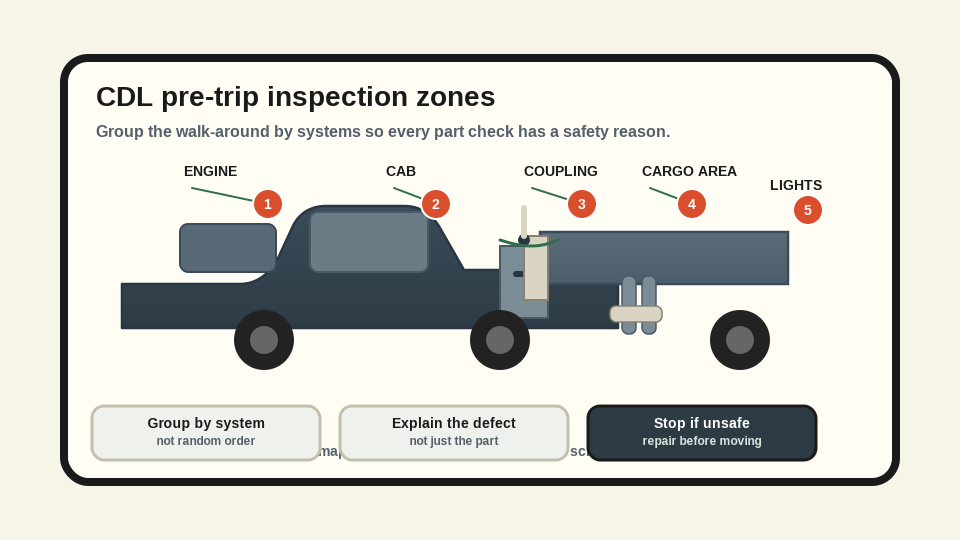
Pre-trip inspection diagram showing engine, brakes, lights, tires, and coupling zones.
Pre-trip inspection zones
Question 6

What is the recommended following distance for a heavy vehicle traveling at 55 mph in ideal conditions?

Submit your exam?

Diagram

Scroll horizontally or pinch to zoom & read labels.