Topic

CDL Air Brakes

Under FMCSA 49 CFR Part 383 testing standards, state CDL written subtests enforce an 80% minimum passing cutoff. Benchmark your readiness on CDL Air Brakes using 6 instant-feedback questions grounded in the FMCSA CDL Manual, eliminate recurring distractor traps, and advance to full 20-question sets.

Last updated:

CDL Manual Section 5 Air Brakes numbers and components

Air Brakes is a threshold-heavy exam (typically 25 questions, 20 correct to pass)—memorize exact psi thresholds and single vs. combination leakage limits before testing.

  • Air compressor governor: cuts in around 100 psi and cuts out between 120 and 140 psi (125 psi typical)
  • Safety relief valve in first wet tank: pops open at 150 psi if the governor fails
  • Low air pressure warning buzzer/light: must activate before tank pressure drops below 55–60 psi
  • Tractor protection valve & spring parking brakes: engage automatically between 20 and 45 psi
  • Static vs. applied leak-down caps: 2 / 3 psi per minute (single) vs. 3 / 4 psi per minute (combination)
How to study this topic

Exact cab air-brake test sequence (LAB / 4-step check)

Examiners fail candidates on cab brake checks more than any other Pre-Trip step. Chock wheels first, build full governor cut-out (120–140 psi), shut engine off with key ON, release parking valves, hold 90+ psi foot pressure for 60 seconds (max 3 psi single / 4 psi combination loss), fan brakes to verify warning at >= 60 psi, and continue fanning until spring valves pop out between 20 and 45 psi.

Dual air systems vs. emergency spring-brake physics

Spring brakes are NOT applied by air pressure—powerful mechanical springs clamp the rear brakes, and 60+ psi of air pressure holds those springs OFF while driving. If both primary and secondary circuits leak away, the springs slam on automatically; never drive a rig whose spring brakes are caged with release bolts.

Stab vs. controlled braking and front-wheel limiting valves

On non-ABS rigs, controlled braking applies steady pressure just short of lockup, while stab braking locks wheels briefly, releases until tires roll, and reapplies. On older trucks equipped with a front-axle limiting valve, keep the control in “Normal”—cutting front braking power in half on ice actually worsens stopping and steering.

Diagrams

Visual study aids.

Use these diagrams to understand the space, parts, or scoring terms behind the study topic.

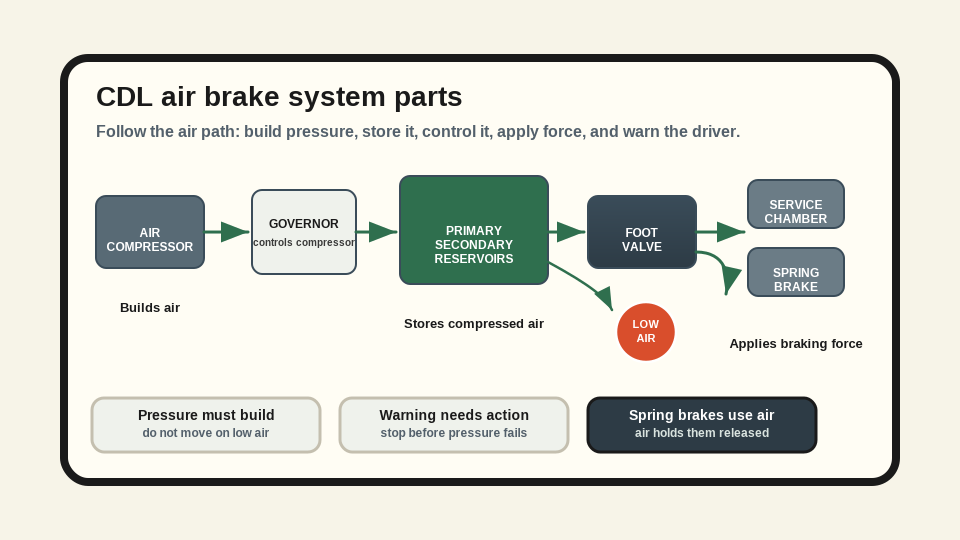
Air brake schematic with compressor, tanks, valve, brake chamber, and low air warning.
CDL air brake system diagram Use the diagram to connect air brake parts, pressure behavior, warnings, and safe responses.
Quick answers

Answers before you practice.

Short answers for the common CDL questions on this topic.

01

Why must air storage tanks be drained regularly?

Compressed air carries moisture and compressor oil that collect at the bottom of air tanks; in freezing weather, undrained water turns to ice and blocks valves or brake lines.

Study air brake components
02

What is the maximum pushrod stroke on manual slack adjusters?

On standard long-stroke/clamp chambers, pushrod travel beyond the legal adjustment limit (typically more than 1 inch of free play by hand with spring brakes released and wheels chocked) signals out-of-adjustment brakes.

Review brake pre-trip checks
03

Why does air brake lag add ~32 feet at 55 mph?

Compressed air takes roughly 0.4 to 0.5 seconds to flow through lines from the foot valve to rear brake chambers after your boot hits the pedal—adding ~32–35 feet at highway speed before shoes even touch drums.

Take Air Brakes Test 1
Study Mode Sample Questions (6 Questions)

Showing 6 study-mode sample questions here so you can check concepts immediately. Take full 20-question sets on the practice hub or try the 50-question timed simulator next.

Study examples
CDL Air Brakes
Answered 0 / 6
Study Mode · Instant feedback
A–D / 1–4 choose · F flag · N/P jump
Question 1

What is the purpose of the air compressor in an air brake system?

Focused air brake diagram showing an engine-driven air compressor unit and governor connected to an unlabeled system outlet.
Air compressor unit and governor
Question 2

When must the low air pressure warning signal come on during an air brake check?

Question 3

What are spring brakes?

Question 4

How do you test the static air leakage rate on a combination vehicle with air brakes?

Question 5

During an applied air leakage rate test, what is the maximum allowable pressure loss for a combination vehicle?

Question 6

What does the air compressor governor control?

Submit your exam?

Diagram

Scroll horizontally or pinch to zoom & read labels.