CDL guide

Commercial Driver's License Guide

Under FMCSA 49 CFR Part 383 testing standards, state CDL written subtests enforce an 80% minimum passing cutoff. Benchmark your readiness on Commercial Driver's License Guide using 6 instant-feedback questions grounded in the FMCSA How do I get a CDL?, eliminate recurring distractor traps, and advance to full 20-question sets.

Last updated:

Federal 49 CFR Part 383 national CDL framework

Created under the Commercial Motor Vehicle Safety Act and governed by FMCSA 49 CFR Part 383, a Commercial Driver’s License (CDL) enforces one nationwide safety baseline administered by your home State Driver Licensing Agency.

  • Single-License Mandate (49 CFR § 383.21): One driver, one license, and one national CDLIS record across all 50 states and D.C.
  • Domicile Issuance: Initial Commercial Learner’s Permits (CLPs) and full CDLs are issued strictly by your state of legal residence
  • Interstate vs. Intrastate Scope: Age 21+ required for interstate commerce or HazMat; age 18–20 restricted to in-state K-code routes
  • Mandatory Registry Screening: FMCSA Drug & Alcohol Clearinghouse, Problem Driver Pointer System (PDPS), and NRCME medical linkage
  • Standardized AAMVA Testing: 80% minimum written subtest threshold plus a three-stage practical exam in a representative vehicle
How to study this topic

Class A vs. Class B vs. Class C federal weight cutoffs (49 CFR § 383.91)

Memorize the three federal thresholds exact to the pound: Class A covers combination vehicles with a GCWR of 26,001+ lbs when the towed unit exceeds 10,000 lbs GVWR; Class B covers single vehicles of 26,001+ lbs GVWR (or towing <= 10,000 lbs); Class C covers vehicles under 26,001 lbs designed to transport 16+ passengers (including the driver) or placarded Hazardous Materials.

Endorsement letters (H, N, P, S, T, X) vs. restriction codes (E, L, O, Z)

Endorsements expand what you can haul: T (Doubles/Triples), N (Tank >= 1,000 gallons aggregate), P (Passenger), S (School Bus), H (HazMat), and X (Combined Tank + HazMat). Restrictions limit your rig if you skip a test step: E bars manual transmissions, L bars air brakes, Z bars full air brakes when tested in air-over-hydraulic, and O bars fifth-wheel tractor-trailers on Class A.

Written CLP testing vs. ELDT vs. three-part skills sequence

Every first-time applicant follows a four-gate federal pipeline: pass the 80%-cutoff written CLP exams at your state DMV, log theory and behind-the-wheel proficiency with an FMCSA Training Provider Registry school, hold the CLP at least 14 days, and pass Pre-Trip, Basic Control, and Road testing in a representative vehicle.

Quick answers

Answers before you practice.

Short answers for the common CDL questions on this topic.

01

Are fire trucks, farm tractors, and personal motorhomes exempt?

Active-duty military tactical vehicles, emergency fire/rescue apparatus, covered farm vehicles within statutory mileage radii, and private recreational RVs not hauling for hire are generally exempt from federal commercial licensing.

Compare non-CDL exemptions
02

Are Canadian National Safety Code and Mexican federal commercial licenses recognized?

Yes. Under bilateral FMCSA reciprocity agreements (49 CFR § 383.23), properly classed Canadian provincial commercial credentials and Mexican federal commercial licenses are valid for cross-border freight without obtaining a separate U.S. state card.

Read U.S. licensing steps
03

How often do plastic commercial cards and TSA HazMat clearances renew?

Most states renew plastic CDL credentials on a 4- to 8-year cycle, whereas Hazardous Materials (H or X) holders must pass a fresh TSA fingerprint threat assessment and written HazMat retest at renewal.

Study HazMat renewal rules
Study Mode Sample Questions (6 Questions)

Showing 6 study-mode sample questions here so you can check concepts immediately. Take full 20-question sets on the practice hub or try the 50-question timed simulator next.

Study examples
Commercial Driver's License Guide
Answered 0 / 6
Study Mode · Instant feedback
A–D / 1–4 choose · F flag · N/P jump
Question 1

Before starting a CDL road trip, what should a driver do first?

Question 2

When road conditions become wet, what is the safest driving adjustment?

Question 3

How far ahead should you be looking while driving a commercial vehicle at highway speeds?

Question 4

What is the minimum tread depth required for the front steering tires of a commercial vehicle?

Question 5

When is it appropriate to use your high beams?

Question 6

What is the purpose of a pre-trip inspection?

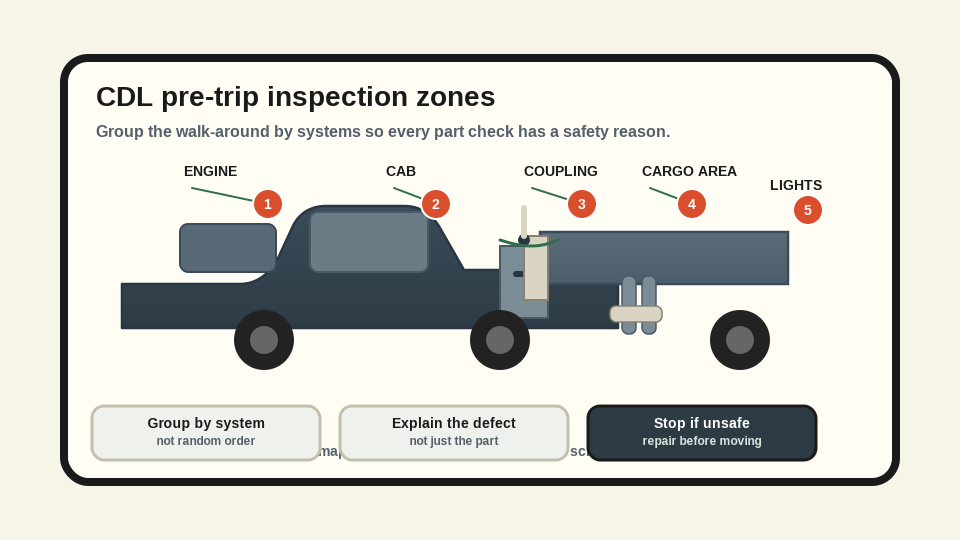
Pre-trip inspection diagram showing engine, brakes, lights, tires, and coupling zones.
Pre-trip inspection zones

Submit your exam?

Diagram

Scroll horizontally or pinch to zoom & read labels.