Signs

CDL Road Signs and Safety Equipment Test

Under FMCSA 49 CFR Part 383 testing standards, state CDL written subtests enforce an 80% minimum passing cutoff. Benchmark your readiness on CDL Road Signs and Safety Equipment Test using 6 instant-feedback questions grounded in the FMCSA CDL Manual, eliminate recurring distractor traps, and advance to full 20-question sets.

Last updated:

Federal 49 CFR § 392.22, § 393.95 & MUTCD scope

Commercial sign and safety-equipment questions combine MUTCD highway sign classification with federal cab equipment and scene-protection mandates under 49 CFR § 392.22 and § 393.95.

  • MUTCD Warning & Regulatory Signs: Bridge clearance heights, steep downgrade percentages, advisory ramp speeds, and truck lane bans
  • 49 CFR § 393.95 Cab Emergency Gear: UL-rated fire extinguishers, three bidirectional warning triangles, and spare electrical fuses
  • 49 CFR § 392.22 Hazard Activation: Immediate four-way flashers followed by roadside warning placement within 10 minutes
  • Flame Prohibition Rules: Zero fusees, liquid-burning pot torches, or open-flame flares near leaking fuel or explosive/flammable loads
  • In-Cab Warning Devices: Mechanical wig-wag arms, audible buzzers, and dash pressure gauges tied to primary and secondary air tanks
How to study this topic

Exact triangle distances: divided highway vs. two-lane vs. blind curve

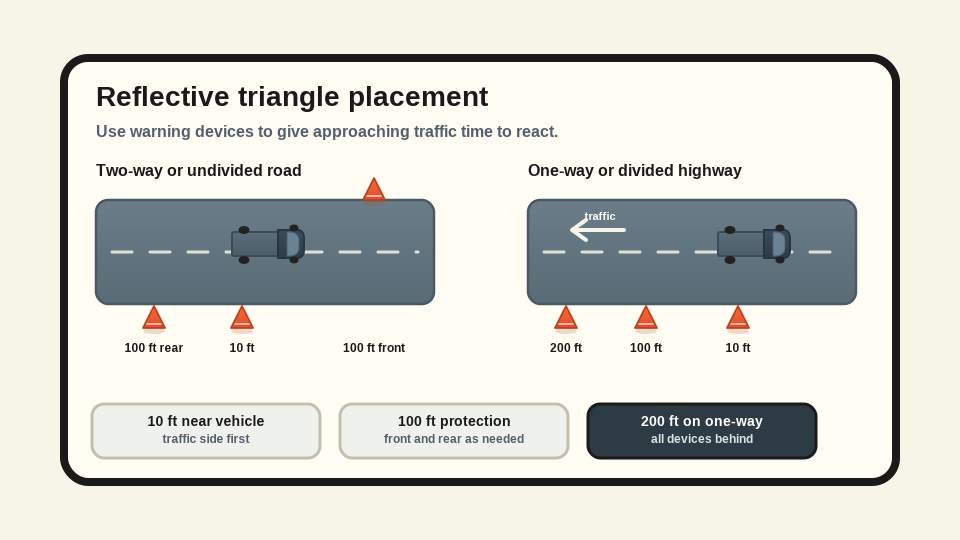
Test writers swap triangle numbers constantly. On a divided highway or one-way road, set all three triangles behind the rig at 10 feet, 100 feet, and 200 feet toward approaching traffic. On an undivided two-lane road, place them 100 feet in front, 10 feet behind, and 100 feet behind. If stopped within 500 feet of a hillcrest or curve, walk the rear triangle back 100 to 500 feet for unobstructed sightline.

MUTCD color and shape codes at highway speed

Yellow diamonds warn of permanent physical hazards (W12-2 low clearance, W7-1 percent grade, W10-1 railroad advance); fluorescent orange diamonds govern temporary work zones and flaggers; white rectangles enforce binding legal limits (weight caps, lane bans, speed maximums). Downshift or change lanes BEFORE passing the sign, never inside the hazard.

Cab emergency kit inspection checkpoints

During your Pre-Trip cab check, state all three required emergency items under 49 CFR § 393.95: three red reflective triangles in a latched box, a properly charged and pinned UL-rated fire extinguisher (gauge in the green), and spare electrical fuses unless every circuit uses resettable breakers.

Diagrams

Visual study aids.

Use these diagrams to understand the space, parts, or scoring terms behind the study topic.

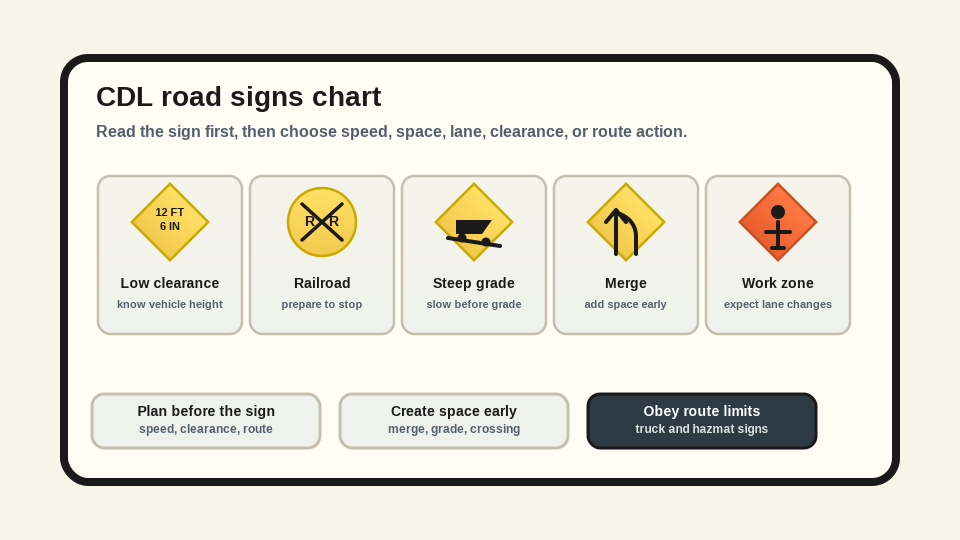
CDL road signs chart with clearance, grade, railroad, merge, work zone, and route signs.
CDL road signs chart Read signs as early driving decisions: slow down, add space, check clearance, choose a lane, or change route.
CDL reflective triangles placement diagram around a stopped commercial vehicle.
CDL reflective triangles placement diagram Warning devices give approaching traffic time to see and react to a stopped commercial vehicle.
Quick answers

Answers before you practice.

Short answers for the common CDL questions on this topic.

01

How soon must reflective triangles be placed under 49 CFR § 392.22?

Activate four-way hazard flashers immediately upon stopping, and place your three bidirectional reflective warning triangles within 10 minutes on the roadway shoulder.

Open 49 CFR Part 392
02

What is a wig wag in older CDL air-brake questions?

A mechanical wig wag is an arm that drops into the driver’s view when air tank pressure falls below roughly 55–60 psi, serving the same mandatory warning role as modern audible buzzers and red dash lamps.

Review air brake warnings
03

What fire extinguisher rating is required on commercial trucks?

Under 49 CFR § 393.95, standard non-HazMat commercial motor vehicles must carry at least one securely mounted, charged 5 B:C (or two 4 B:C) UL-rated fire extinguisher, while placarded HazMat vehicles require at least a 10 B:C rating.

Study pre-trip emergency gear
04

Do CDL road-test examiners ask about road signs AFTER you pass them?

Yes. During the On-Road Driving skills exam, examiners routinely wait until after you cross a bridge or overpass and ask you to state the posted clearance height or weight limit you just passed.

Study on-road test habits
Study Mode Sample Questions (6 Questions)

Showing 6 study-mode sample questions here so you can check concepts immediately. Take full 20-question sets on the practice hub or try the 50-question timed simulator next.

Study examples
CDL Road Signs and Safety Equipment Test
Answered 0 / 6
Study Mode · Instant feedback
A–D / 1–4 choose · F flag · N/P jump
Question 1

What does this orange diamond work-zone sign warn a CDL driver to expect ahead?

Orange diamond work zone flagger ahead warning sign.
Work zone flagger warning
Question 2

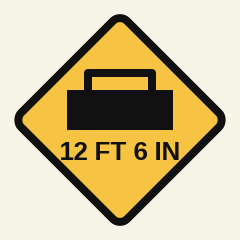
What should a CDL driver do when approaching this low-clearance sign?

Low clearance warning sign showing 12 feet 6 inches.
Low clearance warning
Question 3

What does this railroad crossing advance warning sign tell a CDL driver to prepare for?

Yellow railroad crossing advance warning sign.
Railroad crossing advance warning
Question 4

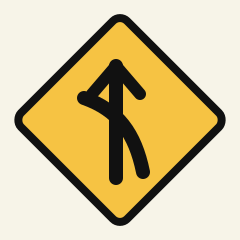
What is the safest CDL response to this merge warning sign?

Yellow merge warning sign showing traffic entering the lane.
Merge warning
Question 5

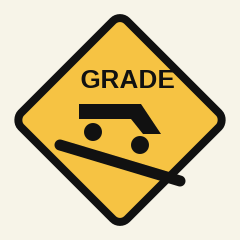
What should a CDL driver do before entering the steep grade shown by this sign?

Yellow steep grade warning sign showing a truck descending a hill.
Steep grade warning
Question 6

How far ahead should you be looking while driving a commercial vehicle at highway speeds?

Submit your exam?

Diagram

Scroll horizontally or pinch to zoom & read labels.