Study CDL alcohol limit rules, alcohol concentration wording, out-of-service concepts, driver fitness, and safe answer patterns for CDL questions.
Where this page fits
Core CDL knowledge: CDL Alcohol Limit for Drivers
This page is one checkpoint inside the CDL study guide. Use the map to move between the full outline, topic notes, practice questions, and focused weak-area review.
Treat alcohol questions as driver-fitness and public-safety questions.
Do not borrow passenger-car assumptions for commercial vehicle operation.
Use federal and state sources for current rule and enforcement details.
CDL alcohol questions test more than a number. They ask whether the driver is fit to operate, whether alcohol use creates a violation or unsafe condition, and what a safe commercial driver should do before driving.
Alcohol concentration wording and why commercial driving has stricter safety expectations
Out-of-service and do-not-drive concepts after alcohol use or unsafe driver condition
Question traps around personal vehicle habits versus commercial motor vehicle operation
Driver fitness, fatigue, drugs, and alcohol as part of general knowledge study
Official federal and state sources control current rule language and enforcement details
How to study this topic
Do not study only the number
Alcohol-limit questions usually test the safety decision: do not drive, report as required, follow out-of-service instructions, and protect the public before schedule or convenience.
Separate CDL operation from personal assumptions
Wrong answers often borrow passenger-car habits. CDL practice should treat commercial vehicle operation as a stricter safety environment with official rules and employer policies.
Use official sources for current rules
Because alcohol, testing, out-of-service, and disqualification rules are high-stakes, use this page for study framing and official federal or state sources for current legal details.
Quick answers
Answers before you practice.
Short answers for the search questions behind this CDL page.
01
What is the alcohol limit for CDL drivers?
Federal commercial-driver rules use a stricter alcohol standard than ordinary passenger driving. Many CDL study questions focus on 0.04 alcohol concentration for commercial motor vehicle operation, but drivers should verify current rules through official federal and state sources.
A commercial driver should not operate when alcohol use, alcohol concentration, medication, fatigue, or any condition makes driving unsafe or prohibited. CDL questions usually reward the answer that keeps the driver out of service until legal and safe.
Commercial vehicles are larger, heavier, and harder to stop. Alcohol can reduce judgment, reaction time, attention, and control, so CDL study treats any impaired condition as a serious safety problem.
04
Do alcohol rules change by state?
Federal rules set key commercial-driver requirements, and states may control licensing, enforcement, penalties, and process details. Check both federal sources and your state CDL agency for current requirements.
Practice questions
CDL Alcohol Limit for Drivers Quiz
Answered 0 / 14
Question 1
How far ahead should you be looking while driving a commercial vehicle at highway speeds?
Good drivers look 12 to 15 seconds ahead. At highway speeds, this is about a quarter of a mile. This gives you time to adjust speed or change lanes to avoid hazards.
Study focusChoose safe speed, spacing, and visual search habits for commercial vehicles.
Common trapDriving at passenger-car speeds without accounting for weight, space, weather, or grade.
Question 2
When is it appropriate to use your high beams?
Use high beams whenever you can to see further ahead, provided it is safe and legal. You must dim them when within 500 feet of an oncoming vehicle or when following another vehicle within 500 feet.
Study focusApply core CDL safe-driving rules to common road and vehicle situations.
Common trapMemorizing rules without applying them to driving scenarios.
Question 3
Which of the following statements about drinking alcohol and driving is true?
Alcohol first affects judgment and self-control. For commercial drivers, it is illegal to operate a CMV with a BAC of 0.04% or higher, not 0.08%.
Study focusUnderstand state-specific CDL requirements, handbook notes, and licensing context.
Common trapUsing generic CDL knowledge without checking state-specific requirements.
Question 4
Why should you avoid using the engine brake (Jake brake) on wet or icy roads?
Engine retarders (Jake brakes) apply strong braking force to the drive wheels only. On slippery surfaces, this sudden braking force can cause the drive wheels to lose traction, leading to a dangerous skid.
Study focusRespond safely to hazards, emergencies, traction loss, and unsafe conditions.
Common trapReacting late or using sudden braking/steering when controlled action is safer.
Question 5
What is the recommended following distance for a heavy vehicle traveling at 55 mph in ideal conditions?
The rule of thumb is 1 second of following distance for every 10 feet of vehicle length at speeds under 40 mph. For speeds over 40 mph, add 1 additional second. A 60-foot truck at 55 mph needs 7 seconds of space.
Study focusChoose safe speed, spacing, and visual search habits for commercial vehicles.
Common trapDriving at passenger-car speeds without accounting for weight, space, weather, or grade.
Question 6
Which of these is a sign of distracted driving?
Eating, using a phone, or reading while driving are major physical and cognitive distractions that take your eyes, hands, and mind away from the critical task of driving.
Study focusRespond safely to hazards, emergencies, traction loss, and unsafe conditions.
Common trapReacting late or using sudden braking/steering when controlled action is safer.
Question 7
What should you do if you are being tailgated?
If you are being tailgated, increase the space in front of your vehicle. This allows you to brake more smoothly and gradually, reducing the chance that the tailgater will crash into your rear.
Study focusChoose safe speed, spacing, and visual search habits for commercial vehicles.
Common trapDriving at passenger-car speeds without accounting for weight, space, weather, or grade.
Question 8
When approaching a curve, what is the best way to handle your speed?
You should brake to a safe speed before entering a curve. Once in the curve, maintain speed or accelerate slightly, as this helps stabilize the vehicle. Never brake hard in a curve.
Study focusChoose safe speed, spacing, and visual search habits for commercial vehicles.
Common trapDriving at passenger-car speeds without accounting for weight, space, weather, or grade.
Question 9
What must you do when placing warning devices (triangles) on a two-lane road with traffic in both directions?
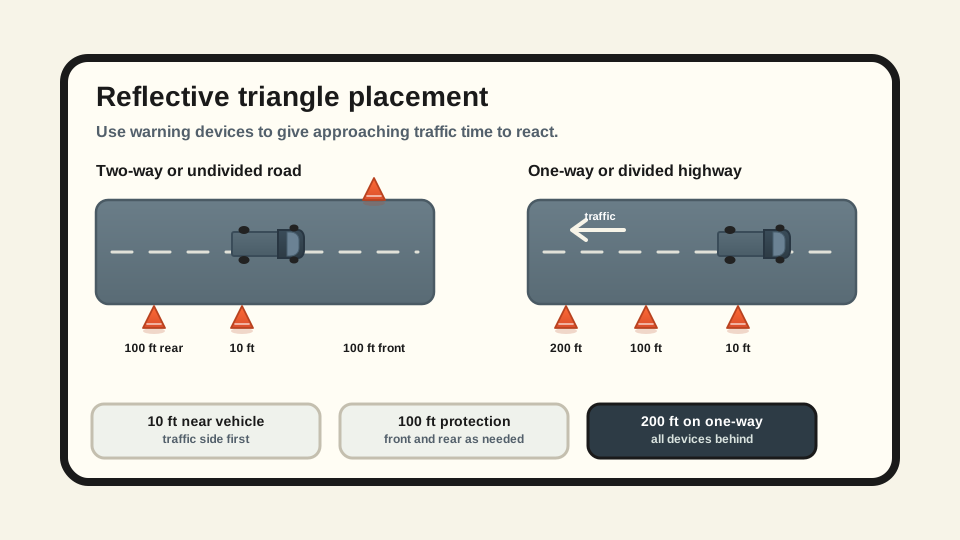
On a two-lane road carrying traffic in both directions, place warning devices within 10 feet of the front or rear corners, about 100 feet behind, and about 100 feet ahead of the vehicle.
Study focusRespond safely to hazards, emergencies, traction loss, and unsafe conditions.
Common trapReacting late or using sudden braking/steering when controlled action is safer.
Question 10
If you must pull over to the shoulder on a highway, how quickly must you place your warning devices?
Federal regulations require that emergency warning devices (like reflective triangles) be placed within 10 minutes of stopping on the shoulder or traveled portion of the road.
Study focusRespond safely to hazards, emergencies, traction loss, and unsafe conditions.
Common trapReacting late or using sudden braking/steering when controlled action is safer.
Question 11
What should you do if your vehicle begins to hydroplane?
To recover from hydroplaning, release the accelerator and push in the clutch. Do not use the brakes, as this can cause the wheels to lock and result in a skid.
Study focusRespond safely to hazards, emergencies, traction loss, and unsafe conditions.
Common trapReacting late or using sudden braking/steering when controlled action is safer.
Question 12
Which of these statements about managing space is true?
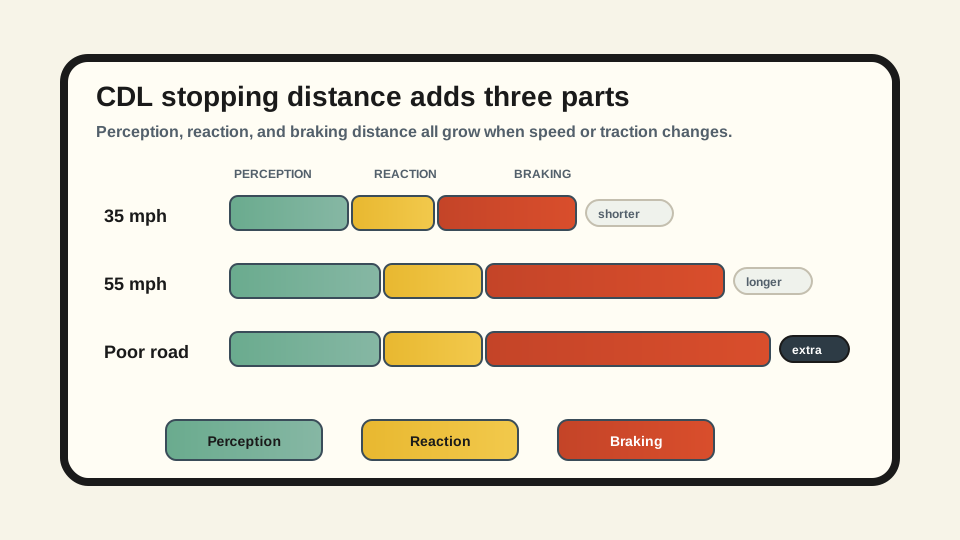
Following too closely (tailgating) severely reduces your reaction time and stopping distance, making it a leading cause of crashes.
Study focusUnderstand state-specific CDL requirements, handbook notes, and licensing context.
Common trapUsing generic CDL knowledge without checking state-specific requirements.
Question 13
What is black ice?
Black ice is a thin layer of clear ice. Because it is clear, you can see the dark asphalt underneath, making the road appear wet rather than icy.
Study focusRespond safely to hazards, emergencies, traction loss, and unsafe conditions.
Common trapReacting late or using sudden braking/steering when controlled action is safer.
Question 14
When should you check your mirrors while driving?
You should check your mirrors regularly (about every 5 to 8 seconds) to be aware of traffic around you and to monitor your vehicle and trailer.
Study focusChoose safe speed, spacing, and visual search habits for commercial vehicles.
Common trapDriving at passenger-car speeds without accounting for weight, space, weather, or grade.