Study topic

CDL Basic Control and Shifting

Under FMCSA 49 CFR Part 383 testing standards, state CDL written subtests enforce an 80% minimum passing cutoff. Benchmark your readiness on CDL Basic Control and Shifting using 6 instant-feedback questions grounded in the FMCSA CDL Manual, eliminate recurring distractor traps, and advance to full 20-question sets.

Last updated:

FMCSA Section 2.2–2.3 shifting bans & backing rules

FMCSA CDL Manual Sections 2.2 and 2.3 test manual transmission control, coasting prohibitions, and sight-side backing discipline on heavy trucks.

  • Zero Coasting Mandate: Never coast with the gearshift in neutral or the clutch pedal held down—you forfeit engine braking and risk drivetrain damage
  • Mandatory No-Shift Zones: Complete downshifts BEFORE entering railroad tracks, intersections, curves, or steep mountain downgrades
  • Sight-Side Backing Priority: Always prefer driver-side (left-side) backing over blind-side (right-side) backing whenever yard layout permits
  • Helper Hand-Signal Pact: When using a ground spotter, agree first on the exact hand signal for “STOP” and halt immediately if you lose sight of them
  • Retarder / Jake Brake Caution: Switch engine/exhaust retarders OFF on wet, snowy, or icy pavement to prevent drive-wheel lockup and jackknifes
How to study this topic

How unsynchronized double-clutching keeps gears from grinding

Heavy commercial manual gearboxes omit passenger-car synchronizer rings. Upshifting follows a crisp rhythm: depress clutch to pull into neutral, release clutch briefly as engine RPM drops to match road speed, then depress clutch again to slide smoothly into the higher gear. Downshifting adds a throttle blip in neutral to raise RPM.

Hold the wheel at 9 and 3 o’clock—thumbs out of the spokes

Striking a deep pothole, curb lip, or steer-tire blowout whips a commercial steering wheel violently. Grip firmly on opposite rims with both hands so kicking wheel spokes cannot fracture your wrists or thumbs.

Back at idle speed and pull forward early to straighten drift

Every backing fender-bender happens because a rushed driver stayed in reverse trying to rescue a crooked trailer angle. Creep at idle without touching the throttle, steer small quarter-turns toward the mirror showing excess trailer, and pull forward straight ahead whenever your line drifts.

Study Mode Sample Questions (6 Questions)

Showing 6 study-mode sample questions here so you can check concepts immediately. Take full 20-question sets on the practice hub or try the 50-question timed simulator next.

Study examples
CDL Basic Control and Shifting
Answered 0 / 6
Study Mode · Instant feedback
A–D / 1–4 choose · F flag · N/P jump
Question 1

During a basic control exercise, what should you do if you are not sure where the rear of the vehicle is?

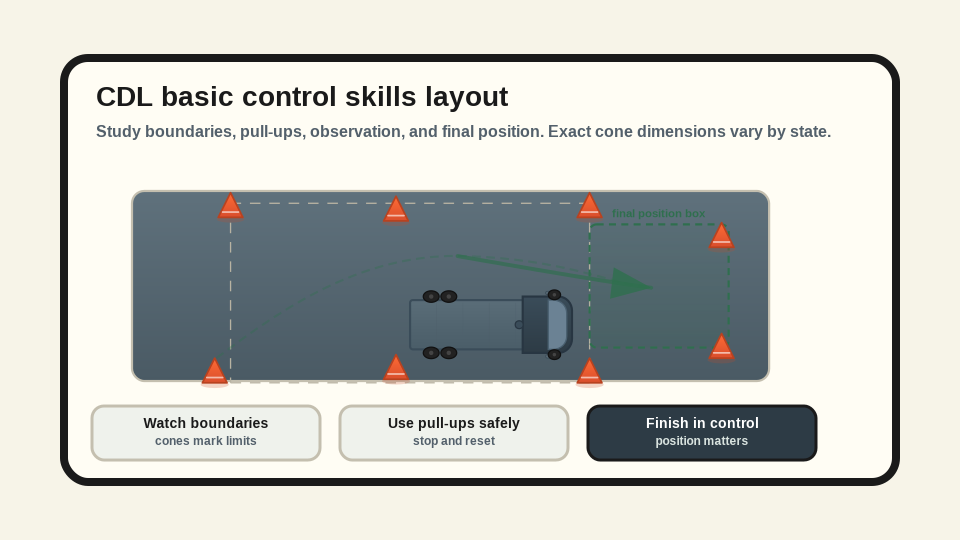
Top-down AAMVA CDL 90-degree alley dock cone layout with an articulated tractor-trailer backing into a coned dock alley.
90° alley dock cone layout and articulated rig
Question 2

What does a pull-up show during a backing or control exercise?

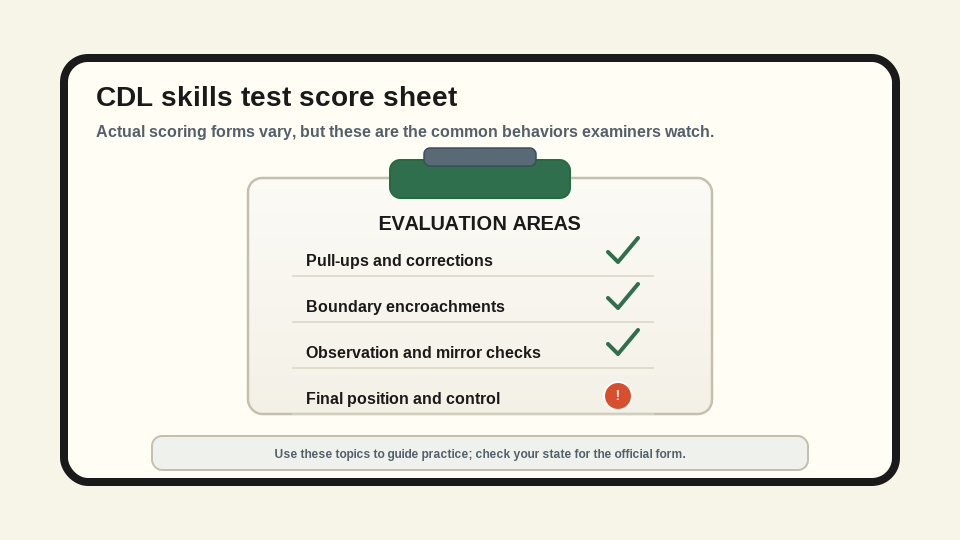
CDL score sheet diagram with pull-up, boundary, observation, and final-position checks.
Score sheet concepts
Question 3

Why are encroachments important during the basic control test?

Question 4

When preparing for the on-road test, what should a driver do before changing lanes?

Question 5

What is the safest habit before making a right turn with a large commercial vehicle?

Question 6

During an on-road test, why is speed management judged continuously?

Submit your exam?

Diagram

Scroll horizontally or pinch to zoom & read labels.