Study topic

CDL Coupling and Uncoupling

Under FMCSA 49 CFR Part 383 testing standards, state CDL written subtests enforce an 80% minimum passing cutoff. Benchmark your readiness on CDL Coupling and Uncoupling using 6 instant-feedback questions grounded in the FMCSA CDL Manual, eliminate recurring distractor traps, and advance to full 20-question sets.

Last updated:

FMCSA Section 6.4 step-by-step fifth-wheel coupling rules

FMCSA CDL Manual Section 6.4 enforces a strict mechanical coupling and uncoupling sequence across tractor air lines, fifth-wheel jaws, and trailer landing gear to prevent dropped highway loads.

  • Zero gap between apron and fifth wheel
  • Pre-Back Nose Height: Confirm the trailer apron sits slightly LOWER than the center of the tilted fifth-wheel plate, lifting the trailer slightly on contact
  • Gladhand Color Coding: Blue (or service-tagged) line carries variable foot-valve air; Red (or emergency-tagged) line supplies trailer reservoirs & spring brakes
  • Uncoupling Ground Support: Crank landing gear firmly onto solid ground without lifting the trailer off the fifth-wheel plate
  • Locking jaws closed around kingpin shank
How to study this topic

Deadly crossed-gladhand trap when hooking a fresh trailer

Accidentally swapping blue service and red emergency gladhands creates an invisible highway trap: pushing the red trailer dash valve IN sends constant air down the service line (locking trailer brakes solid—or worse, on older plumbing, leaving you with zero trailer service brakes and no emergency breakaway protection). Trace each hose from bulkhead to coupler.

Never trust a tug test without crawling underneath with a light

Ice, thick cold fifth-wheel grease, or a kingpin resting precariously atop the jaw edge can hold against a gentle forward tug in the yard—then snap loose across your first highway bump. Always shine a flashlight directly into the fifth-wheel throat.

Uncoupling pause: stop with tractor frame still under the trailer nose

When pulling forward out from under an uncoupled semitrailer, halt as soon as the fifth wheel clears the apron while the rear tractor frame rails still sit beneath the trailer nose. Walk back and inspect landing-gear stability on soft asphalt or gravel—if legs sink, the tractor frame catches the nose instead of dropping 45,000 pounds onto pavement.

Diagrams

Visual study aids.

Use these diagrams to understand the space, parts, or scoring terms behind the study topic.

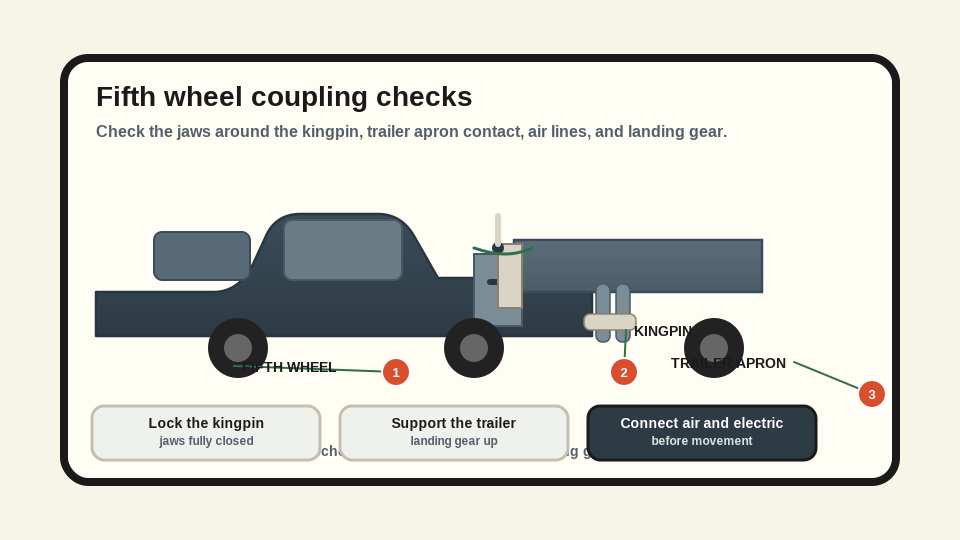
Side-view tractor-trailer coupling diagram with fifth wheel, kingpin, trailer nose, and landing gear.
CDL fifth wheel diagram Use the coupling diagram to connect fifth wheel, kingpin, landing gear, and visual checks before movement.
Study Mode Sample Questions (6 Questions)

Showing 6 study-mode sample questions here so you can check concepts immediately. Take full 20-question sets on the practice hub or try the 50-question timed simulator next.

Study examples
CDL Coupling and Uncoupling
Answered 0 / 6
Study Mode · Instant feedback
A–D / 1–4 choose · F flag · N/P jump
Question 1

Which part of the kingpin should the locking jaws close around?

Kingpin cutaway profile labeling the base, shank, and head sections next to the locking jaws prompt.
Kingpin base, shank, and head profile
Question 2

What color are the trailer air lines (glad hands) usually painted?

Question 3

When coupling a semi-trailer, how should you test that the fifth wheel jaws have locked around the kingpin?

Question 4

Before backing under a trailer, what should you do with the trailer height?

Question 5

Where should the tractor be positioned when uncoupling a trailer?

Question 6

What should you check regarding the space between the upper and lower fifth wheel after coupling?

Submit your exam?

Diagram

Scroll horizontally or pinch to zoom & read labels.