Study topic

CDL Speed and Space Management

Under FMCSA 49 CFR Part 383 testing standards, state CDL written subtests enforce an 80% minimum passing cutoff. Benchmark your readiness on CDL Speed and Space Management using 6 instant-feedback questions grounded in the FMCSA CDL Manual, eliminate recurring distractor traps, and advance to full 20-question sets.

Last updated:

FMCSA Section 2.6–2.7 stopping & following formulas

Under FMCSA CDL Manual Sections 2.6 and 2.7, heavy-truck stopping distance combines four physical intervals—and kinetic energy quadruples whenever road speed doubles.

  • Four-Part Air Stopping Formula: Perception Distance + Reaction Distance + Brake Lag Distance (~0.5 sec) + Effective Braking Distance
  • 55-MPH Dry-Pavement Benchmark: An 80,000-lb rig at 55 mph travels over 400 feet (longer than a football field) before stopping—including ~32 ft of air lag
  • Following-Distance Formula: At least 1 second per 10 feet of vehicle length below 40 mph, plus 1 extra second at speeds of 40 mph or higher
  • Surface Traction Penalties: Wet asphalt roughly doubles stopping distance; packed snow triples it; glare black ice multiplies stopping room up to 10×
  • Overhead Clearance Cushion: Never trust unweighted pavement height alone—packed snow, repaving asphalt, or an empty trailer adds inches
How to study this topic

Why empty tractors actually stop WORSE than fully loaded rigs

This classic written-test trap catches dozens of rookies weekly. Heavy freight presses tire tread hard into pavement; an empty or bobtail tractor has far less vertical tire traction paired with stiff suspension springs, causing wheels to bounce and lock prematurely during hard braking.

Highway exit ramps are posted for low-slung sedans, not high vans

Yellow ramp advisory plaques are engineered for passenger cars with low centers of gravity. Top-heavy 13-foot-6-inch trailers can roll completely over at the posted ramp speed before the tires ever break traction—drop well below the advisory plaque on the straightaway BEFORE entering the curve.

Manage the cushion ahead—never let tailgaters push your throttle

When impatient motorists ride your rear ICC bumper, test writers love offering “speed up slightly” as a tempting distractor. The right commercial move is the exact opposite: widen your front following margin gradually so you can brake gently without triggering a rear-end collision.

Diagrams

Visual study aids.

Use these diagrams to understand the space, parts, or scoring terms behind the study topic.

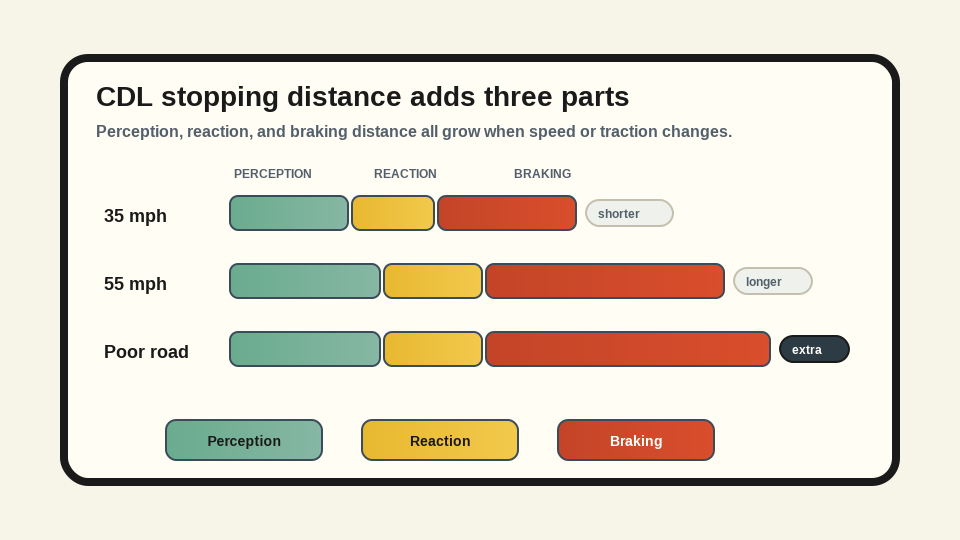
CDL stopping distance chart comparing perception, reaction, air brake lag, and braking distance.
CDL stopping distance chart Stopping distance grows when speed, load, weather, visibility, or brake condition changes.
Study Mode Sample Questions (6 Questions)

Showing 6 study-mode sample questions here so you can check concepts immediately. Take full 20-question sets on the practice hub or try the 50-question timed simulator next.

Study examples
CDL Speed and Space Management
Answered 0 / 6
Study Mode · Instant feedback
A–D / 1–4 choose · F flag · N/P jump
Question 1

How far ahead should you be looking while driving a commercial vehicle at highway speeds?

Question 2

When is it appropriate to use your high beams?

Question 3

What is the recommended following distance for a heavy vehicle traveling at 55 mph in ideal conditions?

Question 4

What should you do if you are being tailgated?

Question 5

When approaching a curve, what is the best way to handle your speed?

Question 6

When driving a commercial vehicle, how should you adjust your speed for driving at night?

Submit your exam?

Diagram

Scroll horizontally or pinch to zoom & read labels.